This page explores the forgotten tradition of the cephalophores, the head‑carrying martyrs whose stories once shaped shrines, landscapes and local devotion across Europe. It traces how these uncanny legends emerged, why they captured the medieval imagination, and what they reveal about the boundaries between miracle, memory and myth.
The Cephalophores: Head‑Carrying Saints History Tried to Forget

Cephalophores [1] are a distinctive group of early Christian martyrs whose legends describe a miraculous act after death: having been beheaded, they rise, lift their severed head, and walk to the place where they wish to be buried. This striking motif appears mainly in late antique and medieval Europe, especially in France, Britain, and Ireland, where local communities used these stories to explain the origins of shrines, relics, and sacred landscapes. The cephalophore tradition reached its height between the sixth and twelfth centuries, when regional saints’ cults and pilgrimage routes were flourishing across the Christian West.
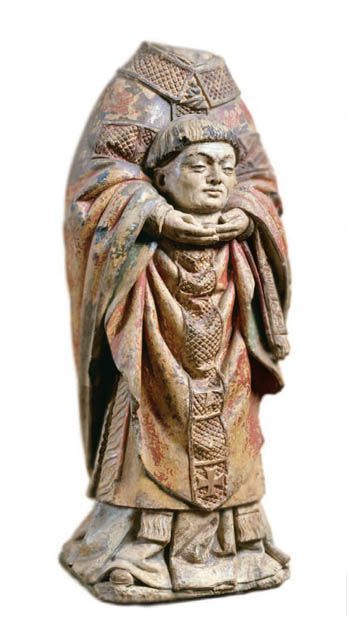
At the heart of every cephalophore narrative is the same pattern: decapitation as the mode of martyrdom, a miraculous post‑mortem journey, and the founding of a church or shrine at the place where the saint finally rests. These legends blend Christian theology with older Celtic ideas about the head as the seat of identity, creating a powerful symbol of sanctity that can’t be silenced by violence. The cults spread through monastic networks, relic translations, and the influence of Frankish and Norman expansion, leaving a trail of dedications, feast days, and distinctive iconography.
Many well‑known and regional saints belong to this tradition, including Saint Denis of Paris, Saint Noyale of Brittany, Saint Osyth of Essex, Saint Justus of Beauvais, Saint Valery, Saint Nicasius, and the near‑cephalophore figure Saint Winefride of Holywell. Their stories form a coherent cluster within medieval hagiography and offer a vivid insight into how communities shaped their spiritual identity through miracle, memory, and place
Cephalophores: Saints Who Carried Their Own Heads
What is a Cephalophore?

Cephalophores are a distinctive group of Christian martyrs whose legends describe a miraculous act that defies both violence and mortality: after being decapitated, they rise, lift their own severed head, and walk to the place where they wish to be buried. The term comes from the Greek kephalē (head) and phorein (to carry), and it marks a tradition that is at once startling, symbolic, and deeply rooted in the religious imagination of late antiquity and the medieval West. These saints appear most vividly in the hagiographies of Gaul, Britain, and Ireland, where the motif of the walking martyr became a way of binding sanctity to landscape and memory.
When do they originate?
The origins of the cephalophore motif lie in the meeting point between Christian martyrdom narratives and older cultural ideas about the head as the seat of identity. In Roman Gaul, where many of the earliest cephalophore stories emerge, the head already carried symbolic weight in Celtic tradition, representing the soul, the self, and the power of the individual. When Christian writers began shaping the lives of local martyrs, this symbolism fused with the theological conviction that martyrdom was not a defeat but a triumph. The cephalophore’s post‑mortem journey became a dramatic expression of divine agency: the saint continues to act even after death, choosing the ground where their cult will take root.
Theological meaning
Theologically, cephalophores embody the idea that sanctity can’t be silenced. Their legends insist that the body of the martyr remains animated by grace, capable of movement, intention, and witness. The severed head, symbol of identity and voice, is carried by the body, symbol of the Church. Together they enact a final gesture of self‑definition: the saint determines the place of their own veneration. This is why cephalophore stories almost always end with the founding of a shrine or church at the spot where the saint’s journey concludes. The miracle is not merely a spectacle; it’s a charter for a sacred landscape.
Geographical origins
Geographically, the cephalophore tradition is strongest in France, where figures such as Saint Denis, Saint Noyale, and Saint Valery became anchors of local devotion. The motif also appears in Britain, especially in Wales and England, where saints like Osyth and Winefride echo the pattern of head‑related martyrdom and miraculous movement. In Ireland, the tradition is less common but still present in stories that emphasise the power of relics and the sanctity of the head. The spread of the motif across these regions reflects the movement of monastic networks, the influence of Frankish and Norman expansion, and the desire of local communities to root their identity in vivid, memorable narratives.
Hagiography
Across these stories, certain elements recur with striking consistency. The martyr is executed by decapitation, often as punishment for refusing to renounce their faith. Immediately after death, the saint rises, lifts the severed head, and begins a purposeful journey. This walk is not random: it leads to the place where the saint wishes to be buried, and where a church or shrine will later be built. The site becomes a centre of pilgrimage, often associated with healing waters, protective miracles, or interventions in times of danger. The head, or fragments of it, frequently becomes the primary relic, preserved and venerated as the heart of the cult. Over time, the saint acquires a liturgical feast day, a set of patronages, and a stable iconography in which they are depicted holding or carrying the head that once defined them.
These legends travelled widely. Norman and Frankish influence carried cephalophore cults into new regions, where relics were translated, churches were rededicated, and local traditions absorbed the motif into their own devotional landscapes. The result is a network of stories that share a common structure yet remain deeply rooted in the places that preserved them.
Cephalophores in Art and Iconography
Cephalophores appear widely in medieval art, where their distinctive miracle made them instantly recognisable. Manuscript illuminations often show the saint calmly holding the severed head at chest height, the body still upright and purposeful. Church sculpture, especially in France and Brittany, places them on tympanums and capitals where the head becomes the focal point of the scene. Stained glass cycles in England and northern France sometimes depict the moment of beheading alongside the saint’s final walk, turning the miracle into a visual narrative. Although styles vary by region, the core image remains the same: a saint who carries their own head, a sign of holiness that survives violence and a reminder of the deep imaginative world that shaped medieval devotion.
How are cephalophores ‘lesser saints’?
cephalophores matter to the Lesser Saints project because they embody the themes at its heart: liminality, memory, marginality, and the fragile survival of stories that might otherwise have been lost. They are saints who literally carry their own identity through violence, erasure, and death. Their journeys mark the landscape with meaning, and their legends reveal how communities used narrative to assert dignity, continuity, and belonging. In many ways, cephalophores are archetypal lesser saints, figures whose stories are strange, local, half‑forgotten, yet profoundly revealing of the cultures that shaped them. They remind us that memory is an act of care, and that even the most extraordinary lives can fade unless someone chooses to carry them forward
After the Middle Ages
Changing patterns within Catholicism

Cephalophores didn’t disappear in a single moment. Their place in Christian life simply changed as Europe moved into a different religious and cultural climate. By the later Middle Ages, the Church was becoming more cautious about miracle stories that relied on dramatic physical impossibilities, and the idea of a saint walking with their own head began to feel harder to defend. As theology became more systematic, and as bishops and theologians tried to regulate the cult of saints more closely, these older stories no longer fitted the kind of faith the Church wanted to present. They weren’t condemned, but they were allowed to fade.
A shift in taste played its part too. Renaissance and Enlightenment thinking made people less comfortable with the strange, bodily miracles that earlier generations had taken for granted. The cephalophore belonged to a world where the boundary between body and spirit felt thin, where landscapes were shaped by miracle, and where local saints anchored a community’s sense of itself. When that world changed, these stories began to seem old‑fashioned or even a little embarrassing to more educated audiences.
Post Reformation / Revolutionary thinking
Catholicism itself was changing as part of the French Counter-Reformation. The Church placed more emphasis on historical evidence and doctrinal clarity. Local cults that relied on oral tradition or regional folklore weren’t encouraged in the same way.
Cephalophores, whose legends often blended Christian martyrdom with older Celtic ideas about the sacred head, didn’t sit easily within this new climate. Without active support, Cephalophore cults thinned, though they were never erased.
Even so, many of these saints remain part of what we might call the lesser saints of Europe in the French countryside. They’re not central figures in modern devotion, but they haven’t vanished either. They linger at the edges, carrying with them the memory of a medieval imagination that wasn’t afraid of strangeness or mystery.
Where to Find Cephalophore Sites Today
Lesser‑known cephalophores appear across Europe in smaller, more localised traditions. Figures such as Saint Firmin of Amiens, Saint Genès of Arles, Saint Minias of Florence, Saint Victoricus of Amiens, and Saint Maxentius of Poitou all share the same core miracle, although their cults never grew beyond the regions that kept their memory. Their stories survive in parish dedications, fragments of sculpture, and local legends that echo the wider cephalophore pattern, reminding us how widespread the motif once was and how many of these saints now linger quietly at the edges of the historical record.
Final Thoughts
Their survival in these small, scattered traces is exactly what makes them matter now. They remind us that the history of sanctity wasn’t only shaped by the great and the well‑documented. It was also carried by local stories, fragile traditions and the quiet persistence of communities who refused to forget.
In the end, the cephalophores belong with the lesser saints of mainland Europe, figures who slipped from the centre of devotion although they still hold their place in the landscape, reminding us that the quiet, local forms of holiness have always carried more of the story than the official record ever admits
Further Reading
- The “Register of Lesser Saints” Project
- Saint Osyth of Essex: England’s Quiet Cephalophore
- Saint Noyale: A British Princess in a Continental Tradition
- Saint: Meta Hub
- The Strange Company of Saints: Martyrs, Passion‑Bearers, and the Rest of Us
- “LES SAINTS CÉPHALOPHORES: Etude de Folklore Hagiographique.” Revue de l’histoire Des Religions, vol. 99, 1929, pp. 158–231. JSTOR, http://www.jstor.org/stable/23664311. Accessed 7 Sept. 2026.
FAQ
Medieval communities used cephalophore stories to explain the origins of shrines, burial sites and sacred landscapes. These legends offered a dramatic way to anchor sanctity to a specific place: the saint’s final walk determined where their cult would take root. The cephalophore’s post‑mortem journey became a dramatic expression of divine agency: the saint continues to act even after death.
Cephalophore legends were most common in France, where over a hundred documented examples survive, but they also appear in Britain, Ireland, Germany and northern Italy. France alone boasts over one hundred and thirty‑four documented examples, showing how deeply the motif shaped regional devotion.
Their decline came from changing religious tastes and increased theological caution. Renaissance and Enlightenment thinkers grew uncomfortable with bodily miracles, and post‑Reformation Catholicism emphasised historical evidence over local folklore. The Church placed more emphasis on doctrinal clarity. These older stories no longer fitted the kind of faith the Church wanted to present.