This page gathers a collection of brief lives, local traditions and fragmentary stories, all held together under one quiet register. It brings together small histories and half‑remembered narratives, tracing the people, places and customs that survive in memory rather than in grand chronicles. The collection reflects the wider Limentinus aim of honouring overlooked lives and the subtle textures of the past.
The Register of Lesser Saints Project

Rijksmuseum, Amsterdam.
Four Windows into Holiness, Memory and the Human Story
Sainthood isn’t a single thing. It isn’t tidy, and it isn’t always official. Some saints appear in old calendars. Others linger in the names of holy wells, in scraps of local legend, in the corners of parish churches, or in the memories of people who kept their stories alive long after the records faded. Some have a single dedication in their favour; others have many. Most sit somewhere in between, half‑remembered, half‑believed, held in place by affection rather than decree.
Across Europe and the UK, these lesser saints remain scattered like seeds the wind forgot to gather. You find them in Brittany, Wales, Cornwall, the English shires, the Scottish islands, the French countryside, the Irish west. Their stories survive in wells, chapels, ruined hermitages, and parish dedications that no one questions because they’ve always been there. They belong to the landscape as much as the hedgerows and the weather.
What they show is a different kind of holiness, local, fragile, human, and tied to place. Holiness shaped not by Rome or great monastic centres but by ordinary people who needed protection, healing, and hope. It’s the holiness of neighbours rather than heroes, of those who stood close enough to be known.
Threaded through many of them is something older still, something the Orthodox tradition names with more clarity than the West ever managed, the passion‑bearer.
Not a martyr in the strict sense, but someone whose suffering reveals the world around them. Someone whose death, or life, or quiet endurance exposes the fault‑lines of their age. I’m not appropriating the term so much as recognising it and the applicability of the term for people who have gone before. Once you see the term ‘Passion Bearer’, you realise how many of these lesser saints carry that shape, the wounded king, the murdered prince, the hermit undone by violence, the modern dead whose names still trouble the conscience of a nation.
The lesser saints aren’t the famous saints or the administrators of the Church in their times. The lesser saints are the ones whose stories illuminate the world by the way the world treated them in their own time.
A few of them are kings, like Henry VI or James II and VII. Others are ploughboys, anchoresses, hermits, or people whose names survive only in a place‑name or a broken shrine. This register gathers some of those individuals whose holiness was local, lived, and often unspoken. They weren’t always acknowledged by the Church. Their sanctity was something people recognised in the grain of daily life.
They’re close to what Pope Francis calls the “saints next door”, the ones who stand beside their neighbour’s suffering, who choose love in the middle of chaos, who replace gossip with compassion, who find time to pray between shifts. Some die quietly. Some die violently, and their deaths echo the Passion in ways that have nothing to do with canon law and everything to do with truth. “Lesser saint” says more about how they’re remembered than about their worth.
I’ve included a few better‑known figures who can’t be ignored, especially those whose cults faded, whose relics were scattered, whose names survive only in stone or story. A few are American and secular, like Matthew Shepard and Danny Lockin, not saints in any formal sense, but passion‑bearers in the old, raw meaning of the word, their suffering revealing the moral failures of their time. A few are strange. Some are clearly fictions. All of them, in their own way, have been held together by time and custom, much like the saints of old.
This page is a kind of field guide to holiness, it isn’t a taxonomy that claims to be complete, but a way of noticing the shapes sanctity takes when it isn’t polished or official. A way of paying attention to the lives that illuminate the world simply by enduring it.
Why This Register Exists
This page on the lesser saints brings four strands together, each looking at a different face of sainthood. They’re distinct, but they speak to one another. Read together, they show how holiness is shaped by its age, its politics, its wounds and its hopes.
Four Windows into Holiness
1. Obscure Lesser Saints: Patterns of Origin and Survival
With case studies of St Wite and St Kenelm, this section looks at saints who sit on the edge of history. Their stories are woven from wells, relics, folk memory and late medieval invention. They show how sainthood often begins in the soil beneath people’s feet, in the places where a community gathers, prays and remembers.
2. A High Anglican’s Guide to Bodily Relics: Saints, Shrines and the English Soul
This section turns to the physical remains that anchor devotion. It explores the uneasy beauty of bones, caskets and shrines, and how English Christianity has lived with them, doubted them and cherished them. Relics remind us that holiness is embodied, not abstract. Burials and the treatment of the dead is a major feature in the development of the cult of relics.
3. Suffering, Death and Sainthood: A Theological Comparison of Matthew Shepard and the Passion of Christ
This brings the question into the modern world. It asks how Christians speak about violence, innocence and abandonment, and whether a secular life can carry a witness that echoes the old stories.
Passion‑bearers, the ones who mirror Christ not through doctrine but through the way the world treats them.
I’m not canonising Matthew Shepard, only recognising that his death exposed the fault‑lines of his time in the same stark way the ancient passion‑bearers did. His story shows how suffering can still illuminate the world, even when the language of sainthood isn’t used.
4. The Sainthood of Emperor Charlemagne: Politics, Pilgrimage and Memory in the Medieval West
A very different kind of sanctity, shaped by power, rivalry and imperial ambition. It shows how sainthood could be used, contested and reshaped by the politics of its time, and how a ruler’s memory could become a battleground between empire and Church.
What These Four Strands Reveal
Taken together, these four sections show that sainthood isn’t confined to one period or one type of person. It’s a mosaic of local memory, bodily relics, political ambition and human suffering. Some saints rise from wells and parish stories. Some are forged in the heat of empire. Some are recognised only by neighbours. Some are never recognised at all. Each reveals something about how people in different ages have tried to name holiness, to honour courage, and to make sense of lives that touched the world in ways that couldn’t be forgotten.
Obscure Lesser Saints: Patterns of Origin and Survival, with Case Studies of St Wite and St Kenelm
Local Origins before Formal Recognition


The origin of local saint cults in England often followed a pattern of grassroots veneration that long predated any formal recognition by bishops or the papacy.
The cult of saints typically began with the burial or the legendary presence of a holy person, often a hermit like Robert of Knaresborough or a local martyr, at a site that possessed a perceived spiritual potency, usually bound to prominent features of the landscape such as springs, wells, groves, or ancient burial mounds12.
Shrines emerged in these settings not through ecclesiastical decree, but through spontaneous communal devotion, often justified by oral tradition and local miracle stories. The Church’s gradual acceptance, if acceptance came at all, typically followed upon solidified lay cult and regular “miracle” reports at the saint’s resting place.
A central pattern in the origin of these cults is lack of reliable contemporary documentation. Many saints became focal points of veneration centuries after the time to which their putative lives were ascribed. Their legends were then elaborated, often through hagiographical collections that included common stock motifs, martyrdom at Viking hands, resistance to pagan invaders, healing miracles at the grave or nearby spring, and through retroactive identifications with continental or biblical holy figures13.
Material Culture: Relics, Wells, Shrines, and Vernacular Practice
Materiality was vital to the early and sustained vitality of a cult. The presence of bodily relics, bones, hair, or even secondary relics such as garments or hallowed dust, gave a focal point for devotion, provided a rationale for pilgrimage, and enabled lay communities to build a narrative of miraculous intercession. In some remarkable cases, such as that of St Wite at Whitchurch Canonicorum, the relics survived both the Norman Conquest and the violence of the Reformation (a unique survival outside Westminster Abbey)45.
Holy wells and springs, often predating Christianity as sites of reverence, played a sustained role. They were places for local ritual, bathing, drinking, offerings, connected both to older, possibly pagan practice and to Christianized healing rites. The wells of some saints (e.g., St Wite in Dorset, St Urith in Devon, St Nectan in Cornwall) provided year-round points for accessing the saint’s virtue, sometimes with seasonal festivals or processions attached62.
Vernacular customs, offering cakes, cheese, or votive objects on the saint’s day, using the shrine or the well for “charm” rites, or visiting on particular feast days, created enduring habits of popular engagement that kept even poorly documented cults alive in folk memory long after ecclesiastical suppression547.
Cultic Survival, Decline, and Adaptation after the Reformation
The great transformation wrought by the Reformation, especially the dissolution of the monasteries and the systematic destruction of shrines and relics, erased many centuries-old cult centers within a decade89. The cults of saints that survived (in attenuated, folkloric, or ambiguous forms) did so usually due to local stubbornness, the absence of valuable relics worth confiscation, or sheer accident. In rare cases, such as St Wite, relics were concealed or overlooked and thus escaped destruction4.
After the Reformation, some cults continued in syncretic or folk forms: holy wells retained their healing reputation and occasional processions; legends transferred to new cultural media (ballads, local histories, parish plays), and saints’ days persisted as local holidays shorn of formal liturgy. Across counties, regional texture is evident, Cornwall retained more vernacular practice tied to saints’ wells and legendary “founders”; Dorset and Worcestershire saw a handful of relic-cults survive into the post-Reformation Anglican Church, often reduced to a few church dedications or shrines with ambiguous status210.
Patterns of Documentary and Legendary Invention

Many of the “obscure” saints under review have no plausible historical basis, their identities manufactured from hagiographical invention, conflation with better-known figures, or post facto associations with healing sites (e.g., springs given a “patron”). Others are entirely duplicative, their names shifting with linguistic or regional variation, and their narratives built up from legendary stock, the stylite, the anchoress, the “white” or “willing” virgin, the boy king murdered for the throne.
Over time, later hagiographers and antiquarians in the Victorian and Edwardian periods continued to reshape these stories, sometimes bolstering local tourist economies, sometimes as exercises in romantic nationalism or religious nostalgia.
Quote to remember in relation to early English saints:
“Saints were once common as blackberries in England. Every rural parish had them, a wild-grown mix of sweet and sharp characters, carrying the heady, slightly winey tang of older religions. These were small, unfamous saints whose holy places were natural features, springs, wells, groves or caves, that had been honoured time-out-of-mind long before Christianity.”5
Case Study Profiles: St Wite of Dorset and St Kenelm of the Clent Hills
St Wite (St Candida) of Dorset

Timeline and Key Sites
- c. 831- Alleged martyrdom in a Danish raid at Charmouth, Dorset.
- Ninth century onwards – Local oral tradition of a woman hermit/beacon-keeper.
- Church of St Candida and Holy Cross, Whitchurch Canonicorum- Shrine with relics; church possibly built by King Alfred or his son.
- Feast Day-1 June (now also Dorset Day).
- Medieval and Late Medieval- Shrine becomes pilgrimage site.
- Reformation (1530s–1540s)- Shrine’s survival is unique, with most others destroyed.
- 1900-Shrine opened and bones confirmed to be those of a woman; lead casket inscribed “Here lie the remains of St Wite.”
- Present- Relics still venerated; local identity bound up with St Wite’s flag/cross.
Key Sources and Contradictions
- Oral Tradition and Hagiography- No contemporary documentation exists; all written accounts are late (15th century on), and even then, rely on local tradition rather than record.
- Later identifications- Speculations identify her with the 4th-century martyr Candida of Carthage, 6th-century Breton St Gwen Teirbron, or the 5th-century Blanche. None hold up to scrutiny; name and tradition remain Saxon and local in colour.
- Legend Formation – Her legend as a anchoress and beacon-keeper likely arose in response to the local dangers of the Dorset coast, and her cult probably absorbed pre-Christian “guardian of the well” elements. “Wite” interpreted variously as “white” (from Latin ‘candida’), or from Old English meanings (“wisdom,” “guardian,” “punishment”).
- Relics and Healing – The shrine’s three oval openings enabled contact between supplicants (especially the sick) and her relics. Distinctive provision for those with leprosy (openings in the exterior wall).
- Holy Well at Morcombelake -Documented since at least 1630; associated with cures, especially for eye disease.
Pilgrimage and Custom
Medieval pilgrimage to St Wite’s shrine was not just a local affair; the site drew visitors across southern England and even beyond. Offerings of cakes, cheese, and other foodstuffs on her day, and continued placement of written petitions and “ex-votos” at the shrine’s openings, showcase centuries of devotional continuity.
Post-Reformation Survival
St Wite’s relics and shrine were not destroyed, possible reasons include the shrine’s simple design, its peripheral location in rural Dorset, and perhaps local complicity. The cult saw a local revival in the 19th and 20th centuries, culminating in the adoption of the St Wite cross and the annual celebration of Dorset Day.
Notable Contradiction:
Despite being viewed as Dorset’s local “saint,” St Wite’s cult was never formally recognized by Rome or the national Church; her legend comes almost entirely from oral tradition and folk practice. Modern DNA and archaeological analysis confirmed the shrine does indeed house the bones of a woman of about the right period54.
Mythic Elements:
- Association with beacon-keeping and light, could reflect much older traditions of guardianship, not necessarily a Christian martyr narrative.
- Multiple speculative “identities,” but only local oral story preserved.
- Her continued post-Reformation “survival” is exceptional.
St Kenelm of the Clent Hills

Timeline and Key Sites
- c. 820-821 or 811-Putative date of Kenelm’s death. Historically, likely died as an adult prince; legend recasts him as a boy-king martyred at age seven.
- 9th Century onwards- Earliest written record appears centuries later; earliest full hagiography is 12th century.
- Winchcombe Abbey, Gloucestershire-Body enshrined here after translation from the Clent Hills.
- Clent Hills, Worcestershire- Alleged site of murder; shrine and holy well established.
- Feast Day- 17 July (date of translation).
- Pilgrimage- Shrine at Winchcombe a major regional focus throughout the Middle Ages; associated with healing and justice.
- Reformation- Shrine destroyed; cult survives only in literature and fleeting parish memory.
Key Sources and Contradictions
- Hagiography- Earliest narrative in a 12th-century Winchcombe Abbey manuscript, derived from oral or earlier monastic sources. Key motifs developed in The Golden Legend, South English Legendary, and other late medieval sources.
- Factual Evidence-Historical records indicate Kenelm was never a child-king; likely died as an adult, possibly in battle, and no records of martyrdom exist. Sister, Cwenthryth (“Quendryda”), was a nun at the time, not a murderous schemer.
- Legend Dynamics- The “murdered boy-king,” the treacherous sister and her lover, the miraculous white dove flying to Rome, the revelation of the grave by a cow, the emergence of springs at his resting places, all are elements found in other royal martyrs’ legends, with only the place-names locally adapting.
- Material Culture- Kenelm’s holy well, numerous springs, and church dedications in Worcestershire, Gloucestershire, and beyond. His relics at Winchcombe became a magnet for regional pilgrimage and healing rituals.
- Oral and Customary Aspects- Folk customs such as “crabbing the parson” on his feast day; folk processions to the well.
Survival and Literary Afterlife
With the Reformation, Kenelm’s cult (and shrine) was targeted for destruction, but the legend entered national literature through Chaucer and later ballads. In the 19th century, renewed antiquarian and Anglican interest sparked parish fairs and rituals, albeit as attenuated folklore rather than living devotion.
Notable Contradiction:
The hagiographical legend, cherished and elaborated, fundamentally contradicts historical reality, but its power and localization anchored centuries of devotional practice historically unmoored from the real Kenelm.
Mythic Elements:
- Miraculous springs at burial and translation sites.
- Prophetic dreams, white doves, and divine justice (falling out of the eyes).
- “Faithful cow” and annual local fairs.
List and Notes of some lesser Saints
Lesser Saints – Saint Hugh of Lincoln

| Saint Name | Known Dedication(s) | County | Feast Day | Notes |
|---|---|---|---|---|
| Ælfheah of Canterbury | Canterbury | Kent | 19th April | Relics lost |
| St Aldhelm | Doulting and Frome | Somerset | 25th May | Major shrine at Malmesbury lost; only Doulting retains relic. |
St Amadour | Rocamadour France | Diocese of Cahors | 20th August | ‘Fake’ saint wholly imaginary |
| St Alphege (Elphege) | Greenwich | London | 19th April | Martyred archbishop; church remains. |
| St Arilda | Oldbury-on-Severn | Gloucestershire | 20th July | Only one known church; local stories of miracle. |
| St Arwald | None | None | 22nd April | No dedications |
| St Bega | St Bees | Cumbria | 6th September | Hermit; cult revived in Victorian era. |
| St Bertha | Canterbury | Kent | 1st May | Queen and Christian convert; local cult. |
| St Cædwalla | Wessex | Wessex | 12thNovember | “Death bed baptism” |
| St. Calepodius | Martyr | Rome | 10th May | Basilica of San Callisto, Rome |
| St Cedd | Bradwell-on-Sea | Essex | 26th October | Missionary to Essex; chapel remains. |
St Charlemagne | Aachen | Aachen Germany | 28th January | Palatine Chapel |
| St Charles I (King) | Tunbridge Wells (5 others) | Kent, Cornwall, Herts, Devon, Derbyshire | 30th January | The only person created an Anglican Saint. |
| St Cuthmann of Steyning | Steyning | Sussex | 8th February | Anglo-Saxon hermit. |
| Saint Dévote | Monte Carlo | Monaco | 27th January | |
| St Drogo | Sebourg | France | 16th April | Église Saint‑Martin, Sebourg, France |
| St Eanswythe | Folkestone | Kent | 12th September | Recent DNA test confirms relics’ authenticity. |
| St Edburga of Bicester | Bicester | Oxfordshire | 18th July | Royal abbess; church retains name. |
| St Edith of Wilton | Wilton | Wiltshire | 16th September | Royal nun; shrine destroyed. |
| St Etheldreda | Ely Cathedral, Histon | Cambridgeshire | 23rd June | Royal abbess; relics translated to Ely. |
| St Ethelburga | Barking | Essex | 11th October | Abbess; Barking Abbey ruins remain. |
| St Felix | Babingley, Felixstowe | Norfolk/Suffolk | 8th March | First bishop of East Anglia. |
| St Frideswide | Oxford | Oxfordshire | 19th October | Patron of Oxford; shrine revived. |
| St Gervase and St Protase | Little Plumstead | Norfolk | 19th June | Basilica di Sant’Ambrogio, Milan |
| St Gwladys | Gelligaer | Glamorgan | 29th March | Only Gelligaer retains well and ancient association. |
| St Hadrian | Canterbury | Canterbury | 9th January | Relics redeposited 9 January 1091 |
| Harold II: The Passion Bearer | Coming Soon | |||
| St Hilda | Whitby | North Yorkshire | 17th November | Abbess of Whitby; strong local cult. |
| Bl John Finch | Local remembrance but not church dedications. | Associated with Lancashire | ||
Saint Julius and Aaron | Caerlon | Newport, Wales | 1st July (trad) 20thJune or 22nd | Little evidence; early male companions |
| St Juthwara | Sherborne | Dorset | 13th July | Little evidence; well and dedication at Sherborne. |
| St Kenelm | Clent Hills, Romsley | Worcestershire | 17th July | Multiple dedications, but only one or two remain active. |
| St Medardus and St Gildardus | Little Bytham | Lincolnshire | 8th June | Only two churches bear this French import dual dedication. |
| St Mildred | Minster-in-Thanet | Kent | 13th July | Abbess; relics translated to Canterbury. |
| SS Nazarius and Celsus | Carcassonne | France (Aude) | Basilica of San Nazaro Brolo, Milan | |
| St Nectan | Hartland | Devon | 17th June | Well and church, remains attested, but only 1–2 dedications. |
| St Neot | St Neot | Cornwall | 31st July | Hermit; church and holy well remain. |
| St Noyale | Sainte‑Noyale, Noyal‑Pontivy | 11 September | Cephalophore | |
| St Oswald | Oswaldkirk | North Yorkshire | 5th August | Royal martyr; relics at Worcester. |
| St Oswin | Tynemouth | Tyne and Wear | 20th August | Royal martyr; local cult revived. |
| St Osyth | Saint Osyth | Essex | 7th October | Partial Cephalophore |
| St Piran | Perranzabuloe (ruins) and Trethevy | Cornwall | 5th March | Ruined oratory, but only two main dedications continue. |
| St Rumon | Tavistock | Devon | 28th August | Only Tavistock maintains a living tradition. |
| St Urith (Hyaritha) | Chittlehampton | Devon | 8th July | Well and shrine, local cult, destroyed at Reformation. |
| St Wistān | Wistow | Leicestershire | 1st June | Royal martyr; few dedications survive. |
| St Wite (Candida) | Whitchurch Canonicorum | Dorset | 1st June | Shrine survives with relics; only English saint so preserved. |
| St Wulfram | Grantham | Lincolnshire | 20th March | Very rare: only few English dedications. |
| St Wulfstan | Worcester | Worcestershire | 19th January | Last Anglo-Saxon bishop; shrine lost. |
Henry VI: A King Half‑Remembered as a Saint

Henry VI belongs to that small company of figures who drift at the edge of sainthood, not canonised, not forgotten, but held in a kind of gentle regard by the medieval imagination.
His reputation for meekness, piety, and misfortune made him a natural focus for quiet devotion, especially in rural parishes where unofficial saints were woven into the fabric of everyday belief. Henry VI sits comfortably among the lesser saints: a king whose holiness was whispered rather than proclaimed, and whose memory still carries the faint glow of a medieval hope that never entirely faded.
- About the Henry VI of England Series
- Chertsey Abbey: A King’s First Grave and a Vanished Glory
- The Burial and Posthumous Veneration of Henry VI of England: From Chertsey Abbey to Unofficial Sainthood
- King Henry VI of England vanished
- The Burial and Posthumous Cult of Henry VI: From Chertsey to Windsor and the Making of a Peculiar Saint
- How Royal Cults Fade and Endure: Henry VI, James II and the Long Memory of Fallen Kings
- The Strange Company of Saints: Martyrs, Passion‑Bearers, and the Rest of Us
- Sainthood of Henry VI of England
- The king who wouldn’t lie still: Henry VI’s troubled afterlife
- Henry VI of England: too pious to be a King
- Henry VI never achieved formal canonisation
- Henry VI: A sufferer of mental illness
These reflections sit here as part of the wider pattern of lesser sanctity, the quiet, local, and often unspoken holiness that threads through this Register.
Analytical Notes
This table captures a selection of saints whose cults, though once more widespread in Europe, now persist only in one or two church dedications, often with continued folk or local association but little wider veneration.
Some, like St Wite and St Eanswythe, have recently drawn renewed attention due to archaeological confirmation of their relics or through county/diocesan heritage campaigns1112.
The list demonstrates the often highly localized nature of obscure English sanctity, with many saints known only by parish tradition, scant written mention, and fossilized through one remaining church or holy well. The list can be used as part of the field guide to holiness.
Source Notes: Reliability, Context, and Bias
- Oral Tradition – Central to the origins and continuance of local cults, but highly mutable, and almost always lacking contemporary corroboration. Later “collected” by antiquarians or hagiographers, oral traditions tend to become standardized, codified, and embroidered over centuries.
- Medieval Hagiography – Hagiographies from the 12th–15th centuries aren’t historical documents in the modern sense; they were crafted to inspire, attract pilgrims, and create local prestige, and often drew freely on previously circulating motifs and miracle tales13.
- Resting-Place Lists. 11th-century lists attempt to catalogue saints’ resting places; though invaluable for detecting the spread of cults, these lists lack critical apparatus and mix legendary and historic names indiscriminately1415.
- Pilgrimage and Miracle Records – Shrine records (where they survive) provide evidence of local practice, but often lack differentiation between surviving traditions and earlier, possibly invented, practices. Post-Reformation visitation lists are patchy and sometimes “restored”, or even invented, by Victorian antiquarians16.
- Archaeological and DNA Evidence- For a handful of saints, modern scientific investigation (as at St Wite’s and St Eanswythe’s shrines) confirms the bones are from a woman of the appropriate period, lending plausibility to their local attributions11.
- Modern Local/Regional Revivals-The flag of Dorset (St Wite’s Cross), and revived feast day practices, tend to romanticize and selectively reinterpret historic sources, blending historical memory with new cultural identity.
Bias Commentary – Modern and Victorian-era writers often “restored” a saint’s legend according to their own religious, antiquarian, or regional ambitions, sometimes conflating different figures (as with St Candida/Wite/Blanche), or simply retelling local traditions as fact. Catholic, Anglican, and modern secular “heritage” accounts may emphasize different aspects (miracle-working, historical identity, folklore, tourist potential), reflecting current interests rather than medieval realities.
Glossary of Key Terms
- Cultus -The system of religious veneration and ritual performed in honour of a particular saint, embracing devotion, physical shrines, and associated customs.
- Translation of Relics – The ceremonial movement of a saint’s remains, usually to a more prominent shrine within a church, marking the formal “founding” of a cult or the confirmation of sainthood by a broader ecclesiastical authority.
- Holy Well – A spring or well regarded as sacred due to its association with a local saint, typically believed to have healing properties, often the focus for ritual and folk rites; sometimes predates Christianization.
- Hagiography – Writing about the lives of the saints, combining biography, miracle stories, moral exempla, and theological lessons; generally soon diverges from historical fact to serve the needs of local devotion and pilgrimage.
- Pilgrimage – The act of journeying to a holy site (shrine, well, church) associated with a saint, usually for healing, penance, or miracle-seeking; both a communal and individual act in Medieval society.
Extended Analytical Discussion
Origins of Local Cults before Formal Recognition
The emergence of local English saint cults presents a case study in the creative dynamism of late antique and early medieval religiosity. Unlike later “universal” saints, apostles, great national martyrs, or theologian, local saints gained a foothold, and often never advanced beyond, a handful of parishes, monastic cells, or regional clusters.
Spontaneity and Material Locality
Key to this process was the immediate association of a burial location (often ad sanctos, literally “next to the saints”), usually the grave but sometimes a well or spring, with miraculous power. Reports of miraculous healings following contact with the soil, water, or bodily relics were the bedrock of claims to sanctity. Local clergy (or laity) were the primary managers and promoters of these shrines.
Legendary Invention and Stock Tropes
Given the lack of historical records from the early medieval period, cults developed through an accretion of legend. Folk memory and oral storytelling fixed certain motifs, murder by pagan invaders, holy wells, miraculous springs, and posthumous apparitions. This pattern is especially notable with the boy-martyr kings, abbesses, and “white” virgin saints of the Anglo-Saxon and early Norman periods, e.g., Kenelm, Eanswythe, Urith.
Moreover, when the papacy and diocesan authorities began to assert more control from the late eleventh century onward, existing cults were typically not invented whole, but rather retrofitted with Vita and Passion narratives that “regularized” their stories according to hagiographical conventions, even as the saints themselves often remained shadowy historical figures1317.
Competition and Local Identity
The relative obscurity or survival of a cult depended on a variety of regional and ecclesiastical dynamics. Sometimes, bishops and abbeys deliberately promoted a local cult, creating formal “translations,” building shrines, collecting miracles, as in the case of Oswald of Worcester and Swithun of Winchester. In other instances, local cults competed with imported saints or with larger regional rivals (see the limited spread of St Wite, in contrast to the wider but less well documented cult of St Kenelm)10.
Role of Sacred Wells, Relics, Shrines, and Vernacular Practices


Simple stone-marked sacred well associated with her medieval cult Rob Farrow. Creative Commons Attribution-Share Alike 2.0 Generic
Wells and Springs – Many wells attributed to “saints” already had prehistoric or pagan associations, which were then rebranded as Christian by linking the water’s healing or spiritual efficacy to the local holy person62. Offerings made at wells (pins, small cloths, coins) or ritual bathing for cure remained common up to the 17th and 18th centuries, particularly in southern and western counties.
Shrines and Relics – Display and access were pivotal. In major sites, such as St Wite’s at Whitchurch Canonicorum, the shrine was built to enable physical proximity, touch, insertion of limbs, or passage of objects. Parish-level shrines might be less elaborate but still supported a local economy and folk healing practice. The process of “translation” of relics formalized a cult and brought an opportunity for elite patronage and architectural investment.
Healing Rituals – Practices at these sites blended Christian liturgy and older folk custom – anointing with water, threefold immersion or passing, crossing wells at sunrise, or eating cakes and cheese “for” the saint on feast days. Customary alms or “thanks” were often left at the site as tokens of healing, see especially the cases at St Wite’s and St Kenelm’s wells18.
Oral and Parish Custom -Especially as written hagiography and actual historical knowledge faded, local cults continued through custom, annual fairs, processions, local parish holidays on the feast day, storytelling at the shrine, and naming children after the saint. Over centuries, these could become separated from explicit religious meaning, but the identity of place and community remained tied to the saint’s presence74.
Pilgrimage Routes -The success or failure of a local cult often depended on its capacity to attract pilgrims, not only for spiritual benefit but for the local economy. The attachment of healing power to a well, or bones to a shrine, could create a chain of minor pilgrimage that persisted even after formal suppression19.
Impact and Patterns after the Reformation
The Reformation was a cataclysmic cultural break – the closure, at times destruction, of shrines and pilgrimage centers, the burning or theft of relics, and the violent suppression of “superstition.” Local saints’ feasts and customs persisted as elements of regional or folk identity – holy wells continued as healing sites for centuries under Anglican regimes; stories endured in printed ballads and local histories; festivals were quietly redirected, absorbed, or “secularized” into new community identities.
In only two cases, Edward the Confessor in Westminster Abbey and St Wite in Dorset, did authentic pre-Reformation English saint relics survive intact to today411. Elsewhere, the memory shifted either to local custom, or to physical remains (ruined shrines, named wells, processional routes). In Cornwall and Devon, the web of wells and festal days often persisted as “folk” custom into the 19th century, attesting to the deep ingraining of sacred geography and oral story in the landscape210.
Examples Entirely Without Historical Basis or limited evidence
Numerous “saints” in medieval calendars and local cults are now recognized as legendary, duplicate, or even fictional, e.g.:
- St Wilgefortis (“Uncumber,” the Bearded Virgin) -Derived from misreadings and folk invention, later deemed apocryphal by the Catholic Church320.
- St Guinefort (dog) – Once venerated in medieval France and reported in England, though it was a dog venerated as a saint,
- St Rumbold or Rumwold was a medieval baby saint in England, believed to have lived for three days in 662. Despite his young age, he is said to have shown great Christian piety.
- St Gervase and St Protase – Little Plumstead, Norfolk. (d. 2nd century) Were said to be the twin sons of the martyrs St Vitalis and St Valeria. Little is known about their life and martyrdom which seems to be based on the ambitions of Saint Ambrose.
References
1Local Saints And Local Churches: In The Early Medieval West. https://academic.oup.com/book/47591
2A Land of Saints – Wilcuma. https://www.wilcuma.org.uk/wessex/a-history-of-cornwall/a-land-of-saints/
37 Unusual Saints of the Middle Ages – TheCollector. https://www.thecollector.com/unusual-medieval-saints-middle-ages/
4Find out about the celebrations for Saint Wite, Dorset’s patron saint. https://www.bridportnews.co.uk/news/24360052.dorset-day-story-patron-saint-st-wite/
5St Wite, Saxon goddess of Dorset by Sara Hudston. https://sarahudston.co.uk/st-wite/
6Holy well – Wikipedia. https://en.wikipedia.org/wiki/Holy_well
7The Language and Communication of a Medieval Saint’s Cult 1. https://www.jstor.org/stable/43345112
8Dissolution of the Monasteries – Historic UK. https://www.historic-uk.com/HistoryUK/HistoryofEngland/Dissolution-of-the-Monasteries/
9Pilgrims and Pilgrimage – University of York. https://www.york.ac.uk/projects/pilgrimage/content/reform.html
10Chapter 27 Leavings or Legacies? The Role of Early Medieval … – Brill. https://brill.com/display/book/edcoll/9789004421899/BP000032.xml
11Early English Saint’s Relics Authenticated by Archaeologists. https://livingchurch.org/news/news-anglican-communion/early-english-saints-relics-authenticated-by-archaeologists/
12St Mary and St Eanswythe Church, Folkestone – British Pilgrimage Trust. https://www.britishpilgrimage.org/places/st-mary-and-st-eanswythe-church-folkestone
13Medieval Hagiography | An Anthology – Taylor & Francis e. https://www.taylorfrancis.com/books/edit/10.4324/9781315656465/medieval-hagiography-thomas-head
14Lists of saints’ resting-places in Anglo-Saxon England – JSTOR. https://www.jstor.org/stable/44510701
15A Handlist of Anglo-Saxon Saints – Oxford Academic. https://academic.oup.com/book/47591/chapter/422335469
16Go on a Pilgrimage | English Heritage. https://www.english-heritage.org.uk/pilgrimage
17The Cult of Saints – University of Oxford. https://english.nsms.ox.ac.uk/oecoursepack/edmund/context/saints.html
18Saint Kenelm – Wikipedia. https://en.wikipedia.org/wiki/Saint_Kenelm
19Routes. https://www.britishpilgrimage.org/routes
20Ten Bizarre and Overlooked Saints from Medieval History. https://www.medievalists.net/2024/09/bizarre-saints-medieval/
Part Two: A High Anglican’s Guide to Bodily Relics – Saints, Shrines, and the English Soul
Why Relics Matter in the English Imagination
.
Relics in an English Landscape

Relics are awkward things. They unsettle, fascinate, and draw people in despite themselves. Bones, hair, dust, scraps of cloth, the worn edge of a coffin, these aren’t abstractions but the physical residue of lives once lived. They carry the weight of touch, memory, and presence, and in England, where centuries of suspicion toward “Romish superstition” have shaped religious instinct, relics sit at an uneasy crossroads between reverence and embarrassment.
Relics persist. They survive in parish chests and quiet cathedral chapels, in the stories of pilgrims, and in the instinctive gestures of people who still light candles or reach out to touch a stone polished by generations of hands. Even in a country that dismantled its shrines with righteous confidence, the longing for embodied holiness never quite disappeared.
You see it most clearly in the early medieval landscape. Repton, for instance, held the royal burials of Mercian kings, a place where the bones of princes and saints blurred into one another. Wistan, murdered in a dynastic quarrel, became a focus of devotion precisely because his body lay there, a royal martyr whose physical remains anchored his sanctity. The same instinct shaped the legend of Kenelm, another royal child whose violent death was transformed into a wellspring of holiness. These were not abstract moral tales; they were stories tied to bodies, to graves, to the places where people knelt.
The pattern of relics wasn’t confined to royal blood. Felix of Burgundy, the missionary bishop who brought Christianity to East Anglia, was remembered through the presence of his relics, a foreign saint whose bones rooted themselves in English soil. Wulfram’s arm at Grantham is another telling example, a single limb, carried across the Channel, treasured because the physical fragment was believed to hold the saint’s virtue, his intercessory power, his accumulated merit. St Gervase and St Protase, at Little Plumstead in Norfolk, show the ability of a relic to transmit a cult from Milan to England
For the Anglo‑Saxons, holiness wasn’t an idea floating free of the world. It clung to bodies. It radiated from bones. The body‑parts of saints carried merit, and that merit could be shared, touched, borrowed, or brought home. Even after the English Reformation tried to strip the land of such things, the instinct endured. England may have learned to blush at relics, but it never quite learned to forget them.
The Anglican Tension
High Anglicanism has always lived with this tension. Intellectually, the Anglican’s inherited the medieval shrines, the bones, the reliquaries, the pilgrim routes, and then inherited the Reformation’s suspicion of them. The result is a tradition that is both drawn to the physicality of holiness and is wary of appearing too enchanted by holiness. Relics become a mirror in which the English soul sees its own contradictions, rational yet yearning, sceptical yet tender, Protestant yet haunted by the memory of saints.
What This Section Explores
This part of the Register looks at relics not as curiosities but as anchors of devotion. It considers how the English Church has handled them, destroyed relics, doubted relics, rediscovered them, and sometimes quietly cherished bodily reminders of the saints. This part of the Register asks what it means to encounter holiness through physical matter, and why the physical remains of the dead continue to speak to the living.
It’s a meditation on touch, memory, and the strange, persistent beauty of bones.
The Classification of Relics: What Makes a Relic “Bodily”?

The English Relationship with Relics
At the core of Christian relic veneration lies the idea that the body, the physical remains, of a holy person retains some measure of their proximity to God, some fragrance of their sanctity. The practice has roots in both scripture and the early church. Touching the bones of Elisha restored a dead man to life (2 Kings 13:21), and handkerchiefs blessed by St. Paul were believed to cure the sick (Acts 19:11-12).
Relics as Embodied Holiness
By the medieval period, relics were carefully classified according to their degree of closeness to the saint’s body and their role in the Christian story:
- First-Class Relics – These are direct bodily remains such as bones, hair, teeth, or flesh. They also include physical objects associated directly with Christ’s passion, such as pieces of the True Cross. Examples contemporary and medieval abound, the skull of St Thomas Aquinas; pieces of the “Holy Blood” at Hailes; the bones of St Cuthbert at Durham. Privately owned relics can be seen in many homes used as devotional items or as antiques.
- Second-Class Relics -These are items the saint used or wore, clothing, sandals, bibles, instruments of martyrdom. The famous staff of St Joseph is said to reside in Naples, while the blood of St Januarius is venerated in Naples Cathedral.
- Third-Class Relics -Any object (a scrap of cloth, a rosary, even a stone) touched to a first- or second-class relic becomes third-class, a “contact relic”. The medieval faithful often sought to turn ordinary objects into spiritual souvenirs through this ritual touch.
The notion of a “fourth class” is sometimes used for items touched to second-class relics or the tombstones of saints, but this is debated within the Church. Officially, only the first three classes are widely recognised.
Shrines, Memory, and the English Soul
The physicality of relics, touching, kissing, placing cloths upon them, was (and is) a defining feature of their veneration, as described in forensic detail by visitors and in the directions for pilgrims. Scent, too, played a part, the “odour of sanctity” was a means by which the authenticity of relics was sometimes affirmed, its sweetness standing in contrast to the normal decay of earthly remains.
Local Acclamation: Saints Before Rome’s Say-So
In the Anglo-Saxon and post-Conquest period, many figures attained sainthood not by decree from Rome but through “the consensus of the people.” If an individual died in a particularly holy manner, or became associated with local miracles after their death, the community might begin to venerate their remains, establish a feast day, and authenticate (or at least claim) the miraculous powers of their relics.
For instance:
- St Walstan of Bawburgh – A farm labourer who, after renouncing wealth, died in 1016. The bishop conducted his funeral, and his burial site (chosen by oxen, following his instructions) became a focus of pilgrimage and miracles for centuries. Walstan was never formally canonised, but the cult was robust enough to maintain shrines, holy wells, and annual fairs long after the Reformation. The people’s faith, and the stories of miraculous healing, were enough to sustain him as a saint in the local imagination.
- St Cuthbert of Lindisfarne – While his cult was endorsed by ecclesiastical authorities, it was local acclaim and reported miracles, especially the incorruptibility of his body and the wonders at his tomb, that led to his veneration as a saint before any papal process.
- Numerous local saints – In Anglo-Saxon England, Christian kings, missionaries such as Eata of Hexham, bishops, and holy men and women who led monastic lives were declared saints through popular consensus, especially if attributed with miracles and charitable acts. Even crusaders, royal martyrs, and pious abbots might receive shrines in their honour.
This ‘bottom-up’ sanctity fostered a deeply embedded sense of Christian geography, every region, town, or hamlet might have its own holy person, whose relics were intertwined with local identity and memory. In some cases, bishops or kings later endorsed these cults or sought papal recognition, but the roots were communal, participatory, and, at times, gently anarchic. The English never totally lost their reverence for the remains of Kings and we see the holiness surrounding the remains of Henry VI, King of England and much later we can see the veneration surrounding the remains of James II and VII, King of England, Scotland and Ireland in the seventeenth Century.
The Trade in Relics: Holy Business, Holy Fraud
Relics were powerful, yes, but they also became commodities, fiercely sought by churches, abbeys, and even entire towns. The medieval relic trade was a bustling, complex affair, often intertwined with tales of theft, deception, and credulity.
The Legitimate Trade
Relics were a source of income, prestige, and pilgrimage traffic. Acquiring an important relic could transform a church’s fortunes. For this reason, monasteries and bishops invested in obtaining prestigious bones or objects from the Holy Land, Rome, and local shrines. Stories of relic “translations” (the moving of relics) became part of hagiography, the Procession of St Cuthbert’s coffin with his body across the north of England is a vivid example.
Relic possession carried real economic muscle. Cathedrals and abbeys housed elaborate shrines, Durham (St Cuthbert), Canterbury (St Thomas Becket), Bury St Edmunds (St Edmund), and Ely (St Etheldreda). Pilgrims made long, hazardous journeys to touch these shrines, make offerings, and take home ampullae of holy oils or water, usually marked with the image of the saint or their church.
The Problem of False Relics

As demand soared, so did supply, much of it highly suspect. Medieval chroniclers, and later Protestant critics, ridiculed the sheer multiplicity of relics, “every Apostle has more than four bodies, and every Saint two or three,” scoffed John Calvin. The brain of St Peter turned out to be pumice stone; churches claimed to possess multiple heads of John the Baptist, the Holy Foreskin of Christ, or the Holy House of Nazareth.
Manufacturing new relics wasn’t uncommon. “Pious frauds” were tolerated, or at least overlooked, if sufficient miracles attended the relic. If pilgrims flocked to a shrine and good works resulted, the relic’s authenticity was rarely too closely investigated. Sometimes relics were openly divided, so that a single saint’s bones might enrich several churches: the “wonders” often followed the bits.
Theft, Smuggling, and Divine Appropriation
Relic theft was legendary. Patrick Geary’s “Furta Sacra” gives accounts of towns commissioning thieves to acquire the relics of desirable saints, a task met with local celebration if successful. The reality was that few, if any, relics arrived at their new homes through strictly above-board channels.
Local English traditions included both licit and secretive movement of relics. In the face of Viking raids or Norman threat, relics were reburied, hidden, and occasionally rescued by daring monks seeking to preserve their treasures for future generations. The cult of the portable relic enabled both continuity and adaptability.
Credulity of the Poor and the Marketplace of Faith
Medieval pilgrims, often the poor and the sick, placed extraordinary trust in these objects. The pilgrims to Walsingham, Canterbury, and Bawburgh, or to local wells and shrines, undertook journeys out of hope, desperation, and deep faith in the power of the saints. The credulity mocked by later reformers was, in many respects, an expression of deep human longing for help, healing, and hope.
Even forgeries could become “real” relics if a miracle occurred, effectiveness to the believer took precedence over provenance.
Sensory and Devotional Encounters: Smell, Touch, and the Ritual Body
A pilgrimage to a medieval shrine wasn’t abstract. It was physical, embodied, and multisensory:
- Touching the Shrine – Kissing, touching, or laying objects (such as handkerchiefs or hats) on a relic or reliquary was a core part of medieval piety. The act of contact was believed to transmit grace and healing.
- The Power of Scent -The “odour of sanctity”, a sweet, unearthly fragrance, was a mark of true relics, often reported at the opening of saints’ tombs. Pilgrims would bring away ampullae containing oil or dust touched to a relic, sometimes carrying home a sensory memory as a proof of the holy visit.
- Seeing and Lighting – Gilded shrines shimmered with candlelight; frail silks decorated tombs; images and stained glass formed an iconographic landscape in the church.
- Processions and Participation – Processions through town or countryside, accompanied by music and singing, created a collective act of faith. Relics were carried forth, and whole communities became actors in a drama of sacred presence.
- Votive Offerings – Wax images, ex votos (modelling limbs or eyes in thanks for healings), and handmade tokens crowded around tombs and wells.
These practices weren’t unique to England but were executed in a particularly local, pragmatic, and communal way in English shrines: ingenious, disorderly, and deeply personal.
England’s Most Famous Relics: Glory and Destruction
England’s medieval landscape shimmered with shrines and relics. The best-known were the focus of pilgrimage, miracle stories, and vast economic flow:
- Canterbury (St Thomas Becket) – One of the most famous European shrines; Becket’s blood, his hair shirt, and items from his life drew crowds across Christendom. The cult endured until its destruction by Henry VIII’s commissioners in 1538, a dramatic, deliberate act intended to obliterate a symbol of ecclesiastical power.
- Durham (St Cuthbert) – His incorrupt body, reburied several times, was at the heart of northern English Christianity. Alongside his remains, the shrine contained his pectoral cross, comb, and vestments, some still preserved.
- Bury St Edmunds (St Edmund) – Royal martyr-saint, his shrine was the second most popular in the kingdom, attracting kings as benefactors and rival pilgrims to those of Canterbury. His body is lost, but the legend and the landscape remain.
- Ely and Etheldreda -Pilgrims came to touch the relics of St Etheldreda, patroness of chastity and healing.
- Walsingham (“England’s Nazareth”) -See below.
These and a host of smaller shrines, St William of York, St Wilfrid of Ripon, St Walstan at Bawburgh, formed a network of spiritual power. Their destruction during the Reformation wasn’t only physical but deeply psychological; it was, in a real sense, the unmaking of a sacred topography.
The Reformation: Destruction, Survival, and Memory
Official Iconoclasm and its Toll

Henry VIII’s break with Rome in 1534 began a process of systematic destruction unprecedented in English religious history. The Dissolution of the Monasteries led to the striping of altars, destruction of shrines, and confiscation or burning of relics. Commissioners dismantled Becket’s shrine, burned St Walstan’s bones, and literally dumped remains and reliquaries into rivers or pits. At Bury St Edmunds, St Edmund’s shrine was destroyed; at Durham, the shrine of St Cuthbert was broken apart.
Focus shifted to the monetary value of gold, silver, and jewels from reliquaries, which were melted down for the treasury. Glorious tapestries, embroidered vestments, and embroidered opus anglicanum were smuggled to continental seminaries or hidden by Catholic families.
The “casualties” went beyond loss of objects. It was the effacing of memory, the severing of belief from physical place and habit. The sense of the presence of the saints was, for many, replaced by a “wilderness of superstition” or, for others, a profound emptiness in the spiritual landscape.
Protestant Criticisms
From the Lollards in the 15th century to the great reformers, the veneration of relics was painted as idolatry, a distraction from true faith, and a fertile ground for deception. Satire abounded, Chaucer’s Pardoner’s Tale, Erasmus’s Colloquies, and John Calvin’s treatises lampooned the existence of multiple heads of the same saint or the unlikely survival of Christ’s foreskin. Latimer denounced “pigs’ bones rather than saint’s relics.” William Tyndale contrasted the imitation of saints’ faith with the veneration of their bodies. Thomas Becon condemned “old rotten bones or reliques” as the material tools of Antichrist.
At the heart of the Protestant criticism lay a rejection of the idea that grace could be mediated through material things, a sharp disjunction between visible and invisible grace, and an assertion that “the sacred couldn’t be confined or localised” in objects.
Human attachment to objects proved persistent. The memory, the locus, and the “empty reliquary” sometimes became objects of secret veneration or later curiosity and antiquarian interest. Victorians might rediscover a hidden hand in a ruined abbey wall; a reliquary became a collector’s prize, even stripped of its sacred meaning.
Secret Persistence and Folk Survival
Despite iconoclasm, not all relics or their traditions disappeared. Some were hidden by recusant Catholics, in walls, beds, or remote farmhouses, forming a shadow culture of clandestine devotion. Popish relics occasionally surfaced in Elizabethan or Jacobean homes under threat of confiscation.
Furthermore, sites themselves often continued as places of memory and local piety. Wells, crosses, and the grounds of former shrines remained focal points, sometimes attracting curious Protestants drawn by the persistence of tradition or the deep, bone-level memory of the land.
Pre-Reformation Pilgrimage in England: Sites Great and Small
Walsingham: “England’s Nazareth”
If Canterbury was the site of Becket’s blood, Walsingham in Norfolk was the beating heart of Marian devotion in medieval England. Its origins lay in the vision of a local noblewoman, Richeldis, in 1061, who was instructed to build a replica of the Holy House at Nazareth. Miracles, especially healing associated with the holy well, abounded, and the shrine became the fourth most important in all of Christendom, drawing kings and commoners alike.
- Physicality of the Site – Pilgrims would walk barefoot for the “Slipper Chapel” mile, pausing at wells and chapels along the way. Water from the holy well was dispensed in lead ampullae, benefiting not only the sick at home but priestly income as well.
- Rituals -The site had a legend of miraculous construction, a replica of Mary’s house, twin wells for healing, and elaborate processions. Words and water were intertwined in a very English combination of the poetic and the practical.
- Destruction and Survival – In 1538, the shrine was destroyed, the statue sent to London and burned, and its treasures confiscated. Even stripped of its relics, Walsingham remained a place of poignant memory.
Today, Walsingham has revived as a site of Anglican and Roman Catholic pilgrimage, ghosts and memory coexisting with contemporary faith.
The Minor Shrines: Walstan at Bawburgh, and Others
Alongside these great pilgrimage centres, local shrines, often tied to locally acclaimed saints, dotted the landscape.
- Walstan at Bawburgh (near Norwich) -His holy well and church were the site of continuous pilgrimage from the Saxon era through the Reformation. The pattern is familiar – local fame for piety, burial in a meadow chosen by oxen, the emergence of holy springs at resting places, a cult of healing for both people and animals.
Even after his bones were burned and scattered and the shrine demolished, the well and traditions persisted, and Victorian pilgrims sought healing at the well.
- Other Minor Sites: Countless lesser-known shrines existed – St Etheldreda at Ely, St Alban, St Wite at Whitchurch Canonicorum, and many holy wells and crosses still remembered in place-names and local festivals. The smaller shrines were, if anything, more intimate, lacking wealth or grand reliquaries but rich in faith and folklore.
Holy Wells and Uncanonised English Piety
The Practice of Well Veneration

Holy wells, springs, and pools are some of the oldest sacred sites in England. Here, water was believed to convey spiritual and healing energy, and almost every region had its wells associated with saints or ancient practices.
These wells were both Christianised and woven deeply into older, perhaps pre-Christian, traditions. Typically:
- A saint was associated with the well, often as its creator (through miracle or association).
- Rituals developed: drinking the water, making offerings (clootie wells in Cornwall and the North, ribbons and cloths tied to trees nearby), circling the well or processing to it on the saint’s day, and blessing of cattle or crops with well water.
- Wells often outlived the destruction of shrines, the water’s power continued even where relics were destroyed.
Anchorites, Hermits, and the Never-Canonised
Not all English spiritual heroes were officially canonised, or even intended to be. The practice of local devotion to holy men and women who lived lives of prayer and service continued, especially among anchorites (men and women who walled themselves into small cells to live out a life of contemplation, often attached to a church).
- Julian of Norwich: The most famous English anchoress, living through the Black Death and Peasant’s Revolt, wrote the earliest known English work by a woman, “Revelations of Divine Love”. Her cell at St Julian’s Church in Norwich became a focus of pilgrimage within her lifetime. The 21st Century Church remains a site of recollection and inspiration, especially for women and contemplatives especially when overseen by Father Robert Llewelyn.
Although never canonised, Julian is remembered with festivals, art, and reverent visitation. Her relic, if such a thing existed, is the surviving manuscript and the cell itself, a living spiritual relic.
- Others: Margery Kempe, the mystic and pilgrim; nameless herb-women, hermits, anchorites, holy fools, and the creators and keepers of well traditions.
Memory and Materiality
For these figures, relics often took non-traditional forms: manuscripts, cells, the landscapes they transformed, or the communities who preserved their memory. Sacred objects became books, beads, or simply the enduring presence of spirit.
Sainthood as Belief and Community Practice
Saints in England were, and are, the product of belief far more than administrative procedures. Sainthood emerges in the willingness of people to pray, to tell stories, to maintain a shrine or a well, to see the invisible in the visible.
Sainthood, then, is not black and white, nor precisely measurable. It’s a quality both bestowed and perceived, emerging from the rich interplay of memory, need, imagination, and prayer.
Relics are powerful because people believe them to be so. They persist, even in an age of doubt, because the human need for the tangible, the mediating, and the miraculous doesn’t simply disappear. In more secular ages, we still gather our tokens, make shrines, and carry relics, whether or not we call them that.
Modern Relics and Secular Saints
It’s an error to imagine that the cult of relics is dead. In the 21st century, the canonisation of modern figures has been accompanied by the careful preservation and veneration of bodily relics.
Carlo Acutis: The Millennial Saint

The most high-profile example in recent years is Saint Carlo Acutis, an Italian teenager beatified in 2020 and canonised in 2025, known for his devotion to the Eucharist and digital evangelism. The heart of Carlo Acutis is an object of veneration; a tiny fragment of his hair is available for veneration in chapels for the faithful, especially youth.
His heart is a first-class relic, and, like medieval saints, it has already acquired a degree of miraculous reputation. Pilgrimage to his tomb and shrines thrives, showing the continued spiritual hunger for nearness to sanctity.
Relics in Everyday Life
The human hunger for contact persists in contemporary secular culture:
- Hair locks, clothes, or personal items of deceased celebrities or family members.
- Massive reaction to the destruction of objects associated with tragic events: the spontaneous shrine-making after disasters, with ribbons, candles, teddy bears.
- The saving and cherishing of photographs, baby shoes, military medals.
- Contemporary veneration of sites and items associated with modern heroes, social, scientific, or political.
Secular relics are, in essence, the same as the old: tokens of connection, vessels for memory, aids to hope. Museums, too, function as repositories for these new relics, sometimes returning them to communities as cultural heritage, now re-interpreted as national or local treasures.
Relics: Loss, Continuity, and the Search for Wonder
It can be easy to smile at the extravagance of medieval relic culture, or to shake one’s head at the credulity of the poor, but from the scent of old stone churches to the touch of water at an ancient well, the human need for the tangible, the beautiful, and the hopeful persists.
Relics aren’t, in the end, only about bones. They’re about memory, about belief, about the messy, ambiguous, sometimes contradictory ways we try to make contact with the spiritual. They are markers not of certainty but of longing. They prompt both prayer and curiosity, faith and scepticism.
Even now, relics still exist if you look for them. Hidden in the quiet church; embedded in folklore; revived in modern saint-making; or secreted away in the earth, waiting for the touch of hope or memory. For the eyes to see and the heart to belie
Why Relics Still Matter and a Final Reflection
Standing in a quiet English church, you may feel only a ghost of all this, the shimmer of candles long past, the worn stone where pilgrims once knelt, the faint taste of sanctity at the well, but if you look carefully, with the eyes of history and the openness of prayer, there is wonder to be found: bones and water, memory and hope, all coiled together in the heart of England.
It’s enough, sometimes, to light a candle, to touch a stone, to whisper a prayer: all shall be well, and all manner of thing shall be well.
The saints aren’t so far away.
Modern Anglican Encounters with Relics
Relics aren’t tidy things. They’re bones, teeth, scraps of cloth, drops of blood. The Church calls them first class when they’re bodily parts, second class when they’re things a saint used, and third class when they’re objects touched to a relic. It sounds neat. In practice it’s muddled. I once stood before a reliquary and thought, this could be anyone’s finger. The hush in the air told me it mattered.
Local saints and acclamation
In England many saints were never approved by Rome. They were made saints by neighbours and pilgrims. A holy man died, a woman prayed at the grave, a healing was claimed, and the cult began. St Walstan at Bawburgh is one such figure. A farm boy, a ploughman, remembered for kindness. His well still runs clear. Julian of Norwich was never canonised and Fr. Robert Lewellyn served at her shrine with devotion. Julian sat in her cell, writing of love and suffering. People came to her for counsel. She became holy in the eyes of those who listened.
Part Three: Suffering, Death, and Sainthood – A Theological Comparison of Matthew Shepard and the Passion of Christ

Why This Section Matters
This part of the Register turns from medieval wells and relics to the modern world, where the language of sainthood is rarely used but the patterns of sanctity still appear.
Matthew Shepard’s death in 1998 wasn’t framed as martyrdom by the Church, although the shape of his suffering, innocence, abandonment, public violence, and the witness that followed, echoes the Passion narratives with unsettling clarity.
This section asks how Christians speak about suffering when the person is not canonised, not religious, and not part of a traditional cult. It explores whether sanctity can emerge from a life the Church never formally names, and how the Passion pattern can appear in places where no one expects it.
The Passion Pattern in Christian Tradition
- the structure of the Passion narratives
- the themes of innocence, betrayal, humiliation, abandonment, and public spectacle
- the way early Christians recognised martyrdom
- the difference between dying for the faith and dying in a way that reveals the world’s cruelty
Matthew Shepard: Context and Witness
- the events of October 1998
- the brutality of the attack
- the fence, the exposure, the hours alone
- the public response
- the way his death reshaped conversations about violence, prejudice, and dignity
Points of Theological Comparison
Innocence and Vulnerability
How both narratives centre on a figure who is unarmed, exposed, and targeted.
Public Spectacle and Abandonment
The fence as a modern echo of the hill; the loneliness of the hours before discovery.
The Body as a Site of Violence
How the wounds themselves become part of the witness.
The Role of the Onlookers
Those who passed by, those who found him, those who responded afterwards.
Transformation of Memory
How both deaths generated movements, vigils, and a reshaping of public conscience.
Why Matthew Shepard Is Not a Canonised Saint
- He didn’t die for the Christian faith.Although we may consider the idea of ‘Passion Bearer’.
- The Church doesn’t canonise secular victims and Matthew was Gay. He belonged to a group considered “disordered” by the Church.
- The category of martyrdom has specific theological boundaries
- Homosexuality still doesn’t sit easily with Christian memory
What This Comparison Reveals
- The Passion pattern isn’t confined to the first century
- Suffering can reveal truths even when the Church has no category for it
- Matthew Shepard’s death became a mirror in which society saw its own violence
- Sanctity can be recognised in the way a life and death change the moral imagination
Detailed Chronology of Matthew Shepard’s Abduction, Torture, and Death

Creative Commons Attribution-Share Alike 3.0 Unported

The story of Matthew Shepard is deeply rooted in the landscape and culture of late-1990s Wyoming. It began in the evening hours of 6th October 1998. Shepard, a 21-year-old student at the University of Wyoming and an openly gay man, attended a meeting of the university’s LGBT group before stopping at a local diner and then walking to the Fireside Bar & Lounge in Laramie. There, he met Aaron McKinney and Russell Henderson, two young men who, as it later emerged, had formed a plan to rob and attack a gay man123.
Shortly after midnight on 7th October, McKinney and Henderson lured Shepard from the bar on the pretext of giving him a ride home. Instead, in a pickup truck, they drove him to a remote, barely developed area east of town. There, McKinney revealed his true intentions, demanded Shepard’s wallet, then began a brutal assault. Using the butt of a .357 Magnum pistol,
McKinney struck Matthew over 20 times, crushing his skull and causing irreversible brain damage. Henderson bound Matthew’s wrists with a rope and tied him to a wooden buck fence. Having stolen his shoes, ID, and wallet, the two men left him alone in the freezing night. This act of abandonment left Shepard utterly vulnerable, exposed to the elements, and unable to call for help145.
The imagery of the scene struck many. The first responder on the scene, Deputy Reggie Fluty, found Matthew so disfigured by the beating that she could only recognise him by the tracks of tears through the blood on his cheeks31. His face was so caked with blood and dirt that his wounds were visible only where his tears had washed them clean. He was found by Aaron Kreifels, a cyclist who initially thought he was seeing a scarecrow.
For around 18 hours, Matthew lay in a coma, alive but unable to move, see, or speak. The temperature dropped well below freezing. Only found by chance, he was rushed to the hospital in Fort Collins, Colorado, but never regained consciousness. He died five days later, at 12:53 a.m. on 12th October, surrounded by vigil-keepers and his family124.
The brutality and public shaming, tied to a fence in a manner that seemed like a crucifixion or lynching, would sear itself into the public’s consciousness. That detail, along with Matthew’s vulnerability and total abandonment, provided an immediate and visceral point of comparison with popular images of Jesus’s last night67.
The Passion of Christ Narrative across the Four Gospels
The canonical Gospels of Matthew, Mark, Luke, and John each present a distinct account of Jesus’s final suffering, collectively known as the Passion Narratives8910. These narratives set the standard for Christian reflection on innocent suffering, blending historical witness with theological proclamation.
The Passion begins with the betrayal by Judas, proceeds through the abandonment in the Garden of Gethsemane, a series of sham trials before religious and political authorities, and culminates in scourging, public humiliation, crucifixion, and death811. In the synoptics (Matthew, Mark, Luke), Jesus’s agony is marked by profound distress, prayer, loneliness, the failure of friends, and open violence. All disciples flee, and Jesus’s own words from the cross echo utter abandonment: “My God, my God, why have you forsaken me?” (Mark 15:34, Matthew 27:46).
John’s Gospel, in contrast, emphasises Jesus’s steadfastness and control even on the cross; the passion is portrayed as a necessary step in his glorification, God’s plan unfolding in full public view128. Crucifixion, under Roman rule, was a punishment of ultimate shame. The condemned were stripped, beaten, forced to carry their crossbeams, and paraded to Golgotha for execution. The means of death were physical exhaustion, thirst, blood loss, and, especially, asphyxiation.
Key elements from the Passion, as relevant to a comparison with Shepard’s death, include:
- Betrayal by a friend or presumed companion
- Physical and psychological torture
- Mockery and public shaming
- Utter abandonment and exposure
- Death after prolonged suffering
- The role of bystanders, some complicit, some passive, a few compassionate
- The aftermath: the body cared for by a small group, public mourning, and the beginning of a legacy
Each Gospel adds its own emphases, but all are agreed in presenting Jesus as suffering innocently and bearing the full weight of human cruelty9.
Anglican Theological Reflections on Suffering and God’s Allowance of Pain
The problem of suffering, or theodicy, is at the heart of Christian reflection. Anglicans, including the Church of England and the wider Anglican Communion, have never issued a single, definitive answer, but they offer several well-developed perspectives131415.
Anglican teaching traditionally insists that God is both wholly good and omnipotent, yet allows suffering. Evil entered creation through the corruption of human will, “original sin”, but suffering isn’t simply punishment or retribution for sin. Rather, it results from the loving decision to grant free will to angels and humans1613. The world, created good, is now marred by brokenness, moral and natural evil.
The Anglican approach to pain is marked by humility and empathy:
- “Don’t believe anyone who tells you they have the complete answer to this most difficult of questions. No one has the definitive answer…”
- Suffering is woven into the fabric of our world. Sometimes it results from our own sin, sometimes from others’, and sometimes simply from the random cruelty of life.
- God isn’t distant in suffering. In the person of Christ, God suffers with us, sharing in our pain and promising never to abandon us.
Resources and catechisms stress that suffering can be formative, producing courage, patience, compassion, and faithfulness1514. At the same time, the Church affirms that there is never justification for cruelty, oppression, or indifference. The Anglican tradition encourages believers to resist evil, work for justice, and care for those who suffer1718.
In practical terms, Anglicans are called to meet suffering with tangible acts of care, feeding the hungry, comforting the bereaved, visiting the sick, and standing in solidarity with the marginalised. This fits well with the pastoral public response to Matthew’s death from the Presiding Bishop of the Episcopal Church: expressions of shared grief, condemnation of violence and exclusion, and a call to “stand with” the marginalised.
Episcopal Church Responses and Statements on Matthew Shepard’s Death
Matthew Shepard wasn’t only a member of the Episcopal Church, but his death prompted public statements and liturgical action from the denomination. At the time, Presiding Bishop Frank Griswold’s response was clear and uncompromising:
“I grieve at the death of Matthew Shepard, and deplore the hate and violence which led to it. My prayers are with Matthew, his family, his friends, and his parish. Matthew wasn’t only a member of our church family, but of our human community. He could have been our child. He was our brother… May we accept anew our responsibility to be agents of the healing love of the risen Christ”.
Later, in 2018, twenty years after his death, Matthew’s ashes were interred in the crypt of Washington National Cathedral. The service was presided by Bishop Gene Robinson, the first openly gay bishop in the Episcopal tradition, alongside Bishop Mariann Edgar Budde of Washington. Robinson declared, “Matt loved the church… Matthew has come home.” The cathedral, described as a place of safety and welcome, stood in contrast to the scenes of hate at Shepard’s funeral, where members of the Westboro Baptist Church picketed, shouting abuse and holding signs with homophobic slurs192021.
The Episcopal Church’s liturgical and public witness marked a significant shift. In the 1980s and ’90s, many US churches either stood aside or were actively hostile to LGBTQ+ inclusion. In commemorating Shepard, the Episcopal Church modelled an ethic of remembrance, repentance, and action, a call for the healing of wounds and the affirmation of the full dignity of LGBTQ+ people.
The language chosen by the Episcopal leadership mirrors that often used about saints and martyrs: the talk of “wounds on our nation,” “bringing light out of darkness,” and positioning the Church as a community of all, not a private club. The careful and deliberate choice to inter Matthew’s remains in a cathedral alongside figures like Helen Keller signalled the ongoing canonisation of secular martyrs within religious space2120.
Christian Theodicy from Anglican and Episcopalian Perspectives
The wearisome old question “Why does God allow suffering?”, so central after tragedies like Matthew’s death, has been answered and re-answered in Anglican thought across generations. Three broad schools emerge22131514:
- Suffering as Instrumental: Some Anglicans argue that God allows suffering to produce spiritual growth, compassion, moral virtue, or deeper trust in God. Suffering is seen as God’s “megaphone to rouse a deaf world,” or as an opportunity for the formation of courage, endurance, and hope. Suffering, while evil in itself, is used by God for transformative good.
- Suffering as Inevitable: Others suggest that suffering is an inescapable part of existing in a complex, physical world. It’s not so much decreed as a necessary cost of freedom and finite existence. Without the possibility of suffering, there could be neither love nor bravery.
- Suffering as Inimical: A third view, also present in Anglican theology, asserts that suffering is contrary to God’s ultimate will. God doesn’t desire suffering; it’s the result of a fallen world, human sin, moral and natural evil. In this view, God is always on the side of the oppressed, working through Christ to defeat suffering and death.
All three approaches insist that the Christian response to suffering must be compassionate and practical. It’s not enough to theologise; the Church is called to comfort, to protest against injustice, and to keep hope alive. This is why the story of Christ’s own suffering and defeat of death, death isn’t the end; hope endures, remains central to Anglican faith15.
Concepts of Martyrdom and Sainthood in Anglicanism
Martyrdom, the witness by suffering, even to death, has a long and complex history in the Anglican and wider Christian traditions232418.
In Anglicanism, a “saint” is understood less as a supernatural figure and more as a holy person, an exemplar for others, recognised for a virtuous life and sometimes for a death endured in the name of truth or justice. The Anglican Communion is intentionally cautious: the process of canonisation is rarely invoked, and the church resists bold claims about a person’s ultimate fate. Instead, it speaks softly of “heroes of the faith,” “examples,” and “witnesses.”
Martyrdom is commemorated through collective worship, notably on feast days for martyrs old and new, such as Dietrich Bonhoeffer,and Janani Luwum, Modern Anglican calendars remember not only ancient and Reformation martyrs, but also 20th-century figures murdered for justice, freedom, and inclusion23.
Canonical Anglican principles, set out by the Lambeth Conference and other sources, insist on economy and restraint. A person is only commemorated if their historical character and devotion are beyond doubt, and if there is a wide and sustained call for such remembrance2423.
Episcopalian and Anglican liturgies for martyrs use language that connects steadfastness in suffering, faithfulness unto death, and a vocation to stand with the weak:
“By whose grace and power your holy martyr N triumphed over suffering and was faithful unto death…”18
Matthew Shepard as a Secular or Lesser Saint

Dylan6889 Creative Commons Attribution-Share Alike 4.0 International

The question of whether Matthew might be considered a “secular saint,” or even a lesser Christian martyr, sits at the crossroads of theology and public memory.
In the immediate aftermath of his death, numerous journalists, activists, and church leaders invoked martyr language. Time Magazine referred to Shepard as a “martyr,” and his death quickly became a symbol for anti-hate activism and legislative reform67. Key features of traditional martyrdom, a life cut short by public violence, a death on account of identity or convictions, and the transformation of grief into action, were present.
Paul Middleton, theologian, has argued that the making of “modern martyrs” like Shepard is a function of “conflict literature”, the tension between the saint (or their supporters) and both their persecutors and their chroniclers. Whether activists or church leaders wished for such a narrative, society at large imposed it. Middleton suggests, with some irony, that both conservative religious groups and LGBT activists sometimes resisted the “martyr” title for Shepard, wishing instead to focus on his life or complexities. In public memory, his death mattered more than his biography, in line with classic hagiography6.
Episcopal liturgy and Anglican teaching stop just short of official canonisation, there is no formal declaration of sainthood. Nor is there a “miracle” attributed, nor the claim that Matthew’s death was a redemptive sacrifice in the manner of Christ. In the language of commemorations at the National Cathedral, in acts of remembrance such as dedicated portraits and annual services, the effect is unmistakably saintly2119.
Matthew is remembered for his vulnerability, his embodiment of Christian virtues (gentleness, kindness, the search for justice), his connection to the church, and especially for his role as a catalyst for change. These are qualities commonly associated with saints in the Anglican tradition.
Hagiography and Martyr Narratives in Culture Wars
Matthew’s story exists within the broader context of a modern hagiography, the telling of saints’ lives as a response to culture war conflict. As Middleton and other thinkers have observed, martyr stories “are difficult to control.” They can be invoked to inspire, to polarise, or to resist social change. In the case of Matthew Shepard, the narrative split:
- For many in the LGBTQ+ community and their allies, Matthew was a symbol of “innocence attacked” and a call to arms against hate.
- For some conservative Christians and right-wing groups, his death was deployed as yet more evidence of an American culture riven by moral decline, or was minimised, in attempts to deny the existence or extent of anti-gay prejudice625.
The contested status of “modern martyrs” mirrors earlier debates. The question of who gets to be a saint, and why, has always been about more than just personal virtue; it’s about the values a community chooses to enshrine.
Matthew as a “secular” martyr highlights the blurring, in modern Western cultures, of religious and civil uses of the idea. Churches may resist making bold theological claims, but in practice, the rituals of public mourning, candles, songs, memorials, processions, look very much like what earlier generations would have called canonisation. Matthew’s resting place in Washington National Cathedral, and the annual commemorations there, give his memory an enduring and sacred character21.
Comparative Theological Analysis of Suffering: Shepard vs Christ
When we compare Matthew’s suffering to Christ’s Passion, several similarities and differences become clear, illustrated in the following table:
| Aspect | Matthew Shepard | Passion of Christ | Analysis and Reflection |
|---|---|---|---|
| Betrayal and Victimhood | Lured by men pretending friendship/trust | Betrayed by Judas, abandoned by followers | Both experienced betrayal and desertion |
| Torture and Abuse | Beaten, tied to a fence, left exposed | Scourged, crowned with thorns, crucified | Physical and psychological torment |
| Public Exposure and Shame | Found tied, compared to a scarecrow | Public crucifixion, ridicule, stripping | Both humiliated before others |
| Abandonment | 18 hours alone, near death, in cold darkness | “Why have you forsaken me?”; darkness at noon | Feelings/experience of utter loneliness |
| Motivation of Attackers | Hatred against “the other” (LGBT prejudice) | Hatred/envy, religious and political expediency | Both victims of scapegoating |
| Agency in Suffering | Passive (victim of crime) | Both passive and active (willingness to suffer) | Distinction: Christ as willing sufferer |
| Religious Significance | Raised as Episcopalian, but not religious martyr | Understood as sacrifice for universal salvation | Christ’s suffering given cosmic meaning |
| Aftermath/Legacy | Legislation, activism, continued remembrance | Resurrection, Church, sacraments | Shepard’s legacy is legal and social |
Legal Context of the Shepard Case and Hate Crime Legislation
Matthew’s murder pushed the question of hate crimes to the centre of American legal and political life.
In 1998, Wyoming was one of a handful of US states without any hate crime law. The brutality of the attack, and the clear evidence that it was motivated by anti-gay hatred, transformed public opinion. President Bill Clinton called for federal action almost immediately after Matthew’s death. National vigils, marches, and campaigns followed322627.
The legal response wasn’t instant. It took more than a decade for Congress to pass the Matthew Shepard and James Byrd, Jr. Hate Crimes Prevention Act (signed into law by President Barack Obama in 2009). This Act expanded the definition of federal hate crimes to cover not only race, religion, and national origin, but also sexual orientation, gender identity, and disability2654.
The trial of Matthew’s attackers was widely covered. Both were found guilty and sentenced to life imprisonment. Efforts to use a “gay panic defence” were rebuffed by the court, setting a precedent that discrimination and hatred can’t justify violence. The activism led by Matthew’s parents has continued through the Matthew Shepard Foundation, focused on education and tolerance.
In this sense, Matthew’s death catalysed a visible shift in the US legal system, framing hate as a matter of national law, not just local custom or church teaching4526.
Cultural and Historical Context of Shepard’s Murder in 1998
The late 1990s were a pivotal time for LGBTQ+ rights and visibility in the United States. Anti-gay violence had long existed, but Matthew’s youth, appearance, and the specifics of the crime drew national attention in a way previous murders had not. He became, in effect, a symbol: young, “innocent,” white, gender-conforming, from the heartland but also cosmopolitan, and importantly, publicly connected to his faith34.
The reaction to his death reveals both the persistence of deep-seated prejudice and the transformative power of storytelling. Memorials, liturgies, and vigils took place in Wyoming and across the nation. However, the funeral was marred by the presence of the Westboro Baptist Church, whose members screamed that Matthew was damned, holding vivid and offensive signs. The moment was partially redeemed by protesters, many dressed as angels, linking arms to shield the grieving family3.
The broader context included a rapidly changing media landscape, the emerging visibility of gay people on television and in politics, and the first serious legislative attempts to address hate crime at a federal level. In this way, Matthew’s death stands within a pattern of secular martyrdom, moments when a death is used to redefine the moral story of a nation, not just a church25.
Conclusion: Matthew Shepard and the Passion of Christ in Contemporary Memory
Matthew Shepard’s story, when placed beside the Passion, isn’t flattened or appropriated, but deepened. He isn’t Jesus, he isn’t the Saviour, nor was his suffering chosen as atonement for anyone’s sins. In his vulnerability, innocence, and public death, he mirrors, however imperfectly, the pattern of Christ’s Passion. The echoes, abandonment, torture, humiliation, and legacy, are amplified by the communal response: the refusal to let suffering have the last word.
Ours is a world still filled with violence against “the other.” The story of Matthew Shepard, held alongside the Passion of Christ, doesn’t allow us easy answers, but it drives us back to the heart of Christian faith; not in explanations, but in solidarity: to grieve, to act, to hope. As the Anglican collect for martyrs prays, may we, “endure reproach and persecution and faithfully bear witness to the name of Jesus Christ,” and in so doing, find the courage to bear one another’s burdens, whatever fence or cross they may be nailed to.
Many people instinctively drew on Christian imagery when responding to Matthew’s suffering, seeing parallels with the Passion narrative, abandonment, violence, and innocence. These comparisons arise not from doctrine but from the deep cultural resonance of Christian stories about suffering and injustice
Anglican and Episcopalian thought tends to emphasise mystery, compassion, and solidarity, rather than definitive answers. The tradition acknowledges the reality of evil while affirming that God is present in human suffering, especially through acts of care, justice, and witness.
Not in the formal, canonised sense, but some people speak of him as a secular or symbolic saint, meaning a life whose suffering and legacy inspire moral reflection, social change, and a deeper commitment to justice. This is a cultural, not ecclesiastical, use of the term.
References
1The Murder of Matthew Shepard | WyoHistory.org. https://www.wyohistory.org/encyclopedia/murder-matthew-shepard
2Matthew Shepard’s murder: Timeline of 1998 events. https://www.coloradoan.com/story/news/2018/10/03/matthew-shepards-murder-timeline-1998/1516482002/
3Matthew Shepard – Wikipedia. https://en.wikipedia.org/wiki/Matthew_Shepard
4Matthew Shepard | Biography, Death, Film, Play, & James Byrd, Jr …. https://www.britannica.com/biography/Matthew-Shepard
5Our Story – Matthew Shepard Foundation. https://www.matthewshepard.org/about-us/our-story/
6The Scarecrow Christ: The Murder of Matthew Shepard and the Making of …. https://www.cambridge.org/core/books/martyrdom/scarecrow-christ-the-murder-of-matthew-shepard-and-the-making-of-an-american-culture-wars-martyr/4B86BD4E8435F8F1F97B0D49A8B1D79A
7The Scarecrow Christ – ScienceOpen. https://www.scienceopen.com/book?vid=fb35ab04-add5-4c50-abcb-bad69d174a76
8Passion of Jesus – Wikipedia. https://en.wikipedia.org/wiki/Passion_of_Jesus
9The Passion Narratives – NCEC. https://ncec.catholic.edu.au/faith/scripture-resources/foundations/key-biblical-understandings/the-passion-narratives/
10The Passion of Christ in Matthew: Meaning, Timeline, and Theological …. https://www.pastorjasonelder.com/the-gospel-of-matthew/the-passion-of-christ-in-matthew-meaning-timeline-and-theological-significance
11THE PASSION NARRATIVE IN THE SYNOPTIC GOSPELS. https://uccduxbury.org/wp-content/uploads/2025/02/Passion-Narrrative-Study-Guide.pdf
12(PDF) The Historical Plausibility of John’s Passion Chronology: A …. https://www.academia.edu/172987/The_Historical_Plausibility_of_John_s_Passion_Chronology_A_Reconsideration
13Anglican – Suffering And The Problem Of Evil – Patheos. https://www.patheos.com/library/anglican/beliefs/suffering-and-the-problem-of-evil
14The problem of suffering – Confessing Anglicans. https://confessinganglicans.com/the-problem-of-suffering/
15Question 322: Why Does God Allow Suffering? – St. Thomas Church. https://thomas.church/catechism/question-322-why-does-god-allow-suffering/
1610. Of Free-Will. – Anglican Heritage. https://anglicanheritage.com/articles/a10/
17Suffering and Punishment, Lent 3 (C) – The Episcopal Church. https://www.episcopalchurch.org/sermon/suffering-and-punishment-lent-3-c-2019/
18Martyrs – The Church of England. https://www.churchofengland.org/prayer-and-worship/worship-texts-and-resources/common-worship/common-material/common-saints/martyrs
19Bishop who confronted Trump led ceremony honoring Matthew Shepard. https://www.advocate.com/news/mariann-budde-matthew-shepard
20Bishop Budde interred gay hate crime victim Matthew Shepard. https://www.thepinknews.com/2025/01/24/bishop-mariann-edgar-budde-matthew-shepard/
21Remembering Matthew Shepard – Washington National Cathedral. https://cathedral.org/congregation/ministries-outreach/lgbtqia-alliance/matthew-shepard/
22The Contribution of Eric Mascall to Theodicy and (Possibly) Providence. https://www.cambridge.org/core/journals/journal-of-anglican-studies/article/contribution-of-eric-mascall-to-theodicy-and-possibly-providence/ED1BD10A5064A24A906EB9439BE1C139
23Calendar of saints (Church of England) – Wikipedia. https://en.wikipedia.org/wiki/Calendar_of_saints_(Church_of_England)
24Resolution 79 – The Book of Common Prayer – The Commemoration of Saints and. https://www.anglicancommunion.org/resources/document-library/lambeth-conference/1958/resolution-79-the-book-of-common-prayer-the-commemoration-of-saints-and.aspx
25John Wolffe. Sacred and Secular Martyrdom in Britain and Ireland since …. https://academic.oup.com/ahr/article-abstract/126/3/1323/6424090
26Matthew Shepard and James Byrd Jr. Hate Crimes Prevention Act. https://en.wikipedia.org/wiki/Matthew_Shepard_and_James_Byrd_Jr._Hate_Crimes_Prevention_Act
27Matthew Shepard and James Byrd, Jr. Hate Crimes Prevention Act. https://www.law.cornell.edu/wex/matthew_shepard_and_james_byrd_jr_hate_crimes_prevention_act
Part Four: The Sainthood of Emperor Charlemagne – Politics, Pilgrimage, and Memory in the Medieval West
This final section turns from local wells, relics, and modern witness to the world of empire. Charlemagne’s sainthood isn’t the fragile holiness of parish memory, nor the embodied devotion of relics, nor the ethical resonance of modern suffering. It’s a political sanctity: constructed, contested, and shaped by the ambitions of kings, popes, and chroniclers.
His cult forces us to ask what happens when sainthood is used to legitimise power, unify kingdoms, or claim divine favour. It shows how holiness can be stretched, manipulated, or resisted depending on who stands to gain. In Charlemagne, the medieval West created a figure who was part ruler, part myth, part saint – and whose memory became a battleground.
Because early medieval Christianity was uneasy about declaring kings to be saints. Most recognised saints were martyrs, monks, or ascetics, not rulers who waged war and exercised political power. Charlemagne’s life didn’t fit the traditional model of sanctity
The only formal attempt occurred in 1165, when Emperor Frederick Barbarossa persuaded Paschal III, an antipope, to canonise Charlemagne. Earlier interest from Otto III around the year 1000 never resulted in an official act
Because it was performed by Paschal III, who wasn’t recognised as a valid pope. His decisions were later annulled by the Third Lateran Council in 1179, meaning Charlemagne was never accepted as a universal saint under canon law.
Historical Context: Empire, Reform, and the Carolingian Vision
As you step into Aachen Cathedral, the air greets you with those familiar fragrances of centuries-old incense, mingling with a faint tang of candle wax and modern tourists. There’s the crisp chill of polished marble underfoot, and high above, stained glass burns soft blue and gold into every shadowed corner.
Somewhere, a bell might be echoing: a single cold note that rolls over mosaic floors and the hush of visiting footsteps. This is Charlemagne’s resting place, his bones locked away in the golden Karlsschrein (Shrine of Charlemagne), encircled by relics and legends. So how did a king, a conqueror, and a builder of an empire find himself declared a saint, and what did it mean for the city he chose as his heart and for the people who followed him?
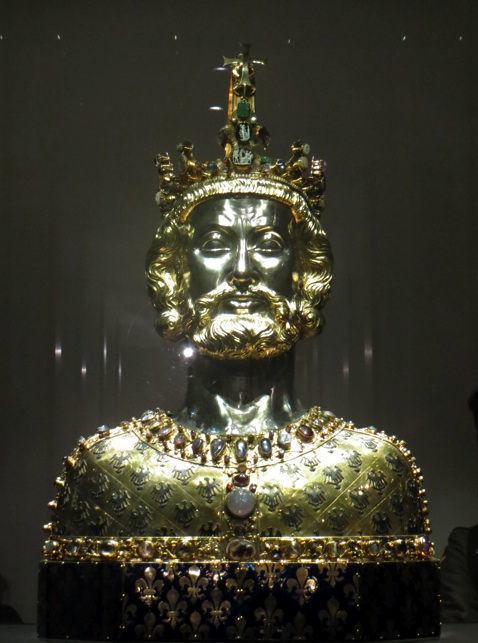
This question brings together politics, faith, protest, and memory running over a thousand years. What does it feel like to stand in a place that is both history and myth? What sort of sainthood is this, and how do we remember it now?
The Making of an Imperial Saint
It’s a tangled old tale, starting not at Charlemagne’s death in 814 but more than three hundred years after, in the charged atmosphere of twelfth-century church politics. The first attempts to canonise Charlemagne were more political ambition than pious reflection. Otto III, Holy Roman Emperor, seemed keen to have Charlemagne recognised as a saint around the year 1000, but nothing truly formal came of it.
The decisive moment arrived on 29th December 1165, when Emperor Frederick Barbarossa, who fancied himself a successor in Charlemagne’s mould, persuaded an antipope, Paschal III, to canonise the long dead emperor. Medieval politics were in play to move the local cultus of Charlemagne onto the Europe wide stage.
Why the strange, aching delay? In part, it came down to the Church’s often uneasy feeling about making kings into saints. Medieval Christianity had its saints mostly among martyrs or those who had renounced worldly power, not those who swung swords and ruled with iron. Sainthood for a sovereign in the Europan context was always rare, and looked at askance. Kings, after all, weren’t commonly paragons of meek humility. We can compare and contrast this with Anglo-Saxon Kings who were often seen as saints.
They made war, they judged, and they held power by force as much as by faith. In twelfth-century Europe, the story changed, thanks to the evolving notion of sacral kingship, kings and emperors tying themselves forever to the church and claiming God’s favour was bound up in their right to rule.
Frederick Barbarossa’s bid was rooted in rivalry. The Holy Roman Emperor wanted an imperial saint, his very own, at a time when the papacy and the Empire were locked in an unforgiving contest for supremacy. Charlemagne, crowned by the Pope himself in 800, seemed the perfect model. Frederick didn’t have the support of Rome. That’s why he turned to Paschal III, an antipope installed during an epic schism that saw two popes in bitter opposition.
This made the canonisation dubious from the outset and very political. Paschal III’s acts lacked legitimacy, and in due course, the Roman Church at the Third Lateran Council in 1179 formally quashed his decisions. Charlemagne was, by strict canon law, never officially made a universal saint.
The people of Aachen, with their own senses, the touch of stone, the glimmer of gold reliquaries, the smell of candles lit for the emperor’s soul, paid little attention to papal bureaucracy. His cult blossomed in and around the city and drew in others from as far away as Reims, Frankfurt, Zurich, and Regensburg. There was a special fervour in France, where Charles V promoted Charlemagne’s veneration as a source of royal legitimacy.
Canonisation and Controversy
The time of Charlemagne’s canonisation was no peaceful summer. The Church found itself convulsed by a great schism, imagine the sound, the argument, the bitterness of Rome divided. Paschal III, Frederick Barbarossa’s antipope, reigned in opposition to the legitimate pope, Alexander III. This was a world where papal claimants had their own armies and realities, where the smell of battle and the smoke of burnt villages was never far away from the perfumed incense of cathedral altars.
Why would Frederick pursue sainthood for his imperial ancestor at such a time? The answer sits at the intersection of ambition, legitimacy, and the desire to beat Rome at its own game. Church and Empire shadow-boxed over who could confer God’s favour best. To have your own saint, an emperor, the very founder of Christendom’s new shape, was to claim not just political power but heavenly approval.
Paschal III’s actions weren’t recognised by Rome although on the ground, in Aachen especially, it hardly mattered. Miracles and processions, relic-venerating crowds, stories whispered in candlelight: the cult was real in the eyes of the people. Sainthood becomes as much about practice and sensory ritual as it’s about papal pronouncements.
Pilgrimage, Relics, and the Imperial Shrine
You might picture Aachen in the twelfth or thirteenth century, a city humming with foreign tongues, pilgrims pressing in tight along cobbled streets, their rough cloaks patched and badges on their hats shining like so many little mirrors. Bells tolled, processions wound through smoky squares, sparrows pecked at the crumbs of holy bread.
Aachen owed all this to Charlemagne. When he chose it as his imperial seat, it was nothing more than a quiet place, notable for its hot springs, a fizzing, steamy aroma rising each morning from stone pools. Within a few decades, Charlemagne had built his palace, cloisters, and, most importantly, the grand Palatine Chapel: octagonal, dark and mysterious, with lantern-light flickering off Byzantine mosaics and gold leaf, meant to remind all of the Heavenly Jerusalem.
When Charlemagne died in 814, he was buried here, in his beloved chapel. The city’s association with the emperor became a driving force for pilgrimage and, across the centuries, civic identity.
After the supposed canonisation in 1165, Aachen’s character shifted. Pilgrims seeking to see and touch the unknown rested in the shadow of Charlemagne’s memory. The city became a place of sanctuaries. Miracle-seekers arrived from the corners of Europe, longing for the healing or wisdom thought to emanate from the emperor’s relics.
What exactly drew these crowds? Aachen’s greatest treasures were four relics, cloths once believed to have touched Christ, the Virgin, and John the Baptist: the Virgin’s dress, Christ’s swaddling clothes, the cloth that wrapped John’s severed head, and the loincloth worn by Jesus on the cross. According to sombre legend, Charlemagne himself received these from Jerusalem, making Aachen a rival of Rome and Compostela in the relic trade.
Since 1349, these relics have been put on display every seven years. Even now, as the scent of burning candles mingles with the musty chill of ancient stone, tens of thousands arrive for this ritual. “For all pilgrims who come to Aachen,” recent guides still tell us, “the question of the authenticity of the relics was and is never important. It’s the experience of community and contact with the holy.” Faith springs alive in the crowds, never in dry papal decrees.
Pilgrims in the Middle Ages often wore pewter badges, small, cool and sharp against the hand, stamped with images of Charlemagne holding his cathedral, or of the Virgin. At Aachen, a special sort of badge had a mirror, a polished disc of glass or pewter framed in lead. Imagine thousands holding up their badges so that the light bounced off the relics, each mirror was thought to catch the holiness of what it reflected, and when it touched the shrine, some hope of healing or blessing might be taken home.
You could say Aachen was soaked in Charlemagne’s odour, his legendary shade beneath the high vaults. Processions would wind around the reliquaries, thick with the singing of ancient hymns, Urbs Aquensis, urbs regalis, with jubilant, trembling voices. The city’s character fused devotion, trade, and the mingled fortunes of empire and town.
Charlemagne in Medieval Memory

After Barbarossa’s radical intervention, Aachen grew in self-confidence. Charlemagne became the city’s patron; his name and memory were invoked at all the key ceremonies. The town’s privileges, granted in the days after his canonisation, helped turn little Aachen into a flourishing imperial city, with the sound of hammers from workshops and the rattle of coins in traders’ ledgers.
Physical reminders were everywhere, too. Charlemagne’s mortal remains, laid at first in a Roman sarcophagus, were moved by Frederick Barbarossa in 1165 and later placed with great pomp in the glittering Karlsschrein in 1215, during the ceremonies for Frederick II’s coronation. This shrine, a box of oak swathed in precious metals and stones, depicts Charlemagne enthroned between the Pope and an archbishop, higher, in the iconography, than either. He becomes the viceroy of Christ.
The city’s status as a coronation centre for emperors cemented Charlemagne’s aura. Thirty kings and twelve queens would be crowned here, advancing up the dark steps to the emperor’s old marble throne. After 1531, the main coronations moved elsewhere, but Aachen’s central place in history was set.
The Daily Sensory World of Pilgrimage
What did this mean to pilgrims, most of them rough-handed and sunburnt from miles on the road? A pilgrim’s journey wasn’t just about approaching a relic, but immersing oneself in the world of colour, scent, sound, and hope. In Aachen, cloth and bone became doorways to the divine, and Charlemagne’s memory a living presence. Badges were souvenirs, but also tiny vessels of power.
The city’s rituals became a refuge and, sometimes, a site of protest, a place to reflect on faith, to gather against tyranny, or to simply make merry. Even today, you’ll find leftover echoes, a seven-year rhythm, a street full of banners, and the low vibration of massed voices at the shrine, where the real and imaginary meet. Pilgrimage to Aachen, then as now, was a layered experience: physical, spiritual, communal, and charged with political meaning.
Why Charlemagne’s Sainthood Matters
It’s tempting to imagine sainthood as a simple matter, one day a candle is lit, the bells ring, and the Church speaks. In Charlemagne’s case, nothing was so orderly. The pope in Rome never recognised his canonisation. Official lists of saints, the Roman martyrology, ignore him even today.
Instead, his cult grew up through a mix of local enthusiasm, regional pride, and the needs of rulers seeking legitimacy. In Aachen, Reims, Frankfurt, Zurich, and Regensburg, his memory was venerated with festivals and Masses. He was regarded as a Christian king and a model for rulers, his name carried weight in France, especially after Charles V’s reign, as French monarchs claimed descent from him and displayed his image at court anniversaries and on coins.
In Germany, too, from the Ottonians down to the Hohenstaufens, Charlemagne’s aura was invoked. Kings were crowned in Aachen; German emperors had their portraits carved on the same shrine. Outside the Rhineland and royal circles, the cult had mixed fortunes. In Rome it was largely ignored; the Eastern Church never embraced him, in part due to Charlemagne’s theological battles with Byzantium.
Does His Cult Still Live? Modern Memory and Fading Echoes
![[Saint Charlemagne et saint Louis écrasant l'hydre de l'hérésie avec la croix] :
Author : Huret, Grégoire (1606-1670). Graveur Public Domain](https://i0.wp.com/limentinus.co.uk/wp-content/uploads/2026/06/Saint_Charlemagne_et_saint_Louis_.Huret_Gr%EF%BF%BDgoire_btv1b53254733x_1.jpg?resize=550%2C910&ssl=1)
So is Charlemagne still a saint? In Aachen, at least, the answer is yes, if sainthood lies as much in the daily rituals of memory as it does in papal decrees. Every year, on the last Sunday of January, a high Mass is offered on his feast day, Karlstag. On that day, the old Latin hymn, Urbs Aquensis, urbs regalis, still fills the cathedral, and the city honours not just its founder, but its living communal bond.
The great Aachen pilgrimage, too, hasn’t faded. Every seven years, the streets brim with pilgrims anew. The relics, swaddling cloth, Virgin’s robe, are paraded in shafts of sunlight, in front of tourists and locals alike. Charlemagne remains a patron of both civic pride and continental unity. Since 1950, the city has awarded the International Charlemagne Prize, celebrating those who work for European unification, a reminder that his political memory, as “Father of Europe,” is ever being remade.
In the wider Catholic Church, his cult lost some of its force. He never had the universal recognition that saints like Louis IX or Edward the Confessor achieved. The smell of oil on the king’s brow at coronation had faded; the stories of his miracles were less told. In the world’s great liturgical books, his name stands on the margins. However, Charlemagne did unite throne and altar at least for some observers.
Charlemagne’s memory crops up everywhere: in university sculptures, paintings, stained glass, and the penned words of old annalists and poets. Modern scholars have written of more than a thousand legends woven around the emperor, far more than for any of his successors. He is hero, tamer of pagans, builder of Christendom, weak and passionate, wise and flawed, a figure made for all seasons.
The Faint Taste of Ashes: Fading, Surviving, Enduring
Is Charlemagne’s cult mere dust now? In Aachen, the answer is clearly no. The annual rituals, the prize in his name, and the continued “living memory” through local veneration mean that his sainthood, contested or not, has never fully died. In France, Germany, and across Christendom, Charlemagne’s spiritual cult has been folded into the broader memory of Christendom: king, lawgiver, patron of unity. The smell of wax and relics gives way to the polished marble of curious tourists.
Conclusion: Reflections on Stones, Shadows, and the Nature of Sainthood
So, if you find yourself in Aachen, stand for a moment beneath the high vaults, and inhale the mingled scents of age, hope, and memory. Trace your fingers along the cold edge of a pilgrim badge. Imagine the choir’s soft echo chanting prayers for Charlemagne. Sainthood isn’t always clear; it’s a fragrance, a rhythm, a persistent memory in the very stones and stories of a place.
The sainthood of Charlemagne, contested and indirect, speaks volumes about medieval power, popular religion, and the living breath of history. Out of antipopes and schisms came a cult that refused to die, whose echoes shaped the fortunes of an entire city and, in a way, a continent.
Charlemagne is a reminders that history isn’t tidy or linear. It’s complicated, sensory, and above all, profoundly human.
Articles on the ‘Lesser Saints’
- Saint: Meta Hub
- The Strange Company of Saints: Martyrs, Passion‑Bearers, and the Rest of Us
- The Legacy of Julian of Norwich: Faith, History, and Renewal
- The Broken Saints: John and Paul, Matthew Shepard, and the Communion of the Wounded
- Market share, Saints and the Roman Catholic Church
- “One Cannot Become a Saint When One Works Sixteen Hours a Day”: Reflections on Sartre, Sainthood, and Sanctity Amid the Ordinary
- Fake Saints and the Selective Recreation of Holiness
- Saint King Charles: Praying with a Blood Stained King?
- Fr Robert Llewelyn: A Story of Faith and Identity
- The Burial and Posthumous Cult of Henry VI: From Chertsey to Windsor and the Making of a Peculiar Saint
- Matthew Shepard: Reflections on Martyrdom, and Suffering
- Father Ignatius: and The Birth of Independent Catholicism
- Saint Aldhelm: Origins, Relics and the Rise and Decline of His Cult in Early Medieval England
- The Quiet Radiance of Ordinary Holiness
- Danny Lockin: Victim and Barnaby Tucker, the wide‑eyed.
- Shrines in the Landscape: How Britons Honour the Dead in Public Spaces
- Saint Guinefort: Smiling at silly things
- Saint Julius and Aaron: Britain’s Paired Martyrs
- St Gervase and St Protase: Paired Martyrs and Ambrosian Imagination
Limentinus is a non‑commercial digital micro‑publication exploring life through liminality, power, sexuality, ancient slavery, identity, and everyday behaviour, written with academic responsibility and structured as a digital‑humanities project. It carries no advertising and generates no income. Images from public collections are credited to their institutions and used under their stated public‑domain or non‑commercial terms, with gratitude for the work these institutions make accessible. Rights holders with concerns may contact limentinus@duck.com for prompt resolution.