This page explores the story of Saint Osyth, an East Saxon royal martyr whose quiet legend links England to the wider, stranger world of the cephalophores. It traces how her tale of faith, death and miraculous persistence took root in the medieval imagination, revealing a saint whose memory endures at the crossroads of history and folklore.
Saint Osyth of Essex- England’s Quiet Cephalophore

AI generated image of the Saxon Princess.
This article is part of the Lesser Saints Project, a wider effort to recover the small, local, half‑forgotten figures who shaped the spiritual landscapes of Britain and Europe. Saint Osyth stands at the heart of this work. An English cephalophore [1] whose story links royal lineage, coastal devotion, and a very French expression of sanctity as seen in the burial site for St. Eucaire. Let’s discover the cephalophores!
Saint Osyth is one of England’s most intriguing local martyrs. An East Saxon princess, an abbess, and, by later tradition, a cephalophore who walked to the church door of Chich holding her own severed head. Her story sits at the crossroads of royal politics, early monastic culture, and the imaginative world of medieval hagiography.
Although her earliest Life does not explicitly describe the cephalophore miracle, the motif became firmly attached to her cult in later centuries, placing her within a tradition more commonly associated with France and Brittany.
Osyth’s legend is a reminder that English sanctity in the early Middle Ages was both deeply local and surprisingly cosmopolitan, shaped by Celtic ideas, continental influences, and the devotional needs of the communities who kept her memory alive.
Who Was Saint Osyth?
Osyth was born into the East Saxon royal family, traditionally described as the daughter of Frithuwald of Surrey and the niece or granddaughter of King Penda of Mercia. This places her squarely within the network of royal women who shaped early English Christianity, figures such as Æthelthryth, Mildrith, and Eanswythe, whose sanctity was inseparable from lineage, landholding, and the founding of monastic houses.
Married to Sighere, King of Essex, Osyth later embraced religious life and became abbess of a small monastic community at Chich, near the Essex coast. Her royal connections gave her cult legitimacy, while her monastic role rooted her story in the landscape. There is nothing surviving of her appearance or imagery and like many of the lesser saints, Osyth must be recreated.
Her legend includes a dramatic episode in which she seizes the moment of her husband’s absence, while he chases a white stag, to veil herself at the altar, securing her religious vocation. Later, she is beheaded by pagan raiders, and in later tradition, she becomes a cephalophore, walking with her severed head to the church door.
The cult was promoted by the Bishops of London and the canons regular of Chich, with relic translations in 1076 and 1186. She was venerated not only in Essex but also in Aylesbury, Bicester, and Hereford, and her story was preserved in multiple Latin and Anglo-Norman lives.
Osyth’s legend blends royal sanctity, monastic foundation, and miraculous martyrdom, and her posthumous miracles often defend her land and rights, reflecting the political tensions between monastic houses and episcopal authority in post-Conquest England.
The Legend and the Cephalophore Motif

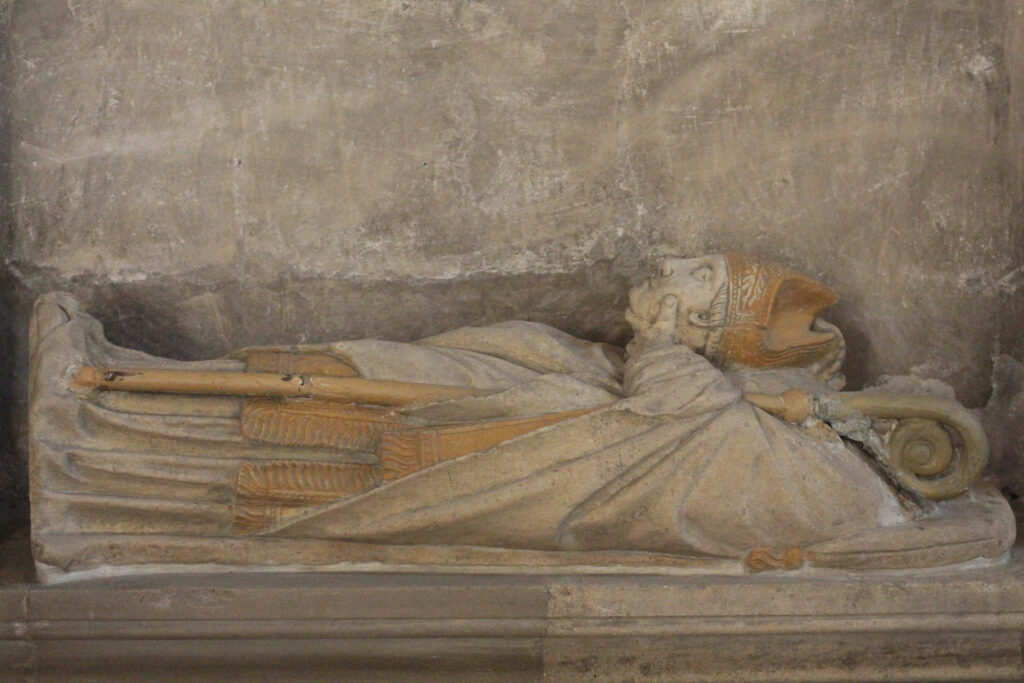
Photographer: FredSeiller Creative Commons CC0 1.0
According to tradition, Osyth was killed by raiders, often imagined as Danes or pirates, who demanded she renounce her faith. When she refused, they beheaded her. Early tradition does not mention her rising or carrying her head. Her cult begins as a local English martyrdom story rooted in Chich, Essex.
By the 12th–13th centuries, Osyth is explicitly depicted as a cephalophore. This is confirmed in modern summaries of her iconography, which note that she is “depicted as a cephalophore” . The motif appears in Anglo‑Norman hagiography, a period when English religious houses were heavily influenced by continental narrative forms.
Osyth rose, lifted her severed head, and walked to the church door of Chich, where she collapsed.
This is a classic cephalophore pattern. A final, purposeful journey marking the place where the saint wishes to be venerated. The cephalophore element is part of a Franco‑Lotharingian narrative world that shaped saints like Denis, Elophe, Euchaire, and Libaire. That distinction matters, because the subtle change in narrative explains both why Osyth is unusual in England and how she came to be depicted carrying her head.
Why Did the Cult of Osyth Take Hold?

Osyth’s cult flourished for several overlapping reasons, each rooted in the landscape and devotional culture of early medieval England.
Royal lineage
Her East Saxon and Mercian connections placed her among the royal saints who dominated early English piety. Royal blood made sanctity plausible, even expected.
Geography
Chich sits in a liminal coastal zone, marshland, estuary, and sea routes. Isolated landscapes often generate strong local cults, especially where danger, isolation, and miracle stories intertwined.
Travellers and monastic networks
The Essex coast was a corridor for continental influence, especially from Francia. Stories of cephalophores such as Saint Eucaire were already flourishing in Gaul. It’s not difficult to imagine the motif travelling over the water with monks, merchants, or relic‑bearers.
Celtic echoes
The idea of the sacred head, identity, voice, selfhood, was deeply rooted in Celtic culture. Even in Anglo‑Saxon Essex, older cultural memories lingered. Osyth’s cephalophore tradition may reflect this deeper symbolic inheritance.
Local tradition
Communities often shaped saints to fit their needs. A martyr who walked to the church door provided a charter myth for the site, explaining its holiness and anchoring local identity.
Osyth as an English Cephalophore

Although cephalophores are overwhelmingly associated with France, Saint Denis, Saint Noyale, Saint Justus, Saint Nicasius, the adoption of the motif into Osyth’s legend shows how English piety was not isolated. Pre‑Norman England was a place of intense religious creativity, where saints were indeed “like blackberries”, abundant, local, and woven into the landscape.
Osyth’s cephalophore identity is therefore both unusual and entirely fitting:
- unusual because England has very few cephalophores
- fitting because English hagiography freely borrowed from continental models
- meaningful because her story expresses the same themes of identity, memory, and place that define the Lesser Saints project
Her cephalophore moment is less a historical claim than a symbolic act of belonging: a saint marking her own ground.
Landscape and Surviving Traces
The village of St Osyth preserves her name, her priory, and the memory of her martyrdom. The church door where she is said to have fallen became a focal point of devotion, and the surrounding marshes, wells, and coastal paths echo the atmosphere of her legend.
Fragments of sculpture, local traditions, and place‑names keep her story alive, even as formal devotion has faded.
Osyth in Art and Iconography
Historical depictions of Osyth are scarce, but the cephalophore motif gives her a recognisable iconography:
- a young abbess holding her head at chest height
- a calm, upright posture
- a church door or coastal landscape in the background
- Representations, tend to draw on French cephalophore imagery, reinforcing the cross‑Channel connections that shaped her cult.
Why Osyth Belongs to the Lesser Saints

An AI generated image of the Saxon Princess.
Osyth embodies the themes at the heart of the Lesser Saints project:
- Liminality – Caught somewhere between history and legend
- Memory – Preserved by local devotion rather than official record
- Marginality – A cephalophore cult overshadowed by larger narratives
- Landscape – A saint whose local story is inseparable from place
Osyth is a saint who survived not through grand institutions but through the quiet persistence of a community that refused to forget her.
Takeaway
Saint Osyth stands at the meeting point of English royal sanctity, continental hagiographic imagination, and the deep symbolic power of the cephalophore motif. Her story shows how early English piety was both intensely local and richly connected to wider European traditions. Though her cult never became universal, it shaped the landscape of Essex and remains a vivid example of how the extraordinary lives of lesser saints continue to echo through place, memory, and story.
.
Timeline of Saint Osyth
Early 7th century – Birth in royal circles
Osyth is born into the East Saxon and Mercian royal networks, traditionally as the daughter of Frithuwald of Surrey and a relative of King Penda. This places her among the first generation of English royal women shaped by Christianisation.
Mid‑7th century – Marriage to King Sighere of Essex
She is married to Sighere, co‑king of Essex. Hagiography emphasises her reluctance and her vow of virginity, aligning her with other royal virgin‑saints of the period.
Mid‑to‑late 7th century – Religious profession and abbacy
During a hunting episode involving a white stag, Osyth seizes the moment to take the veil. She becomes abbess of Chich, establishing a small monastic community near the Essex coast.
c. 653–700 – Martyrdom
Her death is placed anywhere between 653 and 700, depending on the source. She is killed by raiders, often framed as Danes or pagan pirates, after refusing to renounce her faith. Later tradition adds the cephalophore miracle, in which she carries her severed head to the church door.
8th–11th centuries – Early cult and local veneration
Osyth’s name appears in early English calendars and local traditions. Dedications and miracle stories spread through Essex, Buckinghamshire, and the East Midlands.
1076 – First recorded translation of her relics
The Bishops of London promote her cult, translating her relics to strengthen ecclesiastical claims over Chich.
1120s – Foundation of St Osyth’s Priory
The Augustinian canons establish a major house on her site, embedding her cult in the new monastic landscape of Norman England.
1186 – Second translation of relics
Her relics are moved again, reinforcing her status as a regional saint and drawing pilgrims and as a result created an income for the Church from pilgrim donations
12th–14th centuries – Expansion of her legend
Multiple Latin and Anglo‑Norman Lives circulate, including versions used by the canonesses of Campsey Ash. Her cephalophore identity becomes standard in this period.
Later Middle Ages – Decline but persistence
Her cult remained active locally but never becomes universal. Place‑names, parish dedications, and the priory preserve her memory although the English Reformation destroyed her cult as with many others local saints.
Further Reading
The Strange Company of Saints: Martyrs, Passion‑Bearers, and the Rest of Us
FAQ
Saint Osyth (also known as Osgyth) was a noblewoman from early medieval Mercia who became a nun and eventually founded a religious house at Chich, the site that later took her name as St Osyth. She was married into the royal house of Essex, which tied her legacy to the region. After taking religious vows, she established a convent and served as its first abbess, making her a central spiritual figure in the area. Her veneration began soon after her death, and the village of St Osyth remains the heart of her cult.
Medieval tradition holds that after Osyth was beheaded by raiding pirates, she miraculously rose and carried her severed head, a hallmark of cephalophore saints. This detail appears in later hagiographic traditions and became one of her defining attributes in art and devotion. While the historical accuracy of such legends is uncertain, they reflect the medieval fascination with miraculous martyrdom and helped solidify her status as a powerful local saint.
Several stories circulated about Osyth, including a childhood tale in which she drowned while crossing a swollen stream and was restored to life through the prayers of two abbesses. Her later martyrdom, and the belief that she resisted being carried off by pirates, reinforced her image as a steadfast and spiritually protected woman. These narratives, repeated in medieval chronicles, shaped her identity as both a martyr and a miracle‑working saint.