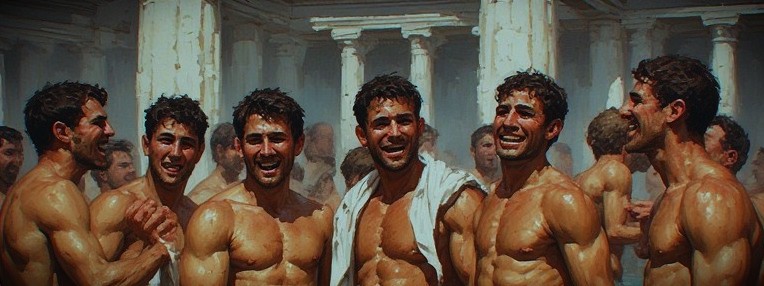
• This is an article that explains Roman ideals of male beauty. Standards were based on Greek classical ideals. Roman writers and artists defined the “beautiful man” as youthful, smooth‑skinned, proportionate, and emotionally controlled. Roman beauty was moral as well as physical: a man’s appearance was expected to express self‑control, dignity, noble bearing, and the ability to endure hardship, shown in models like the Farnese Hercules. These ideals shaped grooming, portraiture, public statues, and elite expectations of masculine behaviour across the empire.


    Roman Male Beauty Standards

    Marble over-lifesized male figure, restored as Apollo with right arm on head and bow in left hand; head, arms, left leg and attributes not ancient; perhaps originally Dionysos. Museum number 1864,1021.6 © The Trustees of the British Museum. Shared under a Creative Commons Attribution-NonCommercial-ShareAlike 4.0 International (CC BY-NC-SA 4.0) licence.
    Marble over-lifesized male figure, restored as Apollo with right arm on head and bow in left hand; head, arms, left leg and attributes not ancient; perhaps originally Dionysos. Museum number 1864,1021.6 (Resized background removed) © The Trustees of the British Museum. Shared under a Creative Commons Attribution-NonCommercial-ShareAlike 4.0 International (CC BY-NC-SA 4.0) licence.

    Roman male beauty standards didn’t originate in Rome. They were fundamentally Greek, inherited through conquest and cultural imitation. When Rome absorbed Greece, admiration of Greek bodies became possession of Greek art, and Greek statuary turned into the visual grammar of Roman masculinity. Romans didn’t invent their bodily ideals, they copied, adapted, and reinterpreted Greek models to define what a perfect male body should look like. Understanding this Greek foundation is essential for interpreting Roman grooming, aesthetics, and public self‑presentation.

    Roman bodily ideals were Greek in origin, Roman in meaning, and imperial in reach. Greek bodies provided the visual forms; Roman power supplied the cultural meanings. Through conquest, appropriation and reinterpretation, Greek statuary became the model of the perfect man, shaped by aesthetics and by Roman religion and mythology, philosophy, and the expectations of Roman citizenship. In this fusion, Greek bodies became the framework through which Roman men understood youth, beauty, discipline, harmony, heroic endurance and dignified bearing.

    Polykleitos’s Doryphoros was the most influential of all. Its proportions, offered Romans a visual formula for the ideal male body: balanced musculature, smooth skin, upright posture and a calm expression.

    Myron’s Discobolus added controlled dynamism, a body in motion but a face composed. Lysippos’s Apoxyomenos introduced a leaner, taller athlete, a form Romans admired for its elegance and restraint. Praxiteles’s Hermes with Dionysus offered soft, youthful beauty, a model that reappears in Roman portraits of Antinous.

    These statues weren’t remote museum pieces. They were everywhere. Roman elites placed Greek bodies in their gardens, porticoes, bath complexes and dining rooms. Greek proportion became the everyday visual environment of Roman masculinity.

    Roman culture absorbed many Greek ideals, although it also clung to a stubborn belief that a certain Roman plainness was a virtue. Ovid makes this tension explicit in Ars Amatoria, a guide for men on how to present themselves at their best. Ovid urges cleanliness and care, but he rejects excessive artifice, the very curated, Hellenised beauty that became fashionable in Rome. What emerges is a dynamic contrast: highly polished Greek‑style grooming on one side, and a stoic Roman “normality” that mistrusted embellishment on the other.

    Conquest and Cultural Transfer: How Greek Bodies Became Roman Property

    Neatness pleases, a body tanned from exercise:a well fitting and spotless toga’s good” Ovid: Ars Amatoria) Book I Part XIV: Look Presentable. Translated by A. S. Kline © Copyright 2001 

    The transfer of Greek bodily ideals into Roman culture was accelerated by conquest. After the sack of Corinth in 146 BCE, Greek sculpture poured into Rome. After conquering Greece in the second century BCE, Romans looted thousands of statues.

    These statues became markers of:

    • elite education
    • cultural sophistication
    • political power
    • participation in romanitas

    Greek aesthetics became part of Roman identity, especially for the upper classes. To be Roman, in elite terms, meant to appreciate Greek harmony, Greek youthfulness and Greek restraint. Greek bodies became imperial bodies.

    Pompeian Frescoes: Greek Bodies in Roman Domestic Settings

    …..don’t mar your neat hair with an evil haircut: let an expert hand trim your head and beard. Ovid: Ars Amatoria) Book I Part XIV: Look Presentable.Translated by A. S. Kline © Copyright 2001 

    Pompeii provides vivid evidence of how Greek bodily ideals entered Roman daily life. Domestic frescoes show athletes, heroes and mythic youths painted with Greek proportions and Greek posture. Domestic wall‑painting shows Greek bodies in Roman domestic spaces.

    In the House of the Vettii, the House of the Faun and the House of the Tragic Poet, male figures echo Polykleitos’s balance, Lysippos’s elongation and Praxiteles’s softness. These frescoes were aspirational images placed in dining rooms, atria and private chambers, spaces where Roman men performed identity, status and masculinity.

    Greek bodies became part of Roman domestic life, shaping how men saw themselves and how they wished to be seen.

    HRoman Diversity: Greek Ideals Across an Imperial Population

    No bad breath exhaled from unwholesome mouth: don’t offend the nose like a herdsman or his flock“. Ovid: Ars Amatoria) Book I Part XIV: Look Presentable.Translated by A. S. Kline © Copyright 2001 

    One of the most important interpretive points is that there was no single Roman man. The empire absorbed men from Italy, Greece, Syria, Gaul, Spain, Africa and beyond. Roman men were diverse, Romanitas absorbed men from Italy, Greece, Syria, Gaul, Spain, Africa and beyond.

    Greek bodily ideals didn’t function as ethnic markers. They were cultural markers, shared symbols of elite identity across the empire. A Roman man from Syria could admire the Doryphoros just as much as a Roman man from Spain. A Roman man from Africa could aspire to Lysippos’s proportions just as much as a Roman man from Gaul.

    Greek bodies became the imperial visual language of masculinity.

    Roman Role Models: the Performance of Masculinity

    Semi‑draped athletic Greek youth with lean Lysippan proportions, bare torso and red cloak over one shoulder, standing in warm golden light before classical columns and a distant marble statue, embodying controlled masculine presence.
    Semi‑draped athletic Greek youth with lean Lysippan proportions, bare torso and red cloak draped over one shoulder, standing in warm golden light before classical columns and a distant marble statue, embodying controlled masculine presence.

    Violence and Decisiveness: The Masculinity of Action

    Put no trust in appearances; after all isn’t every street packed With sad-looking perverts? Juvenal Satire II – Effeminate Rome Translated by A. S. Kline © Copyright 2001 All Rights Reserved

    Roman history and myth celebrate men who act decisively, often violently, and Roman culture treated such force as a sign of strength rather than a failure of masculinity. By the imperial period, admiration for an older, harder style of manhood still lingered, even as elite Romans embraced highly curated, Greek‑influenced beauty practices. Juvenal, especially in Satire II, pushes back against this artifice, mocking men who adopt Hellenised grooming and urging a return to an earlier Roman “roughness.” His satire exposes a cultural tension: the polished, perfected Greek body on one side, and a stoic Roman ideal that mistrusted embellishment on the other.

    Romulus kills Remus. Brutus kills his sons. Horatius kills attackers. Mucius Scaevola burns his hand to prove resolve. Lots of action, lots of drama and all without a hairstylist.

    These figures embody the Roman belief that action, even harsh action, was a masculine virtue. Greek heroic bodies reinforced this ideal. Achilles, Odysseus and Hercules appear in Roman statuary with powerful musculature, controlled posture and heroic bearing. The Farnese Hercules, admired by Romans, shows strength combined with exhaustion: a body shaped by action and suffering.

    Violence wasn’t admired for its own sake. It was admired because it demonstrated decisiveness, courage and the willingness to bear the moral weight of leadership. Roman men were expected to act, and Greek heroic bodies provided the visual model for what such action looked like.

    Restraint and Self‑Control: The Masculinity of Discipline

    One man has blackened his eyebrows, moistened with soot,Extends them with slanting pencil, and flutters his eyelids” Juvenal Satire II – Effeminate Rome Translated by A. S. Kline © Copyright 2001 All Rights Reserved

    Roman masculinity also prized restraint. Romans admired men who could dominate but chose restraint. Self control was as masculine as conquest.

    Cincinnatus walks away from dictatorship. Numa cultivates peace. Augustus stabilises the household of the empire.

    Greek statues embody this ideal through calm faces, composed posture and controlled movement. The Doryphoros stands in perfect balance. The Discobolus twists in motion but shows no strain in the face. The Apoxyomenos is lean, elegant and self‑possessed.

    Roman men admired this visual language of discipline. It aligned with Roman values of moderation, gravitas and dignitas. Masculinity wasn’t only about what a man could do, but what he could refrain from doing.

    Incomplete or Tragic Masculinity: Potential, Charisma and Bearing

    Dry hair a bristling forest, your skin has lost that gloss Produced by depilating it with heated Bruttian pitch, And your legs too, neglected, dark with sprouting hair“. Juvenal The Satires Satire IX Translated by A. S. Kline © Copyright 2001 All Rights Reserved

    Roman role models weren’t always triumphant. Some were admired precisely because their lives were incomplete, tragic or marked by suffering. Failure or incompleteness didn’t disqualify a role model.

    Germanicus dies young. Aeneas suffers, hesitates and obeys. Lucullus is remembered more for luxury than heroism.

    Romans admired potential, charisma and bearing as much as achievement. Aeneas, in the hero role model, shows that masculinity could be defined by endurance rather than complete victory. His beauty, dignity and emotional restraint align with Greek sculptural ideals, especially the calm, burdened faces of Praxitelean youths.

    Roman admiration for tragic masculinity is also visible in the Laocoön Group, a Hellenistic sculpture Romans adored. Laocoön’s twisting body and anguished expression show heroic suffering, not heroic triumph. This visual model reinforced the idea that masculinity included grief, pain and endurance.

    Domestic Authority: Masculinity Inside the Household

    “you should summon your overseer the next day, and should call for a report of what work has been done in good season and why it hasn’t been possible to complete the rest” Roman Farm Management: The Treatises of Cato and Varro Author: Marcus Porcius Cato Marcus Terentius Varro Translator: Fairfax Harrison

    Roman masculinity wasn’t only public; it was profoundly domestic. Writers like Cato the Elder, Varro, Pliny the Younger, and even Augustus’s biographers show that Roman manhood was measured as much in the household as in the forum. Cato’s and Varro’s farm manuals, Roman Farm Management: The Treatises of Cato and Varro, form the bedrock of this tradition, rooting Roman masculine authority in the soil itself.

    Their instructions on rations, labour, discipline, provisioning, and even the placement of slave privies reveal a world where control, frugality, and order defined the paterfamilias. Pliny praises domestic virtue and humane authority; Augustus is celebrated for stabilising the imperial household.

    Pompeian frescoes reinforce this ideal: men seated in dignified poses, supervising rituals, receiving guests. These images echo Greek calm and proportion, but apply it to Roman domestic life, where masculinity meant emotional control, moral leadership, household management, and dignified bearing. Greek bodies supplied the visual ideal; Roman homes supplied the context.

    Beauty, Youth and Presence: The Visual Performance of Masculinity

    Caius Lusius, a nephew of his (Gaius Marius (157–86 BCE), had a command under him in the army. In other respects he was a man of good reputation, but he had a weakness for beautiful youths. This officer was enamoured of one of the young men who served under him, by name Trebonius, and had on made unsuccessful attempts to seduce him“‘ Life of Marius, 1–46 Plutarch  translated by Bernadotte Perrin

    Beauty wasn’t superficial in Roman culture. It was a legitimate part of male virtue. Male beauty was a legitimate part of Roman virtue although it could land people in trouble when they forgot their roles and obligations

    Germanicus is admired for charm and appearance. Scipio Africanus for noble bearing. Antinous for serene, youthful perfection.

    Greek statues reinforced this admiration. The Apollo Belvedere elegant, almost effeminate beauty. The Spinario shows youthful concentration and simplicity. Portraits of Antinous show soft, perfect features that Romans idealised.

    Youth signalled potential, vitality and divine favour. Ageing caused anxiety. Loss of youth meant loss of beauty, status and social power. Greek statuary, with its smooth skin and idealised musculature, became the aspirational model for Roman male beauty.

    Myth and History Blended: The Emotional Blueprint of Masculinity

    Romans didn’t separate myth from masculinity. Myth created masculinity.

    Aeneas is the emotional blueprint: beautiful, dignified, burdened. Hercules is the model of heroic suffering (Farnese Hercules). Laocoön shows idealised endurance and pain.

    Livy writes history as moral theatre. Virgil writes epic as national psychology.

    Greek heroic bodies appear in Roman statuary and frescoes, blending mythic ideals with Roman expectations. Aeneas’s emotional restraint mirrors Greek sculptural calm. Hercules’s suffering mirrors the exhausted strength of the Farnese Hercules. Laocoön’s anguish mirrors Roman admiration for endurance.

    Myth and history together created a visual and emotional model for Roman masculinity.

    Grooming, the Real Roman Body

    Two adult male slaves kneel in a Roman bathhouse, using pumice stones to smooth the legs of an idealised Roman man and remove leg hairs.  Ovid , Ars Amatoria (The Art of Love). Ovid gives a full list of grooming expectations for Roman men
    Two adult male slaves kneel in a Roman bathhouse, using pumice stones to smooth the legs of an idealised Roman man and remove leg hairs. Ovid , Ars Amatoria (The Art of Love). Ovid gives a full list of grooming expectations for Roman men

    Roman bodily ideals were aspirational, not universal. Greek aesthetics shaped grooming, posture, behaviour and self‑presentation, but real Roman bodies were diverse. Romanitas created shared expectations, not uniformity. Grooming, domestic life, art and statuary reveal a culture where masculinity was performed through discipline, youth, beauty, endurance and dignity, broad trends rather than fixed ideals

    Roman bodily ideals were aspirational. The empire was vast, multi‑ethnic and socially diverse, although it was Greek or Hellenised aesthetic that provided a shared visual language for how Roman men imagined beauty, dignity and masculine presence.

    Real Roman bodies varied enormously, but romanitas created broad cultural expectations that shaped grooming, posture, behaviour and self‑presentation. There was no one single Roman man, there were Roman men from all ethnicities and provinces… romanitas held them together.”

    Pompeian frescoes fill domestic walls with heroes drawn from Greek myth, Achilles, Theseus, Heracles, Perseus, men shown with perfect proportions, smooth limbs, calm expressions, and controlled, almost sculptural gestures. These aren’t portraits of real Romans. They’re superhuman bodies, borrowed from Greek art, placed inside Roman homes as visual ideals. The myths on the walls idealise youth, beauty, strength, and emotional mastery; they erase the ordinary human qualities that real bodies carry: age, injury, labour, fatigue, and imperfection.

    What these images hide, sometimes accidentally, sometimes deliberately, are the harsher textures of Roman life. The same households that displayed heroic calm on their walls also ran on strict discipline, hard labour, and the management of slaves. Cato and Varro’s farm treatises make this clear: Roman authority meant rationing food, selling sick slaves, cutting allowances, and organising privies for labourers. Even Seneca, who urged humane treatment, never questioned the institution itself. The frescoes show idealised men; the manuals show the earthy, controlling reality of Roman domestic power.

    These heroic images mattered. They shaped Roman masculinity by giving men a visual script: upright posture, composed gestures, youthful vigour, and emotional restraint. Greek aesthetics became the language through which Romans imagined the best version of themselves, even when daily life told a very different story.

    The Ideal Roman Man Was Never Just One Thing

    Roman male beauty was never a single, stable ideal. It was a collage, sometimes harmonious, often contradictory, built from layers of Greek fantasy and Roman reality. On one level, Roman men aspired to the Greek heroic body: smooth limbs, perfect proportions, calm expressions, sculptural poise. Pompeian frescoes and looted Greek statues filled Roman houses with superhuman men, turning Greek aesthetics into the visual grammar of aspiration.

    Beneath that polished surface lay a far older Roman ideal, the agrarian masculinity of Cincinnatus, Cato, and the farm manuals. De Agricultura shows a world of rationing, discipline, hard labour, and warts‑and‑all practicality. This was a masculinity rooted in soil, sweat, and control, not marble perfection. It was curt, uncomfortable, curmudgeonly, a world where beauty mattered far less than authority.

    In the end, Roman male beauty standards were a paradox: Greek perfection laid over Roman earthiness, rustic virtue competing with urban luxury, heroic calm masking domestic brutality.


    Further Reading

    • Slave Meta Hub A structured gateway into Rome’s systems of ownership, coercion and domestic hierarchy.
    • Roman Religion: Meta Hub Explores the rituals, household cults and civic expectations that shaped Roman identity and behaviour.
    • Rome: Daily Life Meta Hub A survey of ordinary routines, labour, domestic authority and the social pressures that governed everyday life.
    • The Roman World A wider contextual hub covering politics, culture, geography and the shifting ideals of Romanitas across the empire.
    • Bell, Sinclair. “Introduction: Role Models in the Roman World.” Memoirs of the American Academy in Rome. Supplementary Volumes, vol. 7, 2008, pp. 1–39. JSTOR, http://www.jstor.org/stable/40379345. Accessed 20 July 2026.

    Academic Disclaimer

    This article uses the term “Greek” as a conventional English shorthand for the artistic, cultural and intellectual traditions that shaped Roman ideals of the male body. In strict academic terms, these traditions are better described as “Hellenic” or “Hellenistic,” since they arose within a wider cultural sphere that included mainland Greece, the Aegean, Asia Minor, the Hellenistic kingdoms and the broader eastern Mediterranean.

    The term “Greek” is retained here for clarity and accessibility, but readers should understand that the aesthetic and philosophical models discussed belong to a complex and geographically diverse Hellenic world rather than to a single ethnic or national category.

    Last Curated: 28 08 2026

    Part of: The Roman World

  • How to keep a Friend:The Rules of Roman Hospitality

    This article focuses on Pliny’s playful scolding of C. Septicius Clarus. It isn’t just a missed dinner Pliny is writing about. It’s a glimpse into the unwritten rules that shaped elite Roman male friendships: loyalty, presence, good humour and the quiet power of hospitality. In a world where relationships held everything together, even a skipped meal could reveal the true shape of a man’s character.


    How to keep a Friend:The Rules of Roman Hospitality

    Pliny the Younger sits in his villa wearing a white toga, speaking calmly as he dictates a letter. Beside him stands a Greek scribe holding a wax tablet and stylus, listening attentively and ready to write. The room is simple, with plain plaster walls and soft light, reflecting the quiet, orderly rhythm of an elite Roman household.
    Pliny the Younger wearing a white toga, speaking calmly as he dictates a letter. Beside him stands a scribe holding a wax tablet and stylus.

    Pliny’s letter to Septicius Clarus is one of the most revealing pieces of writing we have about elite Roman friendship. On the surface it’s a light, teasing note about a missed dinner. Underneath, it tells us a great deal about how Roman men thought about loyalty, sociability and the obligations that held their world together.

    Pliny or Gaius Plinius Caecilius Secundus, wrote this letter in the early second century CE, during the reign of Trajan. It comes from a period when the empire was stable, prosperous and confident. Pliny himself was a wealthy senator, a provincial governor and a man who moved comfortably in the highest circles of power. C. Septicius Clarus, the recipient, would later become Praetorian Prefect under Hadrian, one of the most powerful posts in the empire.

    At the time of this letter, though, he was simply Pliny’s friend, someone close enough to be scolded for skipping a dinner party.

    Letter writing as a Roman art

    Pliny’s letters were never private jottings. He shaped them carefully, revised them, and eventually published them as a literary collection. In Rome, letter writing was a social performance, a way of presenting oneself to a wider audience. In this letter, Pliny crafts an image of himself as witty, generous, and slightly put out. He wants readers to see a man who hosts refined, tasteful dinners rather than extravagant displays. He also wants to show that friendship matters to him, and that he feels slighted when it’s treated casually.

    Pliny was working within a long and distinguished tradition of Roman epistolary writing. Cicero was the most prolific Roman letter writer, with more than eight hundred surviving letters, including four hundred and fifty to Atticus. Together they form a near‑continuous record of the late Republic. His correspondence reveals strategy, anxiety, ambition, and the daily mechanics of political life, and scholars often treat it as a private journal in which Cicero thinks aloud about the pressures of public office.

    Seneca adapted the form for philosophy. His Letters to Lucilius, one hundred and twenty‑four in number, are moral essays cast as correspondence. They explore Stoicism, self‑discipline, and the challenge of living well under imperial rule. The letters move between everyday experience and philosophical reflection, using the epistolary voice to create intimacy and authority.

    Marcus Aurelius didn’t write letters in the conventional sense, yet his Meditations imitate the introspective tone of private correspondence. They read like personal notes written to oneself, shaped in the manner of a man thinking through moral questions in solitude. The work preserves the inward voice of an emperor who used writing as a tool for self‑examination.

    Fronto, tutor to Marcus Aurelius, left a substantial body of correspondence, roughly two hundred letters and fragments, mostly exchanged with Aurelius and Lucius Verus. These letters reveal the intellectual world of the second century, full of rhetorical criticism, literary discussion, and warm, affectionate exchanges. They show how letter writing could sustain friendship, mentorship, and scholarly debate.

    In the fourth century, Quintus Aurelius Symmachus used letters to navigate the political and religious tensions of the late Empire. His correspondence records the struggle between traditional Roman religion and the rising dominance of Christianity, offering a detailed view of aristocratic life during a period of cultural transformation.

    Pliny’s own letters belong to this broader epistolary pattern. Like Cicero, Seneca, Fronto, and Symmachus, he used correspondence to shape reputation, express values, and present a carefully managed version of himself to posterity.

    What the letter tells us about Roman men

    Roman elite men lived in a world built on relationships. Friendship wasn’t just affection. It was a network of obligations, expectations and mutual support. A missed dinner wasn’t trivial. It was a breach of social duty. Pliny’s mock outrage is playful, but it’s also real. Clarus has broken the unwritten rules of elite male friendship.

    The letter shows us that Roman men valued:

    • Loyalty. Turning up mattered. Being dependable mattered.
    • Reciprocity. If someone invited you, you owed them your presence.
    • Sociability. Dinner wasn’t just food. It was conversation, poetry, music and shared culture.
    • Status. Pliny contrasts his simple, elegant meal with the flashy oysters and dancers Clarus chose instead. He’s making a point about taste and refinement.

    Roman friendships were often competitive. Pliny’s tone is affectionate, but he’s also asserting his superiority. His dinner would’ve been better, more cultured, more meaningful. Clarus has chosen badly.

    Rules of hospitality

    Hospitality in Rome wasn’t optional. It was a moral duty. Hosts were expected to provide comfort, entertainment and good company. Guests were expected to show up, behave well and appreciate the effort. Pliny lists the food he prepared not because it was extravagant, but because it was thoughtful. Lettuce, snails, eggs, barley cake, sweet wine and snow. It’s modest, but it’s curated. It reflects Pliny’s self‑image as a man of taste, not excess.

    When Clarus fails to appear, Pliny treats it as a personal slight. He jokes about charging him for the snow, but the joke rests on a real sense of injury. Hospitality was a bond, and Clarus has snapped it.

    Food, Thoughtfulness and the Art of Hosting

    Pliny, an older Roman man in a white toga, stands between two young male attendants wearing simple white loincloths. Both attendants look down toward the floor. In front of them, a wooden table displays Roman delicacies — figs, olives, bread, cheese, and small amphorae of wine and oil — arranged on terracotta dishes. The background is a plain plaster wall, creating a calm, domestic scene of Roman hospitality
    Pliny, an older Roman man in a white toga, stands between two young male attendants. Both attendants look down toward the floor. Simple Roman delicacies, figs, olives, bread, cheese, and small amphorae of wine and oil, arranged on terracotta dishes.

    Pliny’s menu tells us a great deal about Roman dining culture and the care that went into even the most modest supper. When he lists lettuce, snails, eggs, barley cake, olives, beetroot, gourds and onions, he isn’t apologising for a plain meal. He’s showing off a kind of cultivated restraint. This is the food of a man who wants to appear tasteful rather than extravagant, refined rather than showy. It’s the opposite of the oysters and dancers that tempted Septicius Clarus away.

    Every item on Pliny’s table has been chosen with thought. Lettuce was considered refreshing and good for digestion. Snails were a delicacy, fed on milk to fatten them. Eggs were a standard starter, but good ones were prized. Barley cake was rustic but wholesome. The vegetables reflect seasonality and freshness, which mattered to Roman hosts who wanted to show they understood the rhythms of the agricultural year.

    Then there’s the snow. This is the detail that reveals the most. Snow had to be collected from the mountains and stored in deep pits, packed with straw. It was expensive, fragile and fleeting. Pliny jokes that he’ll charge Clarus for it because it won’t keep, but the joke rests on a real truth: snow was a luxury. It was used to chill wine or create a kind of ancient sorbet. Bringing it out at dinner was a sign of care and effort, not excess. It showed that the host had gone to trouble for his guest.

    Pliny’s menu isn’t about quantity. It’s about intention. He wants Clarus to know that he planned the evening with him in mind, that he chose ingredients that suited a quiet night of conversation, poetry and laughter. The food reflects the atmosphere he wanted to create: light, civilised, intimate. It’s the culinary equivalent of friendship.

    That’s why Clarus’s absence stings. Pliny hasn’t just wasted food. He’s wasted thought. He’s wasted preparation. He’s wasted the small, deliberate acts that turn a meal into hospitality. In Roman culture, that mattered. A good host showed care through the table he set. A good guest honoured that care by turning up.

    Pliny’s irritation is playful, but it’s also sincere. The food he prepared wasn’t grand, but it was chosen with affection. Clarus missed more than a supper. He missed the chance to share in the quiet pleasures that held Roman friendships together.

    The dancers

    Pliny’s remark about “dancers from Cadiz of a certain I know not who” is a playful but pointed jab. Cadiz was famous for its lively, sensual dancers, the sort of entertainment associated with louder, more indulgent parties.

    By pretending not to know the rival host, Pliny is mocking both the company Clarus chose and the taste behind it. It’s a gentle insult wrapped in humour, a way of saying that Clarus abandoned a refined evening of conversation and carefully chosen food for something far more vulgar.

    In one line, Pliny manages to tease his friend, assert his own superior taste and remind him of the social expectations that governed Roman friendship.

    Friendship as a cultural ideal

    Pliny often writes about friendship. He praises Clarus elsewhere as honest, simple and trustworthy. That makes this letter even more interesting. It shows that even the closest friendships had rules, and those rules could be broken. Roman men didn’t expect emotional intimacy in the modern sense. They expected reliability, shared values and participation in each other’s social lives.

    This letter also shows the gentler side of Roman masculinity. Pliny imagines the evening they could’ve had: laughter, conversation, literary amusements. It’s a reminder that elite Roman men weren’t all stern statesmen or brutal soldiers. They were also readers, performers, hosts and friends.

    Dictation and Authorship in the Roman Elite Household

    When Pliny “writes” a letter, he almost certainly isn’t holding a pen. Elite Romans dictated most of their correspondence to trained secretaries, often slave or freed Greek men who were valued for their education and speed. Dictation was part of the daily rhythm of a wealthy household.

    A secretary would follow the master through the villa with wax tablets, ready to catch every phrase as it fell. Pliny’s letters were shaped in his voice, but the physical labour of writing belonged to someone else.

    This doesn’t make the letters any less his. Dictation was still authorship. Pliny chose the words, the tone, the jokes, the structure. The secretary provided the technical skill: shorthand, neat handwriting, the ability to produce clean copies.

    Greek secretaries were especially prized because Greek was the language of culture, and their training made them ideal literary assistants. Many Roman authors worked this way. The creative mind was Roman, the hands that wrote the words were often Greek.

    It’s a reminder that Roman literature was a collaborative process, even when only one name appears on the page. Behind every polished letter stood a household of labour: the scribe who wrote it, the slave who fetched the papyrus, the freedman who prepared the ink. Pliny’s elegant voice rests on the invisible work of others, and the letter to Septicius Clarus is no exception.

    Where this letter sits in history

    Pliny, an older Roman man in a white toga, sits alone at a wooden table eating a simple meal of bread, figs, and olives. His expression is solemn as he dips bread into a dish and holds a cup of wine. Behind him stand two young male attendants — one wearing a gold loincloth and holding a bronze jug ready to pour wine, the other in a blue loincloth with gold trim playing a Greek double flute. The background is a plain plaster wall, softly lit, creating a quiet, reflective scene of Roman hospitality and solitude.
    Pliny, sits alone at a wooden table eating a simple meal of bread, figs, and olives. Behind him stand two adult male attendants. Roman hospitality.

    Pliny wrote during a golden age of Roman literary culture, and his letters offer a clear view of daily life among the ruling class at a moment when the empire stood at its height. His circle included men who would later rise to prominence. Clarus became Praetorian Prefect under Hadrian before being dismissed for excessive informality with the empress. Suetonius, another friend, dedicated The Twelve Caesars to him. These were figures who shaped both the intellectual and political world of their time.

    This letter shows the men before those later achievements. Two friends, one dinner, one broken promise. The scene is small, but it’s human, and it reveals how friendship worked in ancient Rome, warm, competitive, rule‑bound, and deeply woven into elite life.

    There is also a striking counterpoint here. Rome was a society where men could be thrown to wild animals for public entertainment, yet the same culture prized quiet decorum, refined conversation and the subtle etiquette of friendship.

    The brutality of the arena and the gentleness of private sociability existed side by side, each part of the same Roman world.


    Further Reading

    • Slave Meta Hub A structured gateway into Rome’s systems of ownership, coercion and domestic hierarchy.
    • Roman Religion: Meta Hub Explores the rituals, household cults and civic expectations that shaped Roman identity and behaviour.
    • Rome: Daily Life Meta Hub A survey of ordinary routines, labour, domestic authority and the social pressures that governed everyday life.
    • The Roman World A wider contextual hub covering politics, culture, geography and the shifting ideals of Romanitas across the empire.
    • Sherwin-White, A. N. “Pliny, the Man and His Letters.” Greece & Rome, vol. 16, no. 1, 1969, pp. 76–90. JSTOR, http://www.jstor.org/stable/642902. Accessed 22 July 2026.
    • HANAGHAN, MICHAEL. “PLINY’S EPISTOLARY DIRECTIONS.” Arethusa, vol. 51, no. 2, 2018, pp. 137–62. JSTOR, https://www.jstor.org/stable/26497236. Accessed 22 July 2026.

    FAQ

    FAQ 1 – How does Pliny’s letter display Roman civility?

    Pliny’s letters are miniature performances of elite politeness. He apologises, flatters, teases, and corrects with a tone that is warm but rule‑bound. Friendship, for him, is a moral practice: you show respect by keeping promises, arriving on time, and honouring the rituals of hospitality. Even when he is disappointed as in the letter where a friend fails to appear for dinner, he responds not with anger but with a gentle, almost playful reproach. His civility is deliberate, a way of signalling status, education, and self‑control. In a world where power could be loud and violent, Pliny’s courtesy is a kind of quiet resistance.

    FAQ 2 – How does this civility contrast with the violence of the Roman arena?

    he arena was the opposite of Pliny’s world. It was public, chaotic, and built on the suffering of others. Men were torn apart by animals for entertainment; criminals were executed as spectacle; gladiators fought to the death while crowds roared approval. The arena celebrated domination, cruelty, and the raw display of power. Pliny’s letter, by contrast, celebrates restraint, the etiquette of dining, the warmth of friendship, the pleasure of conversation. The contrast is stark: one part of Roman culture revelled in blood, while another cultivated refinement, learning, and social grace.

    FAQ 3 – How can Pliny live a civilised life in such a brutal society?

    Pliny’s world shows that Roman culture was not monolithic. The same empire that built amphitheatres also built libraries, hosted salons, and produced philosophers. Pliny chooses the latter. His letters reveal a man who believes civilisation is made in small acts: keeping appointments, honouring guests, writing thoughtfully, living with decorum. He cannot escape the brutality of Rome, no Roman could, but he can create pockets of gentleness within it. His villa, his dinners, his friendships, and his writing become a counter‑arena: a space where civility, not violence, defines what it means to be human.


    Last Curated: 22 07 2026

    Part of:The Roman World

  • This article explains how enslaved men in the Roman Empire lived under a system that legally defined them as property, not persons. This meant they had no rights or protections: they could be subjected to sexual coercion, physical punishment, forced separation from partners or children, and resale at an owner’s discretion. Their role was economically essential, but their personal security and autonomy were entirely absent.


    Slavery in the Roman Empire: the Vulnerability of Male Slaves

    Obverse: IMP CAE MAGNENTIVS AVG. Draped and armoured bust of Magnentius facing right. Reverse: VICTORIA AVG – LIB ROMANOR // R • F • T. The emperor stands facing forward, head turned right. He holds a military standard with an eagle (aquila) in his right hand and an olive branch in his left. His left foot rests on a captive on the ground to the right. In the left field: A. Obverse: IMP CAE MAGNENTIVS AVG. Draped and armoured bust of Magnentius facing right. Reverse: VICTORIA AVG – LIB ROMANOR // R • F • T. The emperor stands facing forward, head turned right. He holds a military standard with an eagle (aquila) in his right hand and an olive branch in his left. His left foot rests on a captive on the ground to the right. In the left field: A. Obverse: IMP CAE MAGNENTIVS AVG. Draped and armoured bust of Magnentius facing right. Reverse: VICTORIA AVG – LIB ROMANOR // R • F • T. The emperor stands facing forward, head turned right. He holds a military standard with an eagle (aquila) in his right hand and an olive branch in his left. His left foot rests on a captive on the ground to the right. In the left field: A. This work is in the public domain
    Obverse:
    IMP CAE MAGNENTIVS AVG and a captive underfoot delivered into slavery

    Roman legal writers classified slaves as objects rather than members of the civic community. Under this framework, men in bondage held no civic identity, no public voice, and no recognised standing before the law. Their labour, physical autonomy, and daily movements were controlled entirely by those who owned them. This article explains the legal status of enslaved men in Roman society and how that status shaped every aspect of their lives.

    Understanding Roman slavery requires confronting both the legal structures that created it and the realities of daily Roman life that sustained it, the profound vulnerability imposed on the bodies, identities and futures of male slaves.

    In Britain, popular memory often filters Roman slavery through the lens of 1970s comedy. Shows like Up Pompeii present a world of cheeky innuendo, harmless mischief and the running joke of the “2:30 orgy,” where everything resolves itself in thirty minutes with wink‑wink humour. This cultural framing turns slavery into a backdrop for gags.

    The historical truth is far darker. Roman slavery involved real deprivation of liberty, violence, coercion and constant exposure to abuse, all softened in Roman literature by euphemisms such as “indignities” or “rough treatment.” These phrases mask the brutality of a system in which slaves had no protection, no recourse and no recognised personhood.

    The Legal Foundations of Roman Slavery (servitus)

    Roman law explained slavery through two overlapping systems: the ius gentium (the law common to all peoples) and the ius civile (Roman civil law). Under the ius gentium, a person could become a slave through war‑captivity or birth. The principle of partus ventrem sequitur. “the child follows the condition of the mother”, meant that any child born to a slave woman was automatically enslaved from the moment of birth.

    Slaves in the Roman World weren’t created only by formal warfare. IThe slave markets were also fed by the violent margins of empire: brigandage, abduction, piracy, and the seizure of vulnerable people during frontier conflicts. Many slaves were taken not in grand campaigns but captured in small, brutal incidents, raids, kidnappings, punitive expeditions, or the opportunistic violence of soldiers and bandits. Others were vernae, children born into slavery within the household, whose entire lives unfolded under the authority of their owners.

    These mechanisms, war, raiding, kidnapping, and hereditary enslavement, formed the pipeline that sustained Roman slavery. They reveal a system not built on benign domestic service but on coercion, dispossession and the routine conversion of human lives into property.

    Manumission and the Limits of Freedom

    The Lex Aelia Sentia (4 CE) restricted manumission by setting age limits for both master and slave and by creating inferior statuses for some freed people. Other laws, such as the Lex Fufia Caninia, limited the number of slaves who could be freed in wills.

    Even after manumission, freedmen (liberti) owed their former masters obsequium (respect) and operae (services). Freedmen often remained in business with their former masters, and couldn’t bring legal action against them .

    The Slave Market and the Commodification of the Body

    Enslaved males were at the heart of the Empire. Slaves worked in all parts of industry. Nameless and without rights, they toiled in all areas..
    Slaves were at the heart of the Empire. Slaves worked in all parts of industry. Nameless and without rights, they toiled in all areas..

    Slavery in the Roman world wasn’t only a legal condition but a psychological rupture. Many male slaves entered the system through violence, dragged away in war, seized in raids, abducted at frontiers or taken by brigands. Their first experience of Rome was often disorientation, injury and public display: an auction block where their bodies were inspected, priced and sold. From that moment, a man’s future narrowed to the will of his owner.

    Roman law denied male slaves any recognised autonomy. They couldn’t refuse labour, proximity or touch; they couldn’t form legal marriages or secure families; or protect their own bodies. Their daily existence was shaped by coercion, agricultural work, domestic service, skilled labour or intimate duties, all performed under the threat of punishment. The extremes of discipline, including beatings, confinement or execution ad bestias, were never far from view.

    The Latin vocabulary of slavery reveals the depth of this dispossession. Servus defined the man as property; res reduced him to a thing; dominium asserted absolute control; peculium offered only conditional, revocable autonomy; contubernium named relationships without legal protection; manumissio dangled the possibility of freedom without guaranteeing it. These terms describe a world in which the male body was indispensable to Roman society and at the same time it was profoundly unprotected.

    Psychologically, this produced a life lived in permanent liminality, a threshold existence. Male slaves were always present but never secure, always visible but never recognised as persons. In domestic spaces, especially curated environments like the balnea, their bodies became instruments of comfort, ritual and labour. They opened doors, tended thresholds, prepared oils, swept floors and worked in close proximity to their owners, with no right to withdraw.

    The emotional consequences are impossible to quantify but easy to imagine: fear, hyper‑vigilance, dislocation, suppressed anger and the constant negotiation of survival. Some adapted; some resisted quietly; all lived within a structure that denied them legal personhood and exposed them to continuous vulnerability.

    To understand Rome, we must understand this system. It shaped the economy, the household, the law and the culture. It shaped the lives of millions of men whose labour sustained the empire, and its legacy continues to shape how we think about power, freedom and the human body today.

    Daily Life: Labour, Control and Limited Agency

    Male slaves worked across every sector of the Roman economy, agriculture, mining, domestic service, administration, manufacturing and skilled trades. Their life expectancy was significantly lower than that of the free population, and for those in extractive industries such as mining or quarrying it was drastically shorter. Slavery wasn’t a marginal institution but an omnipresent feature of Roman life, woven into every province and every industry.

    Most free men in the empire would have encountered slavery daily, and many would have owned at least one or two slaves. In wealthier households, that number could rise dramatically, with dozens or even hundreds of slaves performing labour, craft, management and intimate domestic service. From villa estates to urban workshops, from military camps to provincial farms, slave labour was the engine that powered Roman production.

    The ubiquity of slavery meant that no part of the empire was untouched by it. Male slaves worked the fields of Britain, the mines of Spain, the quarries of Asia Minor, the kitchens of Rome and the administrative offices of provincial governors. Slavery wasn’t an exceptional condition but the structural foundation of Roman society, a system in which human beings were routinely converted into labour, property and profit.

    The Peculium: A Narrow Path to Autonomy

    Some slaves managed a peculium, a personal fund legally owned by the master but controlled day‑to‑day by the slave. This could be used to buy small goods or, rarely, to purchase freedom. Higher status slaves could earn money, buy their freedom (peculium), or their own slaves..

    Sexual Vulnerability and the Male Slave

      
Elite Roman man in a private balnea attended by a male slave whose legally powerless status underscores his vulnerability within the household.
    A man and his personal slave in the private baths

    Roman domestic space was a curated world of ownership and control, and slaves lived within it with no recognised right of refusal. Roman law didn’t acknowledge consent for slaves: a male slave was legally a res, a piece of property, and owners or overseers could demand sexual access without consequence. Household authority included complete control over a slave’s body, movements and labour, and the law offered him no protection.

    Roman authors discuss this reality with striking casualness. Martial’s epigrams and Juvenal’s satires refer to the sexual use of slave youths and young men as an ordinary privilege of status, not a moral question. Male slaves could be forced into prostitution or sexual service in brothels, with payments going to the owner. The cost of such encounters could be trivial, sometimes no more than the price of a loaf of bread, underscoring how little value was placed on the slave’s autonomy.

    Literary sources such as Petronius’ Satyricon and various elegiac poets present male bodies as available by default, described in terms of desirable attributes and household utility. Legal texts like the Digest reinforce this view, framing sexual access in terms of property rights rather than personal agency.

    The dehumanisation wasn’t only sexual but disciplinary. Refusal wasn’t a recognised category for slaves, and attempts at resistance could be met with punishments ranging from stripping and beatings to confinement to the most extreme penalty, ad bestias, execution by wild animals in the arena. The system allowed no escape: within the household, the slave existed entirely at the discretion of his owner, with his body, labour and fate subject to command.

    The very casualness of Roman references is revealing. Authors didn’t debate whether an slave could refuse because, within a legal and social order that defined him as property, refusal simply didn’t exist. Roman domestic life was built on this foundation of coercion, vulnerability and absolute hierarchy, a reality often softened by euphemism in the ancient texts but unmistakably clear in the structures that governed the lives of male slaves.

    Male Objectification in the Satyricon

    Petronius’ Satyricon offers a rare literary window into how male slaves could be objectified:

    • Slave youths are described like luxury goods, compared to “pearls” or “silverware”.
    • Male dancers are displayed for public amusement, their bodies judged by their ability to entertain.
    • A kiss from a handsome slave is given a price, turning male sexuality into a commodity.
    • Effeminate or “soft‑voiced” male figures are mocked, showing how masculinity itself could be weaponised against male slaves.

    These scenes aren’t historical reportage, although they reflect the attitudes that made male slaves particularly vulnerable to sexual abuse. Their bodies could be used, watched, judged and controlled, with no legal recourse. The death of Hostius Quadra showed how far an owner could push his rights as an owner before slaves revolted.

    Punishment, Branding and the Fear of Flight

    Runaway slaves were a persistent concern for Roman owners, and the Zoninus collar illustrates how routine this anxiety had become. Its inscription, “I have run away, seize me. Return me to my master, Zoninus, for a reward”, is’nt the mark of an unusually punitive individual but part of a wider system of control.

    Forty-five similar collars, along with legal provisions on fugitivi, reward notices, and references in Roman literature, show that escape attempts were common enough to require constant vigilance.

    Branding, tattooing, and the use of inscribed collars weren’t exceptional cruelties but probably standardised responses within a society that normalised brutal coercion and feared the loss of valuable labour.

    Psychological Impact: Identity, Humiliation and Survival

    Two enslaved attendants assisting their master inside a private enclosed balnea, helping him bathe and prepare in a small Roman bathing room that reflects household hierarchy and the intimate labour expected of slaves in domestic spaces.
    Educated male slaves working as accountants and skilled workers

    The combination of legal non‑personhood, bodily vulnerability and constant surveillance shaped the male slave’s sense of self. Some sought manumission through loyalty or skill. Others resisted quietly or openly. Many relied on informal networks of support, shared religious practices and small acts of solidarity.

    The Satyricon captures this psychological landscape in the Roman world. Its slave characters are always present, always necessary and always exposed. Their bodies are handled, judged and displayed. Their vulnerability is woven into the fabric of Roman daily life.

    Why Understanding Roman Slavery Matters

    To understand Roman slavery, we have to confront not only its legal structures but its psychological impact on the men who lived inside it. Enslavement was often the result of violent rupture: men dragged away in war, seized in raids, abducted at frontiers, or captured through brigandage.

    Many arrived in the empire disoriented, injured, and stripped of identity, then placed on auction blocks where their bodies were inspected, displayed, and priced. From the moment of sale, a man’s future narrowed to the will of his owner.

    Roman law offered no concept of consent for slaves. A male slave couldn’t refuse labour, orders, proximity, or refuse physical intimacy. He couldn’t form a legal marriage, hold property securely, or shape his own household. His daily life was defined by coercion, agricultural labour, domestic service, skilled work, or intimate duties, all performed under the threat of punishment.

    The extremes of discipline, including stripping and domestic brutality, confinement, or execution ad bestias, were never far from view.

    The Latin vocabulary of slavery reveals the depth of this dispossession. Servus defined the man as property; res reduced him to a thing; dominium asserted absolute control; peculium offered only conditional, revocable autonomy; contubernium named relationships that had no legal protection; manumissio dangled the possibility of freedom without guaranteeing it. These terms describe a world in which the male body was indispensable to Roman society and at the same time profoundly unprotected.

    Psychologically, this created a life lived in permanent liminality, a threshold existence. Male slaves inhabited spaces where they were always present but never secure, always visible but never recognised as persons. In domestic environments, especially in curated spaces like the balnea, their bodies were instruments of comfort, ritual, and labour. T

    hey opened doors, tended thresholds, swept entrances, prepared oils, and worked in close proximity to their owners, with no right to withdraw.

    The emotional consequences of such a system are impossible to quantify but easy to imagine: dislocation, fear, hyper‑vigilance, suppressed anger, and the constant negotiation of survival. Some men adapted; some resisted quietly; some endured; all lived within a structure that denied them legal personhood and exposed them to continuous vulnerability.

    To understand ancient Rome, we must understand the slave system. It shaped the economy, the household, the law, and the intensely homosocial Roman culture. It shaped the lives of millions of men whose labour sustained the empire, and its legacy continues to shape how we think about power, freedom, and the human body today.


    Further Reading


    Limentinus is a digital micro‑publication that explores Roman social life through the lenses of power, sexuality, slavery, identity, and everyday behaviour, written with academic responsibility and structured like a digital humanities project.


    FAQ

    FAQ 1. Did most people in Rome have real control over their lives?

    No. Roman society was built on hierarchy. Slaves, women, children, and the poor lived under someone else’s authority. Everyone was ultimately under the power of the emperor.

    FAQ 2. What did “lack of consent” look like?

    Consent wasn’t a universal right. Slaves couldn’t refuse labour or punishment. Women had limited say in marriage or household decisions; children were under the father’s legal power.

    FAQ 3. What held people in these dependent roles?

    Patronage, legal inequality, economic necessity and the fear of brutal punishment. These systems kept power flowing downward and autonomy tightly restricted.


    Last Curated: 04 08 2026

    Part of: The Roman World

  • This article tells the reader about Echion a character in the satyricon. Echion talks about the coming games with the relaxed enthusiasm of a man discussing a village fair, not a sequence of lethal encounters. He promises “cold steel in the best style,” and what he means is simple: the crowd will get the full package of carnage. Three days of fighting, seasoned freedmen in the arena, dwarfs, a women in a chariot, all mentioned as casually as if he were listing items on a shopping bill. The extraordinary has become ordinary.


    Who is Echion and What does the Satyricon Reveal

      
“Echion, a wealthy freedman at Trimalchio’s banquet, laughs boisterously while pointing and holding a golden wine cup. He wears a loose off‑white tunic draped off one shoulder, a thick gold chain, and a ring. The warm lamplight reveals his flushed face and the lavish food on the table—roast fowl, figs, and grapes—capturing his slightly drunk, vulgar richness in a Roman setting.”
    Echion, a wealthy freedman at Trimalchio’s banquet, laughs boisterously while pointing and holding a golden wine cup. He wears a loose off‑white tunic draped off one shoulder, a thick gold chain, and a ring. Lavish food on the table, roast fowl, figs, and grapes, capturing his slightly drunk, vulgar richness in a Roman setting.

    When Petronius lets Echion speak in the Satyricon at the Cena Trimalchionis, he offers more than comic relief. He gives a rare, direct glimpse into how ordinary Romans, especially freedmen, talked about the arena, public punishments, politics, scandal and social status. This passage is one of the few surviving windows into everyday Roman attitudes toward spectacle and civic life.

    Echion’s rambling monologue, delivered over wine at the Cena Trimalchionis, is chaotic, vulgar and riddled with uneducated folk sayings, although beneath the noise lies a sharply drawn picture of Roman popular culture. He’s a ragman, a dealer in scraps and second‑hand cloth, a man who lives by recycling other people’s cast‑offs.

    We need to realize that the guests at the Cena have held back their laughter at their host by drinking heavily, and Echion may speak more openly than usual after drinking excessive wine.

    Social position matters. Petronius deliberately lets a man from the lower end of the economic ladder speak with the swagger of a senator, and the result is both ludicrous and revealing. In the absurd setting of Trimalchio’s banquet, where freedmen play at aristocracy, Echion’s opinions expose how Rome looked from below. Encolpius as a free man is somewhere in there among the guests although his freedom is always marginal and constantly being negotiated.

    Through a potentially drunken Echion, we see a society desensitised by spectacle, hardened by the routine use of slaves, and accustomed to casual brutality. We hear of Glyco’s steward, condemned to the beasts because his master’s wife committed adultery. It’s mentioned as if the steward were no more significant than a broken tool. Justice in this world is performative and unishment is staged in public for effect, designed to reassure the crowd that order is being maintained and to keep boredom at bay.

    Everyone, from ragmen to magistrates, lives under the same pressure to perform, to spend, to display, to fight, to entertain, because failure or scandal could drop anyone into the machinery of the arena.

    Echion’s voice gives us Rome stripped of marble and myth. It’s Rome as lived by the men who filled its streets, its taverns and its amphitheatres, a world where spectacle defines status, where scandal reshapes reputations, and where the crowd’s appetite is the only verdict that truly matters.

    A Freedman’s Philosophy: Life Is Hard, So Bring On the Games

    Echion begins with a string of rustic proverbs. “Life is difficult everywhere, he insists; tomorrow might be better than today”; complaining is pointless.

    This fatalistic worldview is typical of the freedman class, men who had clawed heir way out of slavery and now lived in a world where luck, patronage, and spectacle mattered more than virtue.

    His mood lifts the moment he turns to the subject that truly excites him: the upcoming gladiatorial games.

    For Echion, the arena isn’t entertainment. It’s the centre of civic life, the measure of a man’s generosity, and the stage on which political reputations rise or fall.

    “Cold Steel in the Best Style”: What the Crowd Wanted

    Echion promises that the upcoming games will be spectacular. When he boasts of “cold steel in the best style,” he means the crowd will get exactly what it wants: three full days of fighting, not with half‑trained boys from the gladiator schools, but with seasoned freedmen who know how to perform. Novelty isn’t extraordinary to him; it’s expected. He even mentions dwarves and women fighting from a chariot, proof of how inventive Roman spectacle could be.

    Although Echion doesn’t list the mechanical tricks we know were common, collapsing platforms, hidden lifts, staged escapes, or the cruel practice of offering a condemned man false hope of freedom, his tone assumes them. Roman writers confirm this culture of engineered surprise.

    Pliny the Elder describes with astonishment how Curio tried to outdo Scaurus with vast rotating stages and elaborate scenic machinery (Natural History 36.24). The sort of story that tells is about the craving for novelty amongst the spectators.

    For Echion, the arena is a place where surprise is part of the contract. What shocks the modern reader is how unshocked Echion is. A steward being thrown to the beasts is treated as a minor detail in a larger story about local politics and marital scandal. Death isn’t the headline; it’s the background. What matters is whether the sponsor spends enough, whether the crowd is entertained, whether the fighters show bravery, and whether the whole affair feels worth the price of admission.

    Echion’s excitement reveals a world in which bravery, novelty, risk and lavish expenditure are the true currencies of honour. The arena isn’t a moral problem for Echion. It’s simply part of the civic machinery, an industry with its own expectations, rhythms and professionals.

    Money, Honour, and the Politics of Spectacle

    Echion at Trimalchio’s banquet, flushed and laughing as he boasts about the gladiatorial games. He holds a golden wine cup and points toward a blurred arena scene behind him where a bloodied gladiator raises a sword over a fallen opponent while spectators shout and a vendor waves sausages. The warm lamplight highlights Echion’s gold chain and dishevelled tunic, capturing the crude, vulgar spectacle he celebrates.
    Echion at Trimalchio’s banquet, breaking sumptuary laws on wearing gold. He’s flushed and laughing as he boasts about the gladiatorial games

    Echion praises Titus, for his wealth and his willingness to spend it. In Roman civic life, staging lavish games was a form of political investment: a man who gave the people a memorable spectacle could secure loyalty for years. Cassius Dio notes the same pattern when he describes remarkable public entertainments (Dio 66.25.1), which were designed to win favour through generosity and display.

    Echion calculates Titus’ fortune with the precision of someone who knows exactly how much a politician should spend to earn public support.

    This is politics as freedmen understood it, not through speeches or laws, but through visible generosity, risk, and the ability to fund spectacle. Pliny the Elder, writing in Natural History (36.24), marvels at how Curio tried to outdo Scaurus with rotating stages and elaborate scenic machinery, proof that Roman audiences expected innovation and expense. Suetonius adds another example in Life of Nero (12.2), where an actor playing Icarus crashes during a mechanical stunt and splashes the emperor with blood, showing how theatrical engineering and danger were woven into Roman entertainment.

    Scandal in the Suburbs: Glyco’s Shame

    From talking about spectacle, Echion slides effortlessly into gossip. Glyco, a local notable, has condemned his steward to the beasts after catching him with his wife. Echion mocks him mercilessly:

    • The steward was “only obeying orders”
    • Glyco has “published his own shame”
    • A wife’s infidelity reflects on the husband, not the lover

    This is the freedman moral code: crude, cynical, and deeply pragmatic. Honour isn’t about virtue, it’s about public perception. Glyco’s attempt to punish the steward only makes him look weaker.

    Petronius uses this moment to expose the social anxieties of the Roman lower classes. They live in a world where status is fragile, reputation is everything, and scandal spreads faster than truth.

    Rivalry and Resentment: Norbanus and the “Two‑Cent Gladiators”

    Echion then turns his fire on Norbanus, a rival politician whose previous games were a disaster. His gladiators were weak, his cavalry unimpressive, and the crowd demanded punishment for the performers.

    For Echion, this failure is unforgivable. A man who can’t deliver a proper spectacle has no claim to public loyalty. The arena is the true test of leadership.

    His final line, “One hand washes the other”, sums up the freedman worldview. Politics is transactional. Applause is currency. A sponsor gives a show; the crowd gives approval. If one side fails, the whole system collapses.

    What Echion Really Shows Us

      
“Echion reclining at Trimalchio’s banquet, laughing drunkenly as he raises a golden wine cup. His tunic hangs loosely off one shoulder, revealing a thick gold chain. Behind him, dwarf gladiators fight with tridents and small shields while two women gladiators clash with swords and spears in a chaotic Roman arena. Warm lamplight glows across Echion’s flushed face and the feast before him, capturing the vulgar spectacle and moral decay he embodies.
    Echion reclining at Trimalchio’s banquet, laughing drunkenly as he raises a golden wine cup. His tunic hangs loosely off one shoulder, revealing a thick gold chain. Dwarf gladiators fight with tridents and small shields while two women gladiators clash with swords and spears in a chaotic Roman arena.

    Echion’s monologue reveals more about Roman popular culture than many formal histories. Through him, Petronius shows us the mentality of the Roman crowd, a public that craves authenticity, mechanical devices, bravery, novelty and real bloodshed, just as Dio observes when he notes that the populace always wants the genuine thing.

    Echion also exposes the political economy of the arena, where games function not as entertainment but as civic currency, a way for sponsors to buy loyalty and prestige. His voice embodies the freedman worldview: pragmatic, cynical, obsessed with status and shaped by the constant churn of gossip.

    Even scandal becomes social commentary; a wife’s infidelity isn’t a private matter but a public humiliation for her husband, and punishing the lover does nothing to erase the shame.

    Above all, Petronius’ satire cuts through the vulgarity, ambition and insecurity of the newly wealthy, using Echion to show how spectacle, spending and social anxiety defined the moral landscape of everyday Roman life.

    Conclusion: Rome Seen From Below

    Echion’s speech is messy, vulgar and full of contradictions, but that is precisely why it matters. It shows us a Rome built on labour, spectacle and fear, a society where slaves power the machinery of entertainment, where the arena trains the public to accept cruelty as normal, and where even a steward can be thrown to the beasts because his master’s wife strayed. Glyco’s servant dies not for a crime but for embarrassment, a reminder that Roman justice was often performative, a ritual of public sensation designed to reassure the crowd that order was being maintained.

    Through Echion we see how deeply desensitised ordinary Romans were to violence. The arena isn’t shocking to him; it’s simply part of the civic rhythm, a place where death fills the pauses between meal courses and where surprise executions keep boredom at bay. Everyone lives under the same unspoken pressure: perform your role, display loyalty, spend lavishly, fight bravely, because failure, scandal or misfortune could drop anyone into the machinery of punishment.

    This is Rome as Echion knows it: a world where spectacle defines status, where scandal reshapes reputations overnight, and where the crowd’s appetite governs the moral landscape. Petronius strips away marble and myth to show us the city as it was experienced by the men who filled its streets, its taverns and its amphitheatres, a Rome powered by slaves, sustained by spectacle, and hardened by the casual brutality woven into everyday life.


    Further Reading


    Last Curated: 21 07 2026

    Part of :The Roman World

  • What are the effects of constant surveillance on the American male examines how digital platforms and algorithmic systems shape contemporary American male visibility. It explores the sociological impact of self‑presentation, identity performance and cultural expectation, showing how the male body is increasingly evaluated, ranked and commodified within a data‑driven landscape.


    DISCLAIMER: This article discusses adult media purely in the context of sociological, cultural and historical analysis. It contains no explicit material and doesn’t promote or advertise adult content or adult performers. Any references to performers, studios, or platforms are made for informational and academic purposes only.


    What are the effects of constant surveillance on the American male

    Sargent, John Singer. Man and Trees, Florida. Watercolor, gouache, and graphite on white wove paper, 1917. The Metropolitan Museum of Art, New York. Gift of Mrs. Francis Ormond, 1950. Object Number: 50.130.59. Permanent link: https://www.metmuseum.org/art/collection/search/12090 © The Metropolitan Museum of Art.
    Sargent, John Singer. Man and Trees, Florida. Watercolor, gouache, and graphite on white wove paper, 1917. Object Number: 50.130.59. © The Metropolitan Museum of Art.

    This article explores how American male visibility and body culture have become shaped by algorithmic systems that evaluate, rank, and commodify self‑presentation. Through sociological analysis, it examines the historical role of magazines, digital platforms, and identity performance in producing a new marketplace where the algorithm determines male desirability and exposure.

    The New Inspector of Men

    American culture has always judged men, but the nature of the judge has changed. For most of the twentieth century, male visibility was curated by people, magazine editors, casting directors, photographers. Men’s Health covers from the 1990s and early 2000s pushed a single ideal of the American male body, echoed by GQ spreads built around figures like Brad Pitt or Tom Ford. Calvin Klein’s early‑90s Mark Wahlberg campaigns defined an entire generation’s physical template.

    The logic predates mainstream magazines. Bob Mizer’s Athletic Model Guild archives show mid‑century America already staging and lighting the male body to create a visual consumer culture that moved from subcultures into the broader culture. Editors, advertisers and photographers refined that template, choosing the jawlines, physiques and poses that shaped the visual vocabulary of American masculinity. Casting directors selected men like James Marsden or Shemar Moore for roles built on physical appeal, while photographers such as Bruce Weber cemented the look through Abercrombie, Ralph Lauren and countless spreads. Human judgement, biased, aesthetic, political, defined who appeared and who didn’t.

    Now the judge is colder. Algorithms replaced editors, ranking male bodies through patterns scraped from millions of images. They decide who rises, who sinks, who becomes visible, who disappears. The cultural logic is unchanged, but the arbiter is invisible, tireless and mathematical, evaluating without empathy and extracting value without acknowledging the labour behind the image.

    Gay men feel this shift first. Their long relationship of performance with visibility, aesthetics and self‑presentation means they have always lived closer to the lens. For Gay men, being seen has never been incidental; it has been survival, identity and connection.

    In the algorithmic era, the rules of visibility have changed, and the machine has no interest in the human labour that goes into being visible. The modern gay man lies on a digital slab, inspected not by a master or a merchant, but by a machine that sees only metrics.

    The American Visibility Machine – Magazines Built the Template

    Long before algorithms, American magazines built the architecture of male visibility. Men’s Health, GQ, Esquire, Out, The Advocate, Paper and Interview didn’t just display men, they taught men how to be seen. They created the “cover body,” the camera‑ready jawline, the gym‑honed silhouette that defined American aspiration.

    These publications sold masculinity as a project: a performance built through gym hours, grooming rituals, curated wardrobes and practiced ease in front of a lens. They produced a visual language of desirability that was both aspirational and prescriptive.

    Gay men, historically excluded from mainstream masculinity, learned to perform it through these templates. They absorbed the aesthetics of the cover model, the editorial spread and the fitness feature because visibility was never just aesthetic, it was social, political and existential.

    Magazines taught gay men how to inhabit the American masculine ideal even when they weren’t allowed to define it. This was the cultural soil in which the algorithm later took root, inheriting a visual vocabulary shaped by decades of media conditioning.

    The American “Can‑Do” Spirit Becomes a Trap

    The American ethos promises that labour leads to reward. Men are told to work harder, optimise their bodies, hustle, reinvent and perform. Visibility is meant to be earned; recognition is meant to follow effort. In the algorithmic era, that promise collapses. No amount of labour guarantees visibility, reward or recognition.

    American men feel this collapse sharply because they grew up with a visual language built on self‑optimisation. Men’s Health covers from the late 1990s and early 2000s, still easy to find online, sold the idea that discipline and gym work could transform any man. The “can‑do” spirit was printed directly onto the body. Gay men recognised themselves in that imagery because it offered a path out of invisibility: effort could produce desirability, labour could produce belonging.

    Digital culture turns that logic into a trap. The American gay man becomes endlessly self‑optimising, curating images, adjusting poses, refining aesthetics, learning platform trends, chasing engagement. He performs desirability with the same discipline once demanded by magazine editors, but he can’t win. The algorithm wins. The can‑do spirit becomes a treadmill: perpetual motion without arrival, perpetual labour without ownership. The man works; the machine profits. The old ladder becomes a loop.

    The Algorithmic Gaze – How Platforms See the Body

    The algorithmic gaze isn’t human. It doesn’t see personality, history, humour, or charisma. It sees metrics. It evaluates symmetry, lighting, skin tone, muscle distribution, facial ratios, and predicted engagement potential. It calculates desirability signals based on patterns extracted from millions of images. It ranks bodies according to their ability to generate clicks, likes, shares, and watch‑time. The algorithm doesn’t see a person, it sees a dataset.

    This is where the Roman parallel becomes structurally clear. Rome measured men for labour; America measures them for visibility. The modern gay man isn’t inspected for physical toil, but for digital yield.

    The male body becomes a unit of engagement, a commodity in a marketplace he doesn’t control. The algorithmic gaze reduces him to a series of probabilities: how likely he is to be clicked, how likely he is to be shared, how likely he is to be desired. It’s a form of valuation that feels ancient in its logic but modern in its execution.

    Gay Men as Early Adopters of Visibility Culture

    Gay men feel the full weight of algorithmic judgement because they were early adopters of visibility culture. Long before digital platforms, they relied on coded self‑presentation, body‑forward identity, photographic cues, nightlife aesthetics and fashion‑driven signalling. Visibility was how they found one another, expressed identity, negotiated desire and resisted erasure. Entire micro‑cultures grew around the body, the Clone look, the Bear aesthetic, the gym‑built silhouette, the nightlife performance of masculinity. These weren’t superficial gestures; they were acts of survival and self‑definition.

    When digital platforms arrived, gay men moved into them immediately. Instagram, dating apps and image‑driven networks offered new arenas for self‑presentation, and gay men embraced them with the same discipline once applied to magazine aesthetics. After decades of repression, stepping into visibility felt like reclaiming space.

    This eagerness wasn’t a flaw. It was a natural response to exclusion, a desire to be seen on their own terms rather than through mainstream narratives. Gay men curated, refined and performed identity online just as they had in physical community spaces, building digital extensions of the micro‑cultures they already knew.

    The arrival of the algorithm transformed these practices. Visibility became labour. Labour became data. Data became profit, and the profit didn’t belong to the man. What had once been an act of nude self‑expression became part of a system that measured, ranked and monetised the very visibility gay men had fought to claim. The desire to be seen, born from years of erasure, collided with a digital machinery that turned that visibility into a commodity.

    The Slab Is Now Digital

    The American gay man stands in the centre of a visibility economy that never lets him rest. He performs for an audience he can’t see, can’t negotiate with and can’t escape. He’s weighed, sorted, judged and ranked by a system that doesn’t recognise him as a person. The old gatekeepers, the editors and casting directors, have been replaced by something far more indifferent. The algorithm takes his image, strips it of context and feeds it into a machine that profits from every second he’s looked at. It gives him almost nothing in return.

    The slab isn’t metal any more. It’s a screen. The inspection isn’t human. It’s automated. The machine doesn’t blink, doesn’t pause and doesn’t care. It watches him constantly, measuring every gesture, every angle, every attempt to be seen. He’s visible, but he isn’t free.

    The Algorithmic Marketplace of Desire

    Title: Man on Beach, Florida Artist: John Singer Sargent (American, Florence 1856–1925 London) Date: 1917. Object Number: 50.130.61. The Metropolitan Museum of Art.
    Man on Beach, Florida Artist: John Singer Sargent (American, Florence 1856–1925 London) Date: 1917. Object Number: 50.130.61. Public Domain The Metropolitan Museum of Art.

    In the algorithmic age, visibility is no longer a by‑product of self‑expression; it’s labour. Every image uploaded, every pose refined, every aesthetic curated becomes part of a continuous performance designed to satisfy a machine that never sleeps. Gay men, who have long used visibility as a way of finding one another and negotiating identity, now find themselves producing content for an audience that isn’t human. The algorithm watches, measures, and extracts value from every gesture. It’s the only spectator whose attention never wavers.

    This economy of exposure is built on a paradox. Gay men invest enormous emotional and physical labour into self‑presentation, the gym hours, the grooming rituals, the careful calibration of masculinity and softness, the subtle negotiation between authenticity and aspiration.

    The rewards of this labour are fleeting. A moment of visibility, a brief surge of engagement, a temporary sense of being seen. The algorithm takes everything else: the data, the patterns, the predictive insights, the advertising value. The man performs; the machine profits.

    The American Marketplace of Desire

    American capitalism has always been adept at turning bodies into products, but the algorithm has accelerated this process to a degree that feels both intimate and impersonal.

    Gay men now inhabit a marketplace where desirability is quantified, where aesthetics are monetised, and where identity becomes a form of digital currency. The body is no longer simply looked at, it’s processed, categorised, and fed into systems designed to maximise engagement.

    The American gay male body has become a site of commercial extraction. Fitness culture, grooming industries, fashion brands, and influencer economies all rely on the visibility of gay men to sell aspiration.

    The algorithm amplifies this by rewarding certain aesthetics: the lean torso, the symmetrical face, the disciplined musculature, the polished masculinity that photographs well under soft lighting. These aren’t neutral preferences; they’re the result of decades of media conditioning, now automated and intensified by machine learning.

    Gay men find themselves caught in a cycle where the pursuit of visibility becomes indistinguishable from the pursuit of marketability. The body becomes a billboard, the face becomes a brand, and the self becomes a product shaped by forces that can’t be negotiated with. The algorithm doesn’t care about the emotional labour behind the image. It cares only about the metrics the image produces.

    The Algorithm as the Only Winner

    The most devastating truth of the algorithmic marketplace is that the algorithm is the only entity that benefits consistently. Gay men invest time, emotion, and identity into their digital performances, but the machine extracts the value. It gains engagement, behavioural patterns, predictive accuracy, and advertising potential. It becomes more powerful with every image uploaded, every gesture analysed, every moment of visibility offered to its gaze.

    The man receives only temporary rewards: a brief surge of attention, a fleeting sense of desirability, a momentary validation that evaporates as quickly as it arrives. The algorithm, however, accumulates everything. It becomes the central beneficiary of a visibility economy built on human labour it doesnt acknowledge. The man performs; the machine eats the metrics.

    This dynamic transforms visibility into a form of digital servitude. The modern gay man isn’t enslaved, but his visibility is. He works for a system that can’t be satisfied, or reasoned with, and can’t be escaped. The algorithm’s hunger for data is infinite, and the man’s labour becomes part of an endless cycle of extraction.

    The Algorithmic Future of Masculinity

    Bather, Florida. John Singer Sargent. 1917. Object Number: 50.130.60. The Metropolitan Museum of Art.
    Bather, Florida. John Singer Sargent. 1917. Object Number: 50.130.60. Public Domain. The Metropolitan Museum of Art.

    The American man stands at the centre of a visibility economy that consumes him. He performs for an audience he can’t see or negotiate with. His labour feeds a system that grows stronger with every image, every pose, every attempt to be noticed. The algorithm has replaced the old marketplace, treating the male body as its most dependable commodity.

    Its cruelty is indifference. The system doesn’t care who the man is, only what his body can yield. History, effort, intention mean nothing. Any male form, in any condition, becomes raw material. The algorithm strips context, reduces flesh to data and circulates whatever it can monetise. It is voracious, insatiable and remorseless, commodifying anyone without hesitation.

    AI intensifies this logic. It learns from millions of bodies and produces a homogenised male ideal that erases individuality. The machine smooths skin, removes age, flattens complexity and generates a synthetic masculinity assembled from countless others. No real man owns this ideal, yet every man is measured against it.


    Further Reading


    Last Curated: 05 09 2026

    Part of: The Shape of Now

  • A central guide to how the House of Stuart understood death through ritual, status, space and memory. This hub gathers studies on funerary practice, commemoration, identity and political meaning, showing how burial shaped social order . It maps the quiet mechanics of how the dynasty used graves, monuments and ceremony to express power, belonging and the stories they wanted the dead to tell.


    House of Stuart Burials Meta Hub

    James Francis Edward Stuart. 1737. Museum number 1850,0223.988. © The Trustees of the British Museum. Shared under a Creative Commons Attribution-NonCommercial-ShareAlike 4.0 International (Resized) (CC BY-NC-SA 4.0) licence.
    James Francis Edward Stuart. 1737. Museum number 1850,0223.988. © The Trustees of the British Museum. Shared under a Creative Commons Attribution-NonCommercial-ShareAlike 4.0 International (Resized) (CC BY-NC-SA 4.0) licence.

    Embalming


    Further Reading

    An ill-executed medal, struck at the time when the young Prince was arriving in Great Britain. His appearance on the obverse is described in one of the Jacobite songs (1745) Museum number M.8507:- He wears a broadsword at his side© The Trustees of the British Museum. Shared under a Creative Commons Attribution-NonCommercial-ShareAlike 4.0 International (CC BY-NC-SA 4.0) licence.
    An ill-executed medal, struck at the time when Prince Charles Edward Stuart was arriving in Great Britain (1745) Museum number
    M.8507
    . (Resized) © The Trustees of the British Museum. Shared under a Creative Commons Attribution-NonCommercial-ShareAlike 4.0 International (CC BY-NC-SA 4.0) licence.

    FAQ

    FAQ 1: Why do the House of Stuart lack the monumental royal tombs seen for English kings?

    Most Stuart rulers were buried in Westminster Abbey, but they were not given the grand architectural programmes associated with Plantagenet or Tudor kings. Their burials were shaped by political instability, financial constraint, and the fact that several reigns ended in crisis or exile. The result is a royal dynasty whose physical presence in the English funerary landscape is surprisingly muted.

    FAQ 2: How did revolution and anti‑Jacobite sentiment affect Stuart burial sites?

    The Protestant Revolution and later anti‑Jacobite measures led to the neglect, dispersal, or deliberate erasure of Stuart memorial culture. Jacobite burials and monuments were not preserved with the care given to reigning dynasties. Some sites were stripped of meaning, others left unmarked, and the political climate made commemorating the exiled line dangerous or unwelcome.

    FAQ 3: Where do surviving Jacobite burials and memorials exist today?

    Members of the exiled Stuart line were interred in Rome, and their tombs survive in the Vatican. These spaces preserve a quiet, foreign strand of Stuart memory, one shaped by exile, Catholic identity, and the political impossibility of commemorating them at home.


    Last Curated: 22 08 2026

    Part of: The Stuart Dynasty: Exile, Devotion, Memory

  • Yes. Romans did remove pubic hair, using plucking, chemical depilatories, and pumice, but excessive grooming was seen as effeminate for a freeborn man. Elite men relied on enslaved attendants for plucking, applied strong psilothrum creams, or used abrasives, yet writers like Ovid warned that too much attention to the body risked signalling softness and undermining masculine dignity.


    Did Roman Men Shave Their Pubic Hair?

    A Roman man sits in a domestic interior while an enslaved attendant carefully shaves his chest with a small razor in preparation for depilation, highlighting the unequal power relationship and the routine grooming practices expected in elite Roman households.
    A freeborn man receiving careful grooming from an adult male slave who shaves his chest before applying depilatory paste to other areas.

    Romans did remove pubic hair, but attitudes depended heavily on status, gender, and how much effort a man put into grooming.

    Elite men often had slaves pluck hair with volsellae (tweezers), used psilothrum depilatory creams, or rubbed with pumice, but too much attention to the groin was seen as a sign of being effeminate, a lapse in masculine self‑control.

    Ovid’s Ars Amatoria makes this clear. He encourages men dislaying correct behaviour to be tidy, but warns against excessive grooming that blurs masculine boundaries. A man who spent too long smoothing himself, plucking himself, or chemically stripping himself risked looking like a cinaedus, a figure mocked for softness and sexual passivity.

    Women, slaves, and prostitutes were expected to be hairless; male slaves were often groomed by their masters for sexual availability, but a freeborn Roman man had to strike a balance: clean enough to be presentable, never so polished that he appeared passive, over‑worked, or sexually ambiguous.

    In short: Yes, Romans living in a homosocial masculine culture shaved and plucked, but a man who shaved too much or spent too much time on his appearance risked losing face.


    Further Reading

    • Slave Meta Hub A structured gateway into Rome’s systems of ownership, coercion and domestic brutality.
    • Roman Religion: Meta Hub Explores the rituals, household cults and civic expectations that shaped Roman identity and behaviour.
    • Rome: Daily Life Meta Hub A survey of ordinary routines, labour, domestic authority and the social pressures that governed everyday life.
    • The Roman World A wider contextual hub covering politics, culture, geography and the shifting ideals of Romanitas across the empire.

    Limentinus is a digital micro‑publication that explores Roman social life through the lenses of power, sexuality, slavery, identity, and everyday behaviour, written with academic responsibility and structured like a digital humanities project.


    FAQ

    FAQ 1 – Did Roman men remove their body hair?

    Yes. Roman men did remove body hair using plucking, pumice, and strong depilatory creams, but they had to avoid excessive grooming. Writers like Ovid warned that too much attention to the body risked signalling effeminatio and undermining the dignity expected of a freeborn man.

    FAQ 2 – Who performed grooming for Roman men?

    Grooming was typically carried out by enslaved attendants trained in personal care. These workers used tweezers, razors, and abrasive tools, and their labour formed part of the intimate, hierarchical routines of elite Roman households.

    FAQ 3 – Why was over‑grooming seen as a problem in Rome?

    Roman masculinity was defined by restraint and self‑control. A man who appeared too polished or too carefully maintained risked being mocked as soft, passive, or socially ambiguous. Proper grooming was acceptable; meticulous grooming was a threat to status.


    Last Curated: 31 07 2026

    Part of: The Roman World

  • Why Did Romans Throw Criminals to the Lions

    This article presents a fictional letter written in the voice of Martial, describing to his friend Aulus a real Roman execution ad bestias where the condemned were ‘thrown to the lions’. It reconstructs how condemned pirates were displayed, humiliated, and ultimately “thrown to the lions,” showing how mechanical devices, crowd behaviour, and staged exposure to animals turned punishment into a civic spectacle and a lesson in Roman moral discipline.


    Why Did Romans Throw Criminals to the Lions?

    A group of pirates are compelled to mount a revolving device to humiliate them before a crowd in the arena.
    A group of pirates are compelled to mount a revolving device to humiliate them before a crowd in the arena.

    This piece reconstructs a Roman arena spectacle in the voice of Martial, showing how throwing men to the lions, mechanical devices, public humiliation and executions ad bestias shaped civic entertainment in Imperial Rome. It explains how machinery, crowd behaviour and ritualised violence worked together to express Roman power, justice and social hierarchy.

    My dear Aulus,

    You vanished before the finale, a wise instinct, though I suspect it was your bladder rather than your judgement that saved you. Allow me to recount what you missed, if only so you may congratulate yourself later.

    The impresario, desperate to prove he’s both just and inventive, presented ten pirates from the Lycian and Pamphylian coast. Their crimen publicum was read aloud in that pompous legal Latin clerks adore. “piratica, vis contra mercatores, contumacia erga imperium.” The crowd nodded as though they understood any of it. Rome loves the sound of justice more than the substance.

    Then came the machinery.

    The condemned men in the arena were marched onto a rotating platform, yes, a carousel, painted with leopards and tigers, as though the wood itself were hungry. Unseen slaves pushed it from below, and the whole contraption turned with the solemn dignity of a festival float, except the passengers were naked, bound, and very much aware that they were the entertainment.

    The herald, eager to amuse, ordered each pirate to shout the name of his home village in turn. One was ordered to sing a song, something Lycian, I think, but his voice cracked and the crowd booed him as though he had offended Apollo. Another tried to stand proudly, legs apart as instructed, but the platform lurched and nearly sent him sprawling. The children shrieked with laughter. Even the vendors paused mid‑shout to watch.

    The impresario, pleased with his mechanical triumph, had the platform spin faster. The pirates turned like offerings on a platter, each face presented to the crowd in turn. Rome applauded the engineering more than the justice.

    When the carousel finally stopped, some of the naked condemned fell over before being released into the arena. They scattered immediately, one toward the far wall, another toward the tunnel, a third simply spinning in confusion, as though the platform were still turning beneath him. The crowd screamed encouragement, though I doubt any of the pirates heard a word.

    Then the wild dogs were let loose.

    You know how these things go, Aulus. The dogs took their time. They always do. A wild dog is never in a hurry; it enjoys the theatre as much as the audience. One prowled, another circled, a third simply watched, as though deciding which man looked most worth the effort. The whole affair lasted perhaps fifteen minutes. Predictable, tidy, and entirely lacking in artistry.

    I confess, I found it dull. The earlier venatio was far better, at least the hunters pretended to have skill, and the animals showed some spirit. This finale felt like a moral lesson performed by actors who’d forgotten their lines.

    What amused me most was how quickly the arena forgot. The attendants cleared away the mangled remains and raked the sand, the carousel was wheeled away by the slaves who had turned the device, the vendors resumed their calls, and the crowd settled back as though nothing of consequence had happened. Rome digests death the way it digests olives, noisily, quickly, and without reflection.

    So that was the end of our morning, Aulus. Ten pirates, one painted carousel, a pack of hungry taunted dogs, and a spectacle that tried very hard to impress.

    Next time, let us leave after the beast‑hunt. The animals understand drama far better than the condemned.

    Farewell, and don’t pretend you would have stayed for it.

    Throwing men to the lions and executions ‘ad bestias’ was a core part of Roman public spectacle. Events in the arena taught the population about the fate awaiting criminals, reinforced state authority and helped desensitise crowds to violence through repeated exposure. By staging punishment as entertainment, Rome turned justice into a civic lesson, using the arena to display power, hierarchy and the consequences of defying the social order.


    Further Reading

    • Slave Meta Hub A structured gateway into Rome’s systems of ownership, coercion and domestic hierarchy.
    • Roman Religion: Meta Hub Explores the rituals, household cults and civic expectations that shaped Roman identity and behaviour.
    • Rome: Daily Life Meta Hub A survey of ordinary routines, labour, domestic authority and the social pressures that governed everyday life.
    • The Roman World A wider contextual hub covering politics, culture, geography and the shifting ideals of Romanitas across the empire.

    Limentinus is a digital micro‑publication that explores Roman social life through the lenses of power, sexuality, slavery, identity, and everyday behaviour, written with academic responsibility and structured like a digital humanities project.


    FAQ

    As explained by M. Valerius Martialis, who has seen it all and been bored by most of it

    FAQ 1 – What were executions ad bestias

    Executions ad bestias were a form of public punishment in the Roman arena where condemned individuals were exposed to wild animals as part of a state‑sanctioned spectacle. These events reinforced Roman ideas of justice, hierarchy and civic order, turning punishment into a public lesson about the consequences of serious crimes.

    FAQ 2 – Why did Romans watch these executions as entertainment?

    Romans viewed ad bestias as both justice and spectacle. The state used these displays to teach the population about the fate awaiting wrongdoers, while repeated exposure to staged violence helped desensitise crowds. The arena became a place where power, punishment and entertainment merged into a single civic ritual.

    FAQ 3 Were the victims weakened or humiliated before the animals were released?

    Historical sources indicate that victims were often stripped, displayed and physically beaten before the animals were introduced. These actions weakened the condemned and heightened the theatrical impact of the spectacle. The process emphasised Roman authority, reinforced social hierarchy and ensured the crowd saw a clear demonstration of state power.


    Last Curated: 02 08 2026

    Part of: The Roman World

  • Did Roman Men Have Sex With Slaves and Prostitutes?

    Roman same sex relations were common, but they weren’t understood through modern ideas of sexual identity. What mattered was the role a man played. As Tyner notes, it was “extraordinarily shameful” for a freeborn man to take the passive position, while taking the active role was socially acceptable


    Did Roman Men Have Sex With Slaves and Prostitutes?

    Tyner, Kyle. 2015. Sexual Deviancy in the Roman Republic and Early Empire. MA thesis, University of Colorado Boulder.

    Two young men stand in a dim interior, one drawing back a curtain while another watches from behind, evoking the controlled visibility, vulnerability, and intimate power dynamics experienced by male slaves and attendants in Roman domestic spaces.

    A reminder of how male slaves lived under constant coercion and were sexually available.

    Kyle Tyner’s thesis makes one point absolutely clear: same‑sex relations were common in Rome, but they were never understood through modern ideas of sexual identity. Roman males were often homosocial rather than homosexual

    What mattered was role, status, and public masculinity. A freeborn man could take male or female partners, but only in the active, dominant position. Taking the passive role was “extraordinarily shameful,” a threat to honour that could be used for mockery, blackmail, or political attack.

    Tyner’s analysis fits neatly with what we know about Rome’s phallocentric and homosocial sexual culture, where dominance defined masculinity and where everyday life made same‑sex contact easy.

    Male slaves, household attendants, and cheap male prostitutes were widely available, especially in urban spaces like bathhouses, taverns, and brothels. Male slaves had no legal right to refuse, making them a routine part of Roman sexual access. This wasn’t an identity category, it was a system built on brutality.

    Tyner also shows that Greek influence can’t fully explain Roman behaviour. If Greek culture were the sole cause, same‑sex relations would cluster among elites. Instead, evidence appears across all social levels, from emperors to labourers. Literary sources, satire, and graffiti, often invoking Priapus and other ithyphallic gods, reveal a world where sex was framed as penetration, power, and public reputation.

    Tyner’s core insight holds: Romans didn’t care who you slept with. They cared how you did it, who you dominated, and whether you preserved the dignity expected of a freeborn man.


    Further Reading


    Limentinus is a digital micro‑publication that explores Roman social life through the lenses of power, sexuality, slavery, identity, and everyday behaviour, written with academic responsibility and structured like a digital humanities project.


    FAQ

    FAQ.1 – Why is Tyner’s work important?

    It clarifies misconceptions, provides evidence from multiple social levels, and helps modern readers understand Roman sexuality within its own cultural framework.

    FAQ 2 – Why did Romans accept same‑sex relations only in the active role?

    Romans judged sex through dominance, not identity. A freeborn man could take male or female partners, including male slaves, cheap male prostitutes, or attendants in the baths, provided he remained the active partner. Penetration was seen as an assertion of masculinity in Rome’s phallocentric culture, reinforced by ithyphallic gods like Priapus. The passive role, however, signalled loss of status and exposed a man to ridicule, blackmail, and political attack.

    FAQ 3 – How did slavery and prostitution shape Roman same‑sex behaviour?

    Same‑sex relations were common largely because enslaved men were everywhere in Roman households and had no legal right to refuse. Their constant availability, alongside male prostitutes in taverns and bathhouses, made same‑sex contact routine across all social classes. Tyner’s thesis aligns with this: Roman sexuality was structured by power, access, and role, not by categories like “gay” or “straight.”


    Last Curated: 31 03 2026

    Part of: The Roman World

  • Same‑sex behaviour in ancient Rome was common, but Romans had no concept of “homosexuality” as a social identity. Romans, shaped by Greek myth and foundation stories like the Aeneid, judged sexual acts by status and social role, not by sexual orientation or ‘sub group’. Same‑sex acts occurred frequently, especially where power imbalances existed, but the idea of a fixed sexual identity was unknown in the ancient world.


    Was homosexuality big in Rome?

    A Roman scene showing an adult male prostitute and a shadowy adult customer in the background illustrating how same‑sex commercial sex was visible in urban life and shaped by status, power, and the vulnerability of enslaved people.

    An adult male prostitute and a shadowy adult customer in the background illustrating how same-sex activity and commerce was visible in urban life.

    Same‑sex behaviour in ancient Rome was common, but Romans had no concept of “homosexuality” as a sociological sub group or an identity. The term itself was only coined in the 19th century by the sexologist Richard von Krafft‑Ebing, and it describes a modern category of orientation that simply didn’t exist in antiquity.

    Romans, raised on Greek myth, Homeric models, and Roman foundation narratives like the Aeneid, understood sexuality through status, power, and social role, not through personal identity or lifestyle.

    Homosocial Rome judged acts, not orientations. A freeborn Roman male could engage in same‑sex behaviour without social stigma as long as he occupied the dominant role and the partner was of lower status, a slave, a freedman, or a youth without political standing.

    What mattered was preserving Roman masculinity, which was defined by control, authority, and public dignity. Roman masculinity wasn’t static, it was curated by daily decisions and could be lost easily. There was always the risk of a politically motivated charge of ‘effeminacy‘.

    A man was criticised for engaging in same-sex acitivity if he took a passive role, which Romans saw as a loss of status, not evidence of a sexual identity.

    Because of this, same‑sex acts appear frequently in Roman literature, satire, and moral commentary. They were treated as part of everyday life inside households, bathhouses, and social networks. Slaves were especially vulnerable: with no legal rights, they could be compelled into whatever sexual role the master demanded. Their involvement reflected Rome’s hierarchy, not any notion of orientation.

    So how common was homosexuality? Very common, but not in the way modern categories imply.

    Roman sexuality cannot be separated from Roman slavery as an institution, slave ownership, and coercive power. Romans didn’t divide people into “homosexual” or “heterosexual.” They recognised sexual acts, sexual roles, and power relations. Brothels were common and male street prostitutes are well attested.

    Same‑sex behaviour was woven into Roman social life, but the idea of a fixed sexual identity as a sub group, the very concept Krafft‑Ebing later named,was unknown to them.


    Further Reading


    Limentinus is a digital micro‑publication that explores Roman social life through the lenses of power, sexuality, slavery, identity, and everyday behaviour, written with academic responsibility and structured like a digital humanities project.


    FAQ

    FAQ 1 – Did Romans think of homosexuality as an identity?

    No. Romans had no concept of “homosexuality” as a personal identity. The term itself was only coined in the 19th century by Krafft‑Ebing. Romans judged sexual behaviour by status, power, and role, not by orientation. A freeborn Roman male could engage in same‑sex acts without stigma as long as he maintained the dominant position and the partner was of lower social rank. Roman sexual culture was about hierarchy, not categories.

    FAQ 2 – How did domination shape same‑sex behaviour in Rome?

    Roman masculinity was defined by control, authority, and public dignity. Same‑sex acts were acceptable only when they reinforced this hierarchy. A freeborn man was criticised only if he took a passive role, which Romans saw as a loss of status. The gender of the partner mattered far less than the power relationship between them. Roman writers repeatedly frame sexual behaviour as an extension of social dominance, not as evidence of a lifestyle or orientation.

    FAQ 3 – Were slaves coerced into same‑sex acts in Rome?

    Yes, and their involvement reflected power, not consent. Enslaved men and women had no legal rights and could not refuse the demands of the owner and his sons Many were used as prostitutes, made available for sexual purposes because their status placed them entirely under the authority of the owner. Roman literary euphemism treat this as part of everyday domestic life, showing how slavery and sexual access were intertwined within Rome’s broader system of inequality.


    Last Curated: 28 07 2026

    Part of: The Roman World