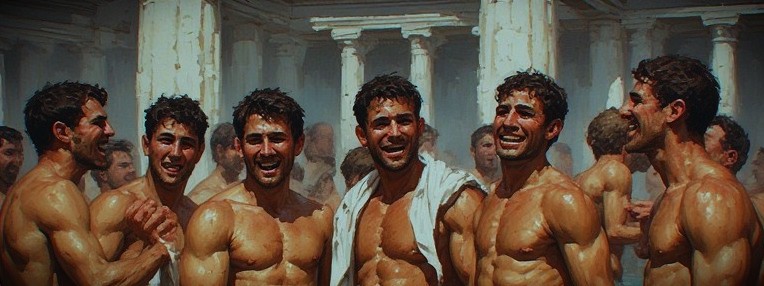
Roman same sex relations were common, but they weren’t understood through modern ideas of sexual identity. What mattered was the role a man played. As Tyner notes, it was “extraordinarily shameful” for a freeborn man to take the passive position, while taking the active role was socially acceptable
Did Roman Men Have Sex With Slaves and Prostitutes?
A reminder of how male slaves lived under constant coercion and were sexually available.
Kyle Tyner’s thesis makes one point absolutely clear: same‑sex relations were common in Rome, but they were never understood through modern ideas of sexual identity. Roman males were often homosocial rather than homosexual
What mattered was role, status, and public masculinity. A freeborn man could take male or female partners, but only in the active, dominant position. Taking the passive role was “extraordinarily shameful,” a threat to honour that could be used for mockery, blackmail, or political attack.
Tyner’s analysis fits neatly with what we know about Rome’s phallocentric and homosocial sexual culture, where dominance defined masculinity and where everyday life made same‑sex contact easy.
Male slaves, household attendants, and cheap male prostitutes were widely available, especially in urban spaces like bathhouses, taverns, and brothels. Male slaves had no legal right to refuse, making them a routine part of Roman sexual access. This wasn’t an identity category, it was a system built on brutality.
Tyner also shows that Greek influence can’t fully explain Roman behaviour. If Greek culture were the sole cause, same‑sex relations would cluster among elites. Instead, evidence appears across all social levels, from emperors to labourers. Literary sources, satire, and graffiti, often invoking Priapus and other ithyphallic gods, reveal a world where sex was framed as penetration, power, and public reputation.
Tyner’s core insight holds: Romans didn’t care who you slept with. They cared how you did it, who you dominated, and whether you preserved the dignity expected of a freeborn man.
Further Reading
Slave Meta Hub A structured gateway into Rome’s systems of ownership, coercion and domestic brutality.
Roman Religion: Meta Hub Explores the rituals, household cults and civic expectations that shaped Roman identity and behaviour.
Rome: Daily Life Meta Hub A survey of ordinary routines, labour, domestic authority and the social pressures that governed everyday life.
The Roman World A wider contextual hub covering politics, culture, geography and the shifting ideals of Romanitas across the empire.
Limentinus is a digital micro‑publication that explores Roman social life through the lenses of power, sexuality, slavery, identity, and everyday behaviour, written with academic responsibility and structured like a digital humanities project.
FAQ
FAQ.1 – Why is Tyner’s work important?
It clarifies misconceptions, provides evidence from multiple social levels, and helps modern readers understand Roman sexuality within its own cultural framework.
FAQ 2 – Why did Romans accept same‑sex relations only in the active role?
Romans judged sex through dominance, not identity. A freeborn man could take male or female partners, including male slaves, cheap male prostitutes, or attendants in the baths, provided he remained the active partner. Penetration was seen as an assertion of masculinity in Rome’s phallocentric culture, reinforced by ithyphallic gods like Priapus. The passive role, however, signalled loss of status and exposed a man to ridicule, blackmail, and political attack.
FAQ 3 – How did slavery and prostitution shape Roman same‑sex behaviour?
Same‑sex relations were common largely because enslaved men were everywhere in Roman households and had no legal right to refuse. Their constant availability, alongside male prostitutes in taverns and bathhouses, made same‑sex contact routine across all social classes. Tyner’s thesis aligns with this: Roman sexuality was structured by power, access, and role, not by categories like “gay” or “straight.”
Same‑sex behaviour in ancient Rome was common, but Romans had no concept of “homosexuality” as a social identity. Romans, shaped by Greek myth and foundation stories like the Aeneid, judged sexual acts by status and social role, not by sexual orientation or ‘sub group’. Same‑sex acts occurred frequently, especially where power imbalances existed, but the idea of a fixed sexual identity was unknown in the ancient world.
Limentinus
Was homosexuality big in Rome?
An adult male prostitute and a shadowy adult customer in the background illustrating how same-sex activity and commerce was visible in urban life.
Same‑sex behaviour in ancient Rome was common, but Romans had no concept of “homosexuality” as a sociological sub group or an identity. The term itself was only coined in the 19th century by the sexologist Richard von Krafft‑Ebing, and it describes a modern category of orientation that simply didn’t exist in antiquity.
Romans, raised on Greek myth, Homeric models, and Roman foundation narratives like the Aeneid, understood sexuality through status, power, and social role, not through personal identity or lifestyle.
Homosocial Rome judged acts, not orientations. A freeborn Roman male could engage in same‑sex behaviour without social stigma as long as he occupied the dominant role and the partner was of lower status, a slave, a freedman, or a youth without political standing.
What mattered was preserving Roman masculinity, which was defined by control, authority, and public dignity. Roman masculinity wasn’t static, it was curated by daily decisions and could be lost easily. There was always the risk of a politically motivated charge of ‘effeminacy‘.
A man was criticised for engaging in same-sex acitivity if he took a passive role, which Romans saw as a loss of status, not evidence of a sexual identity.
Because of this, same‑sex acts appear frequently in Roman literature, satire, and moral commentary. They were treated as part of everyday life inside households, bathhouses, and social networks. Slaves were especially vulnerable: with no legal rights, they could be compelled into whatever sexual role the master demanded. Their involvement reflected Rome’s hierarchy, not any notion of orientation.
So how common was homosexuality? Very common, but not in the way modern categories imply.
Roman sexuality cannot be separated from Roman slavery as an institution, slave ownership, and coercive power. Romans didn’t divide people into “homosexual” or “heterosexual.” They recognised sexual acts, sexual roles, and power relations. Brothels were common and male street prostitutes are well attested.
Same‑sex behaviour was woven into Roman social life, but the idea of a fixed sexual identity as a sub group, the very concept Krafft‑Ebing later named,was unknown to them.
Further Reading
Slave Meta Hub A structured gateway into Rome’s systems of ownership, coercion and domestic brutality.
Roman Religion: Meta Hub Explores the rituals, household cults and civic expectations that shaped Roman identity and behaviour.
Rome: Daily Life Meta Hub A survey of ordinary routines, labour, domestic authority and the social pressures that governed everyday life.
The Roman World A wider contextual hub covering politics, culture, geography and the shifting ideals of Romanitas across the empire.
Limentinus is a digital micro‑publication that explores Roman social life through the lenses of power, sexuality, slavery, identity, and everyday behaviour, written with academic responsibility and structured like a digital humanities project.
FAQ
FAQ 1 – Did Romans think of homosexuality as an identity?
No. Romans had no concept of “homosexuality” as a personal identity. The term itself was only coined in the 19th century by Krafft‑Ebing. Romans judged sexual behaviour by status, power, and role, not by orientation. A freeborn Roman male could engage in same‑sex acts without stigma as long as he maintained the dominant position and the partner was of lower social rank. Roman sexual culture was about hierarchy, not categories.
FAQ 2 – How did domination shape same‑sex behaviour in Rome?
Roman masculinity was defined by control, authority, and public dignity. Same‑sex acts were acceptable only when they reinforced this hierarchy. A freeborn man was criticised only if he took a passive role, which Romans saw as a loss of status. The gender of the partner mattered far less than the power relationship between them. Roman writers repeatedly frame sexual behaviour as an extension of social dominance, not as evidence of a lifestyle or orientation.
FAQ 3 – Were slaves coerced into same‑sex acts in Rome?
Yes, and their involvement reflected power, not consent. Enslaved men and women had no legal rights and could not refuse the demands of the owner and his sons Many were used as prostitutes, made available for sexual purposes because their status placed them entirely under the authority of the owner. Roman literary euphemism treat this as part of everyday domestic life, showing how slavery and sexual access were intertwined within Rome’s broader system of inequality.
This article asks whether Encolpius can be understood as ‘gay’ in modern terms and how the Satyricon portrays Roman sexual roles. It explains who Encolpius is in Petronius’ narrative, highlighting his unstable position within Roman masculinity and the social dangers he faces as a poor, desirable youth. His vulnerability, humiliations, and encounters with powerful men reveal the novel’s themes of identity, status, and the fragile boundary between citizen and commodity in Nero’s Rome
Limentinus
Was Encolpius Gay: How the Satyricon Shows Roman Sexual Roles
Encolpius, the cynical and sharp‑tongued narrator of The Satyricon, introduces himself with the weary confidence of someone used to chaos
What is the Satyricon and who is Encolpius?
The Satyricon is a fragmented Roman novel from the first century CE, usually attributed to Petronius, that blends satire, adventure, and social commentary to expose the excesses and moral instability of Nero’s world.
It follows a trio of drifters through taverns, back rooms, wealthy banquets, and the underside of Roman daily life, revealing a landscape where status, desire, and survival constantly collide.
Encolpius, the narrator, is a young, educated but impoverished wanderer whose sharp observations and frequent humiliations shape the tone of the work. The journey is no more than three messy young men on a chaotic, sex‑fuelled road trip through the Roman Empire.
He’s both a participant in and victim of the chaotic world he describes, an unstable figure whose struggles with desire, power, and identity make him the lens through which the Satyricon explores the fragility of Roman sexuality, masculinity and the social margins of the empire.
Encolpius is one of the most revealing narrators in Roman literature precisely because he’s not what a Roman man was supposed to be. He’s educated but rootless, articulate and powerless, sexually active but repeatedly humiliated.
He lives in a homosocial world although not a world of ‘homosexuality‘ as that term was unknown. Encolpius knows the ideals of romanitas, self‑control, dominance, honour, and the ability to command others, but he moves through a world where the Roman virtues are constantly undermined by poverty, instability, and the company he keeps.
What is Encolpius like as a character?
Petronius constructs him as a man who understands the Roman hierarchy intimately although he can’t quite maintain his place within it. His character becomes transparent when we examine how he navigates the sexual economy of the Satyricon, a world where slave bodies are traded, masculine reputations are fragile, and the line between desire and degradation is thin.
Encolpius’ position within the Roman dominant/submissive model is unstable from the start. Roman masculinity was defined not by whom one desired but by one’s role in the sexual act. The active partner retained honour, while the passive partner risked disgrace. Encolpius knows this, and his narration is full of anxiety about being placed in a passive or dependent position.
Is Encolpius a super hero of ancient Rome?
The threat of Encolpius comes primarily from older, wealthier, socially powerful men who see him not as an equal but as a desirable, vulnerable youth and a potential victim. He frequents brothels and risks being seen as ‘infames’.
His life circumstances make Encolpius vulnerable rather than a super-hero. He’s poor, itinerant, and often dependent on the hospitality of wealthier men. These men don’t always see him as an equal guest, ‘
They see him as a potential object of pleasure. The threat of being sexually dominated, of being treated as a youth rather than a man, hangs over him throughout the narrative. His repeated sexual failures, which Petronius plays for comedy, are also symbolic.
They reveal a man who can’t consistently inhabit the dominant role that Roman culture demanded of him. In the Satyricon, the threat of Encolpius being sexually dominated comes primarily from older, wealthier, socially powerful men who see him not as an equal but as a desirable, vulnerable youth.
Petronius never stages a completed scene of Encolpius being overpowered, but he repeatedly places him in situations where the expectation is unmistakable. The clearest examples come from banquet settings and encounters with wealthy hosts, where hospitality is laced with sexual implication.
At Trimalchio’s dinner, for instance, Encolpius is surrounded by freedmen and patrons who treat him as entertainment rather than a guest, and the atmosphere suggests that a young, attractive wanderer like him could easily be pressured into intimacy if the host wished it.
Elsewhere, Encolpius and Giton are pursued by wealthy male admirers who attempt to “acquire” Giton and, by extension, show interest in Encolpius as well. These men represent the Roman danger zone for someone of Encolpius’ status. They have the money, the power, and the social freedom to take what they want, and Encolpius knows that resisting them could cost him shelter, safety, or even his reputation.
In Roman terms, allowing himself to be sexually dominated by another man, especially a richer one, would risk branding him with infamia, the stain associated with passivity and prostitution. Petronius uses this tension to show how precarious Encolpius’ masculinity is, he’s constantly navigating and negotiating a world where he could be used, and he knows that one wrong step could collapse the fragile Roman identity he’s trying to maintain.
Is Encolpius simply a tease looking for a rich Roman patron to care for him?
Encolpius isn’t written as a calculating seducer angling for a wealthy patron. He’s far too chaotic, insecure, and emotionally reactive for that. although he does move through the Roman world in a way that makes him look like a tempting morsel on the sexual menu for richer men.
He’s young, handsome, poor, unattached, and constantly in need of shelter, food, and protection. In Roman social logic, that combination practically advertises vulnerability. Petronius knows this, and he uses it to create tension. Encolpius isn’t offering himself, but he’s read as someone who could be claimed.
This is why he’s so often treated as a potential dependent or plaything. Wealthy men in the Satyricon are always scanning for beautiful youths, and Encolpius travels with Giton, who is even more desirable. That alone puts them both in the crosshairs of men who assume that anyone this pretty and this poor must be available for the right price.
Encolpius doesn’t tease, he simply exists in a body and a social position that Rome sexualised by default.
What about Encolpius and the seedy sex life of ancient Rome?
Although Encolpius doesn’t explicitly buy prostitutes, he moves through the sexual underworld of the Roman Empire with familiarity. His encounter with Quartilla is the clearest example. Quartilla’s attendants behave like ritualised sex workers, and the entire episode unfolds in a space where consent is blurred and sexual access is demanded rather than requested.
Encolpius doesn’t hand over coins, but he’s drawn into a situation where his body is expected to perform, and the dynamic resembles the world of prostitution more than that of romance. He also frequents taverns and inns, places where informal prostitution was common.
The women he encounters there aren’t named as prostitutes, but Roman readers would have recognised the setting. Dim rooms, cheap wine, and women whose company was part of the establishment’s business model. Encolpius benefits from this system even if he doesn’t explicitly pay for it.
What does engagement with prostitutes tell is about Encolpius?
His use of men and women reveals even more about his character. With women, he often seeks pleasure or escape, but with men, the dynamic is more fraught. Giton is the clearest example. Encolpius treats him as a lover, a companion, and at times a possession. He hides Giton, displays him, negotiates over him, behaviour that mirrors how slaves or prostituted youths were handled in Roman society.
Encolpius’ desire for Giton is genuine, but it’s also shaped by the social logic that a beautiful youth is a form of currency. His jealousy over Giton isn’t only emotional, it’s social. Losing Giton means losing status, losing a symbol of desirability, and losing a kind of power that he can’t obtain through wealth or lineage.
Encolpius is also used by men, even if he never fully submits. Wealthier men pursue him, offer him hospitality with expectations attached, or treat him as part of the entertainment. These moments are dangerous for a freeborn Roman. To be sexually dominated by another man, especially for material benefit, risked being labelled cinaedus, a term associated with passivity and disgrace.
Encolpius never explicitly crosses that line, but the risk is part of his character’s tension. His reputation is fragile because he moves in circles where the boundaries between guest, dependent, and sexual object blur. Petronius uses this ambiguity to satirise Roman anxieties about status and masculinity.
Does Encolpius have sex with anyone?
Encolpius is often on the run, hiding, evading and looking for somewhere to sleep. He’s a free man but staying one hop away from being enslaved and treated in that role by men
Although The Satyricon uses Roman euphemism and avoids explicit description, it leaves no doubt that Encolpius is sexually active and involved in multiple relationships. Petronius uses suggestion, innuendo, and comic framing to indicate encounters with both men and women, especially in Encolpius’s complicated ties to Giton and his misadventures with figures like Quartilla and Circe.
These scenes are deliberately indirect, but they clearly establish him as a participant in the erotic world the novel satirises. His episodes of impotence are part of the work’s humour and self‑mockery, not a denial of his sexuality, if anything, they highlight that he’s a fully realised character whose desires, frustrations, and failures are all woven into the narrative’s chaotic energy.
Where is the Romanitas of Encolpius?
Encolpius’ romanitas is compromised and always being negotiated. He isn’t stripped of it entirely, he’s educated, articulate, and capable of moral reflection, but he’s constantly pulled toward the margins of Roman respectability. His proximity to the infames, prostitutes, performers, freedmen, and the sexually exploited, stains him by association.
Romanitas required stability, honour, and the ability to command others. Encolpius has none of these. He’s a man who knows what he should be but can’t maintain it. His humiliations, his poverty, and his entanglements with the sexual underclass reveal a man whose identity is frayed by the world he inhabits.
How and why Petronius uses sexual chaos as satire
Petronius uses sexual chaos in the Satyricon as a deliberate satirical weapon, exposing the moral confusion, social instability, and hypocrisy of Nero’s Rome. He does this, not through abstract moralising, but through specific scenes where desire collapses into disorder, where characters lose control of their bodies, and where the Roman hierarchy of dominance and self‑mastery is turned upside down.
The sexual world of the Satyricon isn’t erotic, it’s chaotic, humiliating, and absurd, and Petronius uses that chaos to mock a society that pretends to value discipline while drowning in excess.
Ritualised sexual performances for Encolpius and Giton
One of the clearest examples is the Quartilla episode, where Encolpius and Giton are forced into a ritualised sexual performance by a priestess of Priapus. The scene isn’t about pleasure, it’s about loss of control. Quartilla’s attendants behave like ritual sex workers, and the entire encounter becomes a parody of Roman religious seriousness. Petronius uses this forced, theatrical sexuality to satirise both religious cults and the Roman elite’s obsession with spectacle.
The chaos, people fainting, laughing, crying, collapsing, turns what should be sacred into farce, revealing a culture where even religion has become a stage for appetite.
Another example is Encolpius’ repeated sexual impotence, especially in his encounters with Circe. Roman masculinity depended on dominance and performance, although Encolpius fails at the very moment he tries to assert himself. His body betrays him, and Petronius turns this into comedy.
The satire is sharper than the joke, Encolpius’ impotence mirrors the impotence of Roman moral authority. A society that claims to be disciplined can’t even control its own desires. Petronius uses Encolpius’ humiliation to mock the Roman ideal of the self‑mastered man, suggesting that beneath the toga lies a body ruled by chaos.
The sexual chaos of the Cena trimalchio
Even the famous Trimalchio’s dinner is saturated with sexual disorder. Freedmen brag about their affairs, guests grope servants, and Trimalchio himself flaunts his boy‑lover in front of everyone. The banquet becomes a parody of elite Roman dining, where luxury and lust overwhelm decorum.
Petronius uses this sexual excess to satirise social climbing and the vulgarity of the nouveau riche. The chaos at the table reflects the chaos of Roman social mobility, where freedmen imitate aristocrats but only succeed in exposing the emptiness of aristocratic values.
In every case, Petronius uses sexual disorder not to shock but to reveal. The chaos exposes the fragility of Roman masculinity, the hypocrisy of Roman morality, and the instability of Roman social order. By showing characters who can’t control their desires,
Petronius mocks a society that claims to be governed by reason and discipline. Sexual chaos becomes a mirror held up to Rome, reflecting a culture where appetite rules, boundaries dissolve, and the old virtues have collapsed into farce.
What is the status of prostitutes in the Satyricon?
The scenes in the Satyricon are often erotic but not sexual, they reinforce the chaotic nature of the book and the role of Encolpius who stumbles and runs around the dangerous world that threatens his masculinity.
The prostitutes in the Satyricon, male and female, aren’t admired. They’re necessary, accessible, and woven into the fabric of Roman life, but they’re marked by infamia, a legal and social stain that stripped them of honour. They exist in the shadows, taverns, back rooms, bathhouses, and private houses where the wealthy could indulge their desires without consequence. They’re desired and despised in equal measure. From the way Encolpius interacts with them, we learn that prostitutes were economically essential yet socially marginal, tolerated but never respected.
Male prostitutes can be extrapolated from this portrayal. The Satyricon rarely names them directly, but the text allows us to infer their position. Like female prostitutes, male sex workers would have been young, often slaves or impoverished, valued for beauty, and available in taverns, baths, and private houses.
They were legally infames, vulnerable to exploitation, and treated as commodities. Giton’s treatment mirrors this world. He isn’t sold, but he’s handled as though he could be, and the men who desire him behave like clients seeking a prized youth. Encolpius’ jealousy reveals that he understands this economy intimately, he knows that a beautiful boy can be taken, bought, or kept.
How does this end for Encolpius?
In the end, Encolpius is wholly ambiguous and a man caught between Roman ideals and Roman realities. He knows the dominant/submissive paradigml but can’t consistently inhabit the dominant role. He uses others and is used in turn. He moves through spaces where prostitution, formal or informal, shapes every interaction.
Encolpius isn’t the semi-divine Odysseus returning home, nor Aeneas founding a city in a foundation myth, nor even a tragic hero, like Nisus, and granted the dignity of a noble fall. He’s something far more precarious, a man drifting through a world where identity is unstable and honour is always at risk.
He hasn’t lost his manhood to another man, and in Roman terms this allows him to cling to the faint, brittle veneer of respectability that separates a freeborn wanderer from the infames who haunt the taverns, brothels, and back rooms he passes through. The suspicion remains , and Petronius cultivates it carefully, that Encolpius could one day slip across that boundary and end up in the passive role with a man.
Encolpius moves in the orbit of wealthier, more powerful men who might easily reduce him to a dependent, a kept youth, a decorative body in a rich man’s household. His survival so far is a matter of luck rather than judgement, and the fragmentary ending leaves him suspended at the very moment when his identity feels most fragile.
He isn’t a gladiator, despite what some modern readers assert, he isn’t a man of the arena, not a figure of brute force or public spectacle. Instead, he’s a hapless victim of circumstance, a man whose battles are fought in cramped lodgings, crowded banquets, and the shifting terrain of desire and humiliation.
His story ends not with triumph or catastrophe but with the uneasy sense that he may yet become the sort of plaything Rome devours, a reminder that in Petronius’ world, the line between citizen and commodity is perilously thin, and Encolpius stands forever on its edge.
Further Reading
Beck, Roger. “Encolpius at the ‘Cena.’” Phoenix, vol. 29, no. 3, 1975, pp. 271–83. JSTOR, https://doi.org/10.2307/1087620. Accessed 19 Apr. 2026.
The Project Gutenberg eBook of The Satyricon – Complete
Beck, Roger. “The Satyricon: Satire, Narrator, and Antecedents.” Museum Helveticum, vol. 39, no. 2, 1982, pp. 206–14. JSTOR, http://www.jstor.org/stable/24816262. Accessed 21 Apr. 2026.
Slave Meta Hub A structured gateway into Rome’s systems of ownership, coercion and domestic hierarchy.
Roman Religion: Meta Hub Explores the rituals, household cults and civic expectations that shaped Roman identity and behaviour.
Rome: Daily Life Meta Hub A survey of ordinary routines, labour, domestic authority and the social pressures that governed everyday life.
The Roman World A wider contextual hub covering politics, culture, geography and the shifting ideals of Romanitas across the empire.
Limentinus is a digital micro‑publication that explores Roman social life through the lenses of power, sexuality, slavery, identity, and everyday behaviour, written with academic responsibility and structured like a digital humanities project.
FAQ
FAQ 1: Does The Satyricon depict sexual relationships?
Yes. Although Petronius avoids explicit description, the narrative frequently alludes to sexual encounters through implication, innuendo, and comic framing. Scenes involving Quartilla, Giton, Circe, and others make it clear that erotic activity is part of the story’s fabric, even if the details are left to the reader’s imagination.
FAQ 2: Is Encolpius portrayed as sexually active?
Absolutely. Encolpius is shown to have relationships with both men and women, though the text presents these encounters obliquely. His emotional entanglement with Giton, his rivalry with Ascyltos, and his misadventures with women all establish him as a character with real desires, attachments, and vulnerabilities.
FAQ 3: How should we understand Encolpius’s impotence episodes?
His impotence is a running joke rather than a defining flaw. Petronius uses it as a satirical device, mocking Encolpius’s pride, exposing his insecurity, and adding comic tension to the plot. Far from undermining his masculinity, these episodes highlight him as a fully human figure whose sexuality includes both successes and failures
Same‑sex behaviour in ancient Rome was common, but Romans had no concept of “homosexuality” as an identity. The term itself was only coined in the 19th century by Krafft‑Ebing. Romans, shaped by Greek myth and foundation stories like the Aeneid, judged sexual acts by status and social role, not orientation. Same‑sex acts occurred frequently, especially where power imbalances existed, but the idea of a fixed sexual identity was unknown in the ancient world.
Limentinus
How common was homosexuality in ancient Rome?
Marble portrait bust of a man Roman ca. 110–120 CE. This man’s resolute expression and the simple yet studied arrangement of locks at his forehead bring to mind official portraits of the emperor Trajan (r. A.D. 98–117). Object Number: 10.231.2 The Metropolitan Museum of Art.
Same‑sex behaviour in ancient Rome was common, but Romans had no concept of “homosexuality” as a sociological sub group or an identity. The term itself was only coined in the 19th century by the sexologist Richard von Krafft‑Ebing, and it describes a modern category of orientation that simply didn’t exist in antiquity.
Romans, raised on Greek myth, Homeric models, and Roman foundation narratives like the Aeneid, understood sexuality through status, power, and social role, not through personal identity or lifestyle.
Roman sexual culture judged acts, not orientations. A freeborn Roman male could engage in same‑sex behaviour without social stigma as long as he occupied the dominant role and the partner was of lower status, or a slave, a freedman, or a youth without political standing. What mattered was preserving Roman masculinity and being a “proper” man, which was defined by control, authority, and public dignity.
A man was criticised only if he took a passive role, which Romans saw as a loss of status, not evidence of a sexual identity.
Because of this, same‑sex acts appear frequently in Roman literature, satire, and moral commentary. They were treated as part of everyday life inside households, bathhouses, and social networks. Slaves were especially vulnerable to their owners: with no legal rights, they could be compelled into fulfilling whatever sexual role the master demanded. Their involvement reflected Rome’s hierarchy, not any notion of orientation.
So how common was homosexuality? Very common, but not in the way modern categories imply.
Limentinus is a digital micro‑publication that explores Roman social life through the lenses of power, sexuality, slavery, identity, and everyday behaviour, written with academic responsibility and structured like a digital humanities project.
FAQ
FAQ 1 – Did Romans think of homosexuality as an identity?
No. Romans had no concept of “homosexuality” as a personal identity. The term itself was only coined in the 19th century by Krafft‑Ebing. Romans judged sexual behaviour by status, power, and role, not by orientation. A freeborn Roman male could engage in same‑sex acts without stigma as long as he maintained the dominant position and the partner was of lower social rank. Roman sexual culture was about hierarchy, not categories.
FAQ 2 – How did domination shape same‑sex behaviour in Rome?
Roman masculinity was defined by control, authority, and public dignity. Same‑sex acts were acceptable only when they reinforced this hierarchy. A freeborn man was criticised only if he took a passive role, which Romans saw as a loss of status. The gender of the partner mattered far less than the power relationship between them. Roman writers repeatedly frame sexual behaviour as an extension of social dominance, not as evidence of a lifestyle or orientation.
FAQ 3 – Were enslaved people involved in same‑sex acts in Rome?
Yes, and their involvement reflected power, not consent. Enslaved men and women had no legal rights and could not refuse the demands of the owner and his sons Many were used as prostitutes, made available for sexual purposes because their status placed them entirely under the authority of the owner. Roman literary euphemism treat this as part of everyday domestic life, showing how slavery and sexual access were intertwined within Rome’s broader system of inequality.
This article explains homosocial life in ancient Rome, where social and political worlds were centred on relationships between men. It clarifies that homosocial does not mean homosexual and does not imply modern sexual identity. Roman men lived, worked, bathed and exercised among other men, and public life and domestic authority were male domains. The article shows how this male‑centred structure shaped marriage, informal relationships, leisure spaces like the baths and the dynamics of slave ownership, including status‑based sexual access to male slaves. It defines homosocial in its historical context and describes how it influenced Roman masculinity and daily life..
Limentinus
What Does Homosocial Life Mean in Ancient Rome?
Marble portrait bust of a man Roman ca. 110–120 CE. This man’s resolute expression and the simple yet studied arrangement of locks at his forehead bring to mind official portraits of the emperor Trajan (r. A.D. 98–117). Part of The Metropolitan Museum of Art’s open Access policy, Object Number: 10.231.2
This article defines homosocial life in ancient Rome and explains how Roman society was organised around relationships between men. It clarifies that homosocial does not mean homosexual and does not imply modern sexual identity.
The article describes how Roman men lived, worked, served, bathed and exercised among other men, and how public life and domestic authority were male domains. It shows how this male‑centred structure shaped marriage, informal relationships, leisure spaces like the baths and the dynamics of slave ownership, including sexual access to female and male slaves. The purpose is to explain homosociality in its historical context and how it influenced Roman masculinity and daily life.
Power moved through male networks and reputation was judged by male eyes. Roman men didn’t experience a ‘static’ masculinity, instead their experience of masculinity needed to be curated and constantly performed for other men. It’s fair to say there was an occasional sexual confusion. Status shaped every interaction and their social position depended on maintaining a traditional image and avoiding the ‘passive role‘ during sex.
Roman marriage sat inside this homosocial world rather than outside it. Marriage was a civic duty and a household alliance, not a private emotional refuge.
A man’s honour depended more on how he behaved among other men than on what happened inside his marriage. His wife belonged to the domestic sphere, but his social identity was built in male spaces such as the forum, the army and the baths. Polyamorous arrangements, tolerated affairs and informal relationships were shaped by status and control rather than modern ideas of equality or desire.
Public baths and private balnea were one of the clearest homosocial environments. Men washed, exercised and relaxed together. Bodies were visible and judged. Slaves worked in close proximity, heating water, carrying towels and tending fires. Their presence reinforced hierarchy. They were part of the scenery of male leisure and male power. The baths made homosocial life physical and immediate.
Slave ownership intensified homosocial dynamics. A male slave lived within arm’s reach of his master and his body was available by default. Sex with male slaves was not framed as identity. It was framed as status. The master acted, the slave endured.
This created a homonormative pattern in practice, even though Rome had no concept of sexual orientation. Male intimacy, dominance and vulnerability all existed inside a system that recognised acts rather than identities.
Homosocial life shaped Roman masculinity, domestic authority and the emotional world of slaves. It was the structure behind the gaze.
Further Reading
Slave Meta Hub A structured gateway into Rome’s systems of ownership, coercion and domestic brutality.
Roman Religion: Meta Hub Explores the rituals, household cults and civic expectations that shaped Roman identity and behaviour.
Rome: Daily Life Meta Hub A survey of ordinary routines, labour, domestic authority and the social pressures that governed everyday life.
The Roman World A wider contextual hub covering politics, culture, geography and the shifting ideals of Romanitas across the empire.
Limentinus is a digital micro‑publication that explores Roman social life through the lenses of power, sexuality, slavery, identity, and everyday behaviour, written with academic responsibility and structured like a digital humanities project.
FAQ
FAQ 1 What does homosocial mean in ancient Rome?
Homosocial refers to social worlds centred on relationships between men. It does not mean homosexual. In Rome it described the everyday reality that men lived, worked, bathed and exercised among other men, and that public life and domestic authority were male domains.
FAQ 2 – Why were the baths and slave ownership key homosocial spaces?
The baths were intensely male environments where bodies were visible, judged and ranked. Slave ownership reinforced hierarchy. Male slaves lived within arm’s reach of their masters and their bodies were available by default. Sexual access was framed as status, not identity, creating a homonormative pattern in practice.
FAQ 3 – How did homosocial life shape Roman marriage and relationships?
Marriage sat inside a male‑centred social world. A man’s honour depended on how he behaved among other men, not on private emotional life. Polyamorous arrangements and tolerated affairs were shaped by status and control rather than modern ideas of desire or equality.
Romans captured slaves through war, kidnapping, piracy and the trafficking of the poor and vulnerable. War captives supplied huge numbers, while abduction and Mediterranean piracy seized travellers and farmers. The poor could be sold or trafficked, as shown by Encolpius’ fear of being kidnapped in the Satyricon. Children born to enslaved women (vernae) were automatically slaves. These streams fed a massive slave economy in which enslaved people had no rights and lived under the total authority of owners, including complete sexual vulnerability within the household.
Limentinus
How did Romans capture slaves?
A male slave on sale in an auction in Rome, standing there for all to see and without privacy
Rome built the biggest slave economy in the Mediterranean, and it fed that system by capturing people wherever and however it could. Slavery wasn’t a side‑effect of Roman power, it was the major engine of the Roman economy.
The largest source was war. Defeated peoples were taken wholesale: entire towns emptied, prisoners marched in chains, families split on the spot. A Roman victory meant thousands of new slaves flooding the markets. Captives from Greece, Gaul, Britain, Judea, Dacia, anyone Rome conquered became potential property.
War was only one pipeline. Rome also relied on kidnap and piracy, especially in the eastern Mediterranean. Pirates seized travellers, farmers, merchants, even children, selling them into Roman ports where dealers bought them in bulk.
Abduction happened inside Italy too: people snatched on country roads or in city alleys, especially the poor and the unprotected. Petronius’ Satyricon shows how real this fear was, Encolpius worries he could be kidnapped and sold if he strays too far from safety. Petronius shows the real links of slavery and forced prostitution.
A third stream was trafficking the vulnerable. Poverty pushed people into debt‑slavery, parents sold children, and criminals were condemned into servitude. Some slaves were moved quietly in small private batches, not through markets: women taken “to order,” men sold directly into brothels, individuals traded between households like livestock.
Rome also reproduced slavery internally. Children born to enslaved women, the vernae, inherited their mother’s status automatically. A slave’s pregnancy created new property, new labour, new profit. No rights, no protection, no family security.
All of this fed a massive system. Rome was the largest slave‑owning society in the Mediterranean, and slavery was a major part of its economy. Every slave lived under the absolute authority of an owner who operated in a private world where his rule was law and domestic brutality was usual. That meant total vulnerability: labour, punishment, sexual access, and reproductive control were all at the master’s discretion.
Rome captured slaves through conquest, kidnapping, piracy, trafficking and birth, whatever kept the system supplied.
IMP CAE MAGNENTIVS AVG. His left foot rests on a captive on the ground
Further Reading
Slave Meta Hub A structured gateway into Rome’s systems of ownership, coercion and domestic brutality.
Roman Religion: Meta Hub Explores the rituals, household cults and civic expectations that shaped Roman identity and behaviour.
Rome: Daily Life Meta Hub A survey of ordinary routines, labour, domestic authority and the social pressures that governed everyday life.
The Roman World A wider contextual hub covering politics, culture, geography and the shifting ideals of Romanitas across the empire.
Limentinus is a digital micro‑publication that explores Roman social life through the lenses of power, sexuality, slavery, identity, and everyday behaviour, written with academic responsibility and structured like a digital humanities project.
FAQ
FAQ 1 – How did Romans capture slaves?
Romans captured slaves through war, kidnapping, piracy and the trafficking of the poor and vulnerable. War produced huge numbers of captives, while abduction and Mediterranean piracy seized travellers, farmers and even children. The Satyricon shows how real this danger was, Encolpius fears he could be kidnapped and sold. Children born to enslaved women (vernae) were automatically slaves, feeding Rome’s massive slave economy.
FAQ 2 – Could Roman slaves be sold into brothels?
Yes. Enslaved people had no rights and could be sold wherever their owner wished, including brothels. Some were trafficked privately in small batches, taken “to order” for sexual labour. Women were especially vulnerable: their bodies were legally accessible to the master and male members of his household, and sale into sexual work was treated as a normal commercial transaction.
FAQ 3 – Why were enslaved people so vulnerable in ancient Rome?
Rome was the largest slave‑owning society in the Mediterranean, and slavery was a major part of its economy. An enslaved person lived entirely under the authority of an owner who operated in a private world where his rule was law. With no legal rights, slaves were exposed to forced labour, punishment, sale, and sexual access within the household. Their vulnerability was built into the system, not an exception to it.
Romans didn’t treat their slaves well. Treatment varied, but every enslaved person lived without rights and entirely under their master’s control. Some household slaves were managed carefully, while others faced exhausting labour, violence, sexual exploitation or sale into brothels. Rome was the largest slave economy in the Mediterranean, fed by war, piracy and abduction, and the wellbeing of slaves mattered only when it protected an owner’s investment.
Limentinus
Did Romans treat their slaves well?
The welfare of slaves always depended on their owner and their wishes
This article is an explanation of how Romans treated their slaves, examining law, daily life, and violence.
In ancient Rome, the treatment of slaves depended entirely on who the slaves were, where they came from, and what their owners wanted from them.
Rome was the largest slave economy in the Mediterranean, and it fed that system by enslaving anyone it could: defeated enemies in war, people seized in piracy, travellers abducted on country roads, the poor taken from city streets, and vulnerable individuals trafficked quietly through private networks.
Some were sold in huge slave markets and prices varied; others were moved in small, secret batches, including women and men pushed into prostitution and imprisoned in brothels or taken “to order.”
Once enslaved, their treatment varied wildly. A household slave might live under constant surveillance as in the Satyricon, as witnessed by Encolpius as the main character, but avoid the brutal labour of the fields. A farm slave could face exhausting work, chains, or punishment. A skilled slave might be valued for profit but still owned completely.
Women were doubly vulnerable, used for labour, reproduction, and sexual access. Men could be brutally beaten, branded, or forced into dangerous work. Every slave lived under the same legal reality: they had no rights, no protection, and no control over their own bodies or futures.
Some masters treated their slaves with a degree of care especially if the purchase price was high, but this was never kindness in the modern sense, it was management. A slave’s wellbeing mattered only when it protected the owner’s investment.
Rome didn’t build a system that allowed good treatment; it built a system that allowed anything.
Further Reading
Slave Meta Hub A structured gateway into Rome’s systems of ownership, coercion and domestic brutality.
Roman Religion: Meta Hub Explores the rituals, household cults and civic expectations that shaped Roman identity and behaviour.
Rome: Daily Life Meta Hub A survey of ordinary routines, labour, domestic authority and the social pressures that governed everyday life.
The Roman World A wider contextual hub covering politics, culture, geography and the shifting ideals of Romanitas across the empire.
Limentinus is a digital micro‑publication that explores Roman social life through the lenses of power, sexuality, slavery, identity, and everyday behaviour, written with academic responsibility and structured like a digital humanities project.
FAQ
FAQ 1 Did Romans treat their slaves well?
No. Roman slaves had no legal rights and lived entirely under their master’s control. Treatment ranged from strict management to violence, exploitation and sale. Any “good” treatment existed only when it protected the owner’s investment, not the slave’s wellbeing.
FAQ 2 – Why did treatment vary so much in ancient Rome?
Treatment depended on the slave’s role, origin and value. Household slaves might avoid heavy labour but faced constant surveillance. Farm and mine slaves endured brutal work and harsh punishment. Women were doubly vulnerable, used for labour, reproduction and sexual access. Men could be beaten, branded or forced into dangerous tasks.
FAQ 3 – Where did Roman slaves come from, and did this affect how they were treated?
Rome enslaved anyone it could: war captives, victims of piracy, people abducted on roads, the urban poor, and individuals trafficked privately. Large groups were sold in markets; smaller numbers were moved quietly, including men and women pushed into brothels or taken “to order.” Origin rarely protected them, once enslaved, their treatment depended entirely on the master’s wishes.
This article examines issues for pregnant slaves and reproductive control in ancient Rome, answering the question of how enslaved women were treated when their bodies became sites of labour, profit and domination. It explains how Roman law turned pregnancy into property, how masters controlled reproduction for economic gain, and how enslaved mothers and their children were denied rights from birth. This piece is part of a wider series on ancient Rome, exploring the practices, ideas and people that shaped Roman civilisation.
Limentinus
What Happened to Pregnant Slaves in Ancient Rome
A pregnant slave, her posture tense, as her legal owner watches from the background
In ancient Rome, pregnancy didn’t shield an enslaved woman, it bound her even tighter to the household that owned her. Roman law turned her womb into property: any child she carried was automatically a slave, regardless of the father. Her body wasn’t just controlled; it was instrumentalised.
Female slaves were bought not only for labour but for reproduction. Their pregnancies were investments. Masters forced them to keep working, sparing them only when a “healthy” birth meant a more valuable infant. Protection was never about the mother, only the profit she carried.
Sexual exploitation didn’t stop during pregnancy. Roman law offered enslaved women no defence, and their bodies remained subject to the desires and demands of the household. I
f the master fathered the child, the baby became a verna, a home‑born slave, sometimes granted a small peculium, a personal allowance that might one day buy freedom. Some women were manumitted after childbirth, even married by their former owners, but these were exceptions that proved the rule: their status was always conditional, always revocable.
When the child was born, the mother had no rights. The baby could be kept, sold, or abandoned. Families were broken before they ever existed. Pregnancy wasn’t hope, it was captivity multiplied.
Rome perfected reproductive control. For enslaved women, motherhood was never liberation.
FAQ 1 – What happened when a slave woman became pregnant in ancient Rome?
Pregnancy did not protect an enslaved woman; it intensified her captivity. Roman law made her womb a legal asset, and any child she carried was automatically a slave. Masters controlled her labour, her body and the fate of her newborn, treating pregnancy as part of the household’s property.
FAQ 2 – Did Roman masters exploit pregnant slaves sexually?
Yes. Pregnancy offered no legal protection. Enslaved women remained vulnerable to sexual use by the household, including the master himself. If he fathered the child, the baby became a verna, a home‑born slave, sometimes given a small peculium or later manumitted, but still born into slavery.
FAQ 3 – What happened to the children of pregnant slaves?
Slave‑born children inherited their mother’s status at birth. They could be kept, sold, or abandoned depending on the master’s wishes. Mothers had no legal claim over their babies, and families were routinely broken apart as part of Rome’s system of reproductive control.
Limentinus is a digital micro‑publication that explores Roman social life through the lenses of power, sexuality, slavery, identity, and everyday behaviour, written with academic responsibility and structured like a digital humanities project.
Further Reading
Slave Meta Hub A structured gateway into Rome’s systems of ownership, coercion and domestic brutality.
Roman Religion: Meta Hub Explores the rituals, household cults and civic expectations that shaped Roman identity and behaviour.
Rome: Daily Life Meta Hub A survey of ordinary routines, labour, domestic authority and the social pressures that governed everyday life.
The Roman World A wider contextual hub covering politics, culture, geography and the shifting ideals of Romanitas across the empire.
This article examines how adult male–male relationships operated within the social and legal structures of Imperial Rome, separating modern ideas of sexual identity from the status‑driven sexual hierarchy of antiquity. Focusing on language, power, and domestic life, it explores how Roman men expressed desire, enforced dominance, and negotiated honour in a world that recognised sexual acts but not identities. Through surviving literature and evidence from the Roman household, it highlights how male slaves lived under the master’s gaze, revealing the everyday violence, coercion, and intimate brutality that shaped male slavery and power inside the Roman home.
Limentinus
What Did Roman Masters Do to Their Male Slaves at Home
Marble portrait bust of a man Roman ca. 110–120 CE. This man’s resolute expression and the simple yet studied arrangement of locks at his forehead bring to mind official portraits of the emperor Trajan (r. A.D. 98–117). Part of The Metropolitan Museum of Art’s open Access policy, Object Number: 10.231.2
“All this time the poor slaves may not move their lips, even to speak. The slightest murmur is repressed by the rod; even a chance sound,a cough, a sneeze, or a hiccup, is visited with the lash. There is a grievous penalty for the slightest breach of silence. All night long they must stand about, hungry and dumb “Moral letters to Luciliusby Seneca, translated by Richard Mott Gummere
This article provides a historical and academic examination of male slavery, domestic authority, and homosocial power structures in Imperial Rome. It discusses violence, coercion, and sexual vulnerability strictly in a scholarly context, drawing on primary sources to explain how Roman households operated. No part of this article endorses or promotes harmful behaviour. All descriptions and images are presented for educational and historical analysis only.
Roman slavery began with the body. Before a man lost his freedom or his legal standing, he lost control over the physical self that anchored his identity. The Satyricon as a central piece of Latin literature is full of the imagery of slavery and how the lead, character, Encolpius come close to being enslaved.
Although we have the Satyricon in parts, Roman writers rarely described this liminal boundary between one world or one way of being and another. They preferred silence, and Roman euphemism, a sort of moral abstraction. The structure of Roman slavery reveals the truth. A man’s body became the first thing taken and transformed, the first thing judged, and reshaped by the household that owned him.
The Roman world was intensely homosocial.in terms of culture Men lived among men, served in the army together, worked among men, and were judged by men. Masculinity wasn’t a private matter. It was a public performance shaped by reputation, posture, the traditional Roman virtues, and the way a man carried himself. In all of this cultural clutter there was space for confusion and ambiguity for the Roman man.
A slave entered this private world stripped of the ability to choose how he appeared. His body became a surface that others read and curated. The slaves dignity depended on the interpretations of men who held power over him.
Seneca saw this clearly. In Letter 47, he calls the abuse of slaves “degrading” and urges masters to recognise their shared humanity. His plea reveals how normalised bodily domination of slaves had become, and how deeply it shaped the slaves sense of self.
Public Exposure and the Auction Block
The Roman slave auction made bodily loss a public event. A man stood on a platform and often that was stripped and naked while buyers inspected his physique, his teeth, his scars, and his posture. His value lay in his body, not his story or his thoughts unless he was a grammarian. The moment of sale marked the beginning of a new identity, a liminal moment of transition. A man became a commodity, priced according to skill, geography, and physical condition.
This moment of public exposure wasn’t simply economic. It was social. A man was judged by other men, ranked by them, and purchased by them. The homosocial nature of the auction reinforced the idea that a slave’s body belonged to the male world of Roman power.
Juvenal’s bitter remark in Satire 9 that “the tongue is the vile slave’s vilest part” shows how easily a man could be reduced to a single trait, a single flaw, a single perceived weakness. The auction made such reduction public and permanent. The man became the slave, a ‘res’ or a thing.
Life Inside the Household Cage
Once inside the private household of his owner, the slave made another transition and entered a more enclised homosocial environment where male authority was focused, constant and unchallenged. The master’s body stood at the top of the hierarchy. Power flowed through his flesh. The emperor’s body was treated as divine and the bodies beneath him were treated as expendable and slaves even more so. This hierarchy echoed down into ordinary homes. The master’s body was protected. The slave’s body was available and used.
Domestic servitude created a world of proximity. A man lived within arm’s reach of his master. His movements were watched and his posture was judged. The slaves presence was interpreted. This closeness shaped how he saw himself. His identity narrowed to the space allowed by the master’s gaze. In response the owner became wary of the slave, anxious of them and always aware of the risks presented by slaves
Violence reinforced this loss of slave autonomy. Punishment though stripping and beating as witnessed in the Satyricon through the eyes of Encolpius was woven into daily life. A slave learned that his body was always vulnerable. Fear became part of his identity.
Silence, Euphemism, and the Erasure of Experience
“Another, who serves the wine, must dress like a woman and wrestle with his advancing years; he cannot get away from his boyhood; he is dragged back to it; and though he has already acquired a soldier’s figure, he is kept beardless by having his hair smoothed away or plucked out by the roots, and he must remain awake throughout the night, dividing his time between his master’s drunkenness and his lust; in the chamber he must be a man, at the feast a boy”.Moral letters to Luciliusby Seneca, translated by Richard Mott Gummere
Roman writers often hid the realities of the bodily vulnerability behind jokes,moralising and euphemism, although Seneca does capture many of the issues.
Roman literary silence became a tool of control, and by refusing to describe what happened to slaves, elite authors preserved their own dignity while erasing the experiences of slaves. Seneca is safe in writing to Lucillus because he risks nothing and is virtue signalling without risking anything. Even Seneca wasn’t calling for an end to slavery, just a softer form of coercion.
Masculinity, Comparison, and the Homosocial Gaze
Masculinity was a currency. Roman men used the body to express dominance, humour, and social standing. A slave lived inside this world without the ability to shape his own role within it.
Punishment reinforced the slave’s loss of bodily autonomy as we find within the Satyricon. Trimalchio’s villa is awash with examples whereby the slave is robbed of his dignity. The removal of clothing erased dignity and was probably fairly standard. The body became a site of discipline as well as a constant pantomime. We know the Roman’s loved to enact mythological scenes and we may reasonably assume that slaves were often dressed in costumes and livery that referenced Roman and Greek religious figures
Even in quieter settings, the slave’s body remained exposed. Domestic bathing spaces created intimate environments where slaves worked within arm’s reach of their masters. Heat, scent, and steam intensified the sense of exposure and vulnerability. For the slave, this closeness wasn’t leisure. It was labour performed under observation.
Pliny offers a rare glimpse of emotional complexity. In Letter 8.16, he mourns the death of his slaves and notes that he allowed slaves to make wills. His grief reveals how fragile the slave’s life was, and how easily it could be lost. Pliny is rare in offering some degree of personahood although we note it’s in the gift of Pliny and not a right of the slave
The Slave’s First Loss of Self
The element of the striking and bizarre in the action is amply present in the sheer choice of sexual combinations: a eunuch attempting sexual assault on a man (23-24),15 an attempted seduction of a young man by a girl ending in impotence (126 ff.), a love triangle involving male homosexuals (9-11 and elsewhere), a courtesan sampling a young boy, and then arranging a ‘Union between the boy and a pre-pubertal girl (24-26), and so on. The Sexual Episodes in the Satyricon Christopher GillClassical Philology Vol. 68, No. 3 (Jul., 1973), pp. 172-185
Roman sexuality in the Satyricon may be exaggerated for effect, but even its satire points to the wide range of sexual behaviours that existed in the ancient world. Within this environment, identity was never his own to shape. Every force that defined him, labour, movement, punishment, and desire, came from outside. He lived in a world where his body was available by default, where male authority pressed upon him at every moment, and where literary silence politely avoided naming the sexual vulnerability that structured his daily life.
For the slave, the self narrowed to whatever tasks he was ordered to perform, the rooms he was permitted to enter, and the meanings imposed upon him by those who owned him. In a homosocial society that prized control, reputation, and bodily dominance, the slave learned to see himself through the eyes of his master: as someone whose presence existed for use, whose obedience was expected, and whose resistance, sexual or otherwise, was unimaginable.
As we have seen, the domestic sphere wasn’t a refuge but a closed world of constant surveillance, coercion, and the ever‑present threat of brutality. Within that world, the slave’s availability wasn’t a choice; it was a condition of his existence.
From Bodily Loss to Emotional Control
Ancient Roman private bathhouse scene showing a household servant performing domestic duties in the ‘balnea‘, illustrating daily labour and proximity within the Roman home
Once a man’s body was taken, the next loss was emotional autonomy. Roman slavery didn’t rely on constant violence. It relied on presence and the threat of violence. A slave lived inside a homosocial world where male authority was continuous and unchallenged. The household became a cage built from proximity, silence, and the master’s gaze.
Fear shaped behaviour even when punishment wasn’t happening. A slave learned to anticipate danger. He learned to read the master’s moods. He learned that his own feelings didn’t matter. Emotional erosion began with vigilance.
This vigilance wasn’t a choice. It was survival.
The Household as a Micro State
(Suetonius tells us……) .“he opened a brothel ( lupanar) on the Palatine, setting apart a number of rooms and furnishing them to suit the grandeur of the place, where matrons and freeborn youths should stand exposed ( starent)”.CHAMPLIN, EDWARD. “Sex on Capri.” Transactions of the American Philological Association (1974-), vol. 141, no. 2, 2011, p321
A Roman household functioned as a small political system, and the behaviour of the elite shaped expectations within it as did the Julio-Claudian emperors often ruling from Capri.
Seneca’s Letter 47 makes this clear: he describes the household not as a private refuge but as a hierarchy of power in which the master’s conduct set the moral tone. When he writes, “They are slaves… Nay, rather they are men,” he isn’t simply defending humane treatment; he is acknowledging that the household had become a site where cruelty, indulgence, and domination were normalised.
Even if we treat Suetonius as a politically motivated collector of gossip, his stories echo the same truth Seneca hints at. The elite lived in ways that were widely known, widely discussed, and widely imitated. Seneca’s vivid descriptions of domestic excess, slaves forced to stand silent through long banquets, boys kept beardless to satisfy their master’s desires, bodies used as instruments of service, show how far the imperial household had drifted from the Republican ideal.
The world of Cincinnatus, with its austere simplicity and civic virtue, is nowhere to be found in Seneca’s account. Instead, he presents a household ruled by appetite and fear, where “as many enemies as you have slaves” becomes a common saying, and where the master’s behaviour creates the very hostility he fears. This isn’t the moral universe of early Rome; it’s the domestic reality of the imperial age, shaped by status, luxury, and the unchecked authority of the paterfamilias.
Seneca’s letter therefore stands as evidence of a profound shift. The Roman household was no longer the disciplined, self‑contained world imagined in Republican legend. It had become a microcosm of imperial power, hierarchical, performative, and often brutal, where the enslaved lived under constant scrutiny and where the master’s gaze defined every relationship within the home.
The master held absolute authority. The slave had none. Households formed the basic units of Roman labour. Power flowed downwards and obedience flowed upwards. Inside this domestic micro state, the slave’s identity narrowed. He became a presence rather than a person. His emotional world was shaped by the demands of men who controlled his movements, his tasks, and his time.
When a master died violently as in the case of Lucius Pedanius Secundus, the entire household could be treated as suspect. The emotional pressure on slaves to perform for and to protect the owner was immense. Their loyalty was assumed, and their fear was expected.
Surveillance and Permission
Surveillance wasn’t a formal system. It was environmental. A slave lived within sight, within reach, and within hearing. Permission shaped every movement. Leaving a room, stepping aside, or pausing in a task could be interpreted as insolence.
Elite writers noticed the smallest gestures. A slave’s hesitation could be mocked. His silence could be judged. His posture could be criticised. The homosocial gaze was constant.
This gaze shaped emotional behaviour. A slave learned to hold himself in ways that pleased the master. He learned to speak softly. He learned to avoid drawing attention. His emotional world became a performance of calmness and obedience.
Male Intimacy and the Politics of Proximity
The dynamics of domestic service within an elite Roman household. The attendant’s lowered posture, simple clothing, and historically supported metal collar reflect the bodily discipline and restricted autonomy imposed on enslaved men, whose labour sustained the private routines of the home.
Roman domestic life was built on male proximity, and Seneca’s Letter 47 makes that proximity unmistakable. A slave lived within arm’s reach of his master, dressing him, serving him, accompanying him, and waiting for instruction. Seneca describes slaves who “must remain awake throughout the night, dividing [their] time between [the] master’s drunkenness and his lust,” a reminder that closeness wasn’t a privilege but a condition of vulnerability.
This proximity was never intimacy in a modern sense. It was exposure. The slave’s emotional state was shaped moment by moment by the master’s presence. He learned to anticipate needs before they were spoken. He learned to avoid mistakes that might provoke anger. He learned to suppress fear because fear itself could be punished. Seneca notes that even a cough or sneeze could be met with the lash, showing how emotional control became part of the labour.
Domestic baths intensified this dynamic. Slaves worked in heat, scent, and steam, spaces where the master’s body was uncovered and the slave’s availability was assumed. These were environments of heightened exposure, where the enslaved man’s presence was both functional and vulnerable. In such close quarters, emotional discipline wasn’t optional; it was survival.
Seneca’s account reveals a household where proximity served power, where the master’s gaze defined the slave’s sense of self, and where the boundaries between service, surveillance, and coercion dissolved into the routines of daily life.
Silence, Misinterpretation, and Fear
Silence was one of the strongest tools of control. Roman writers often refused to describe the emotional realities of slavery. Silence protected elite dignity while erasing enslaved experience.
This silence created emotional uncertainty. A slave never knew how his actions would be interpreted. Misinterpretation was a constant threat. A gesture could be read as insolence. A pause could be read as reluctance. A glance could be read as defiance.
Fear shaped emotional identity. Repeated exposure to violence and hierarchy created emotional numbness. A slave learned to suppress his reactions. He learned to hide his discomfort, and learned to present calmness even when afraid.
The Slow Breaking of the Self
Emotional erosion didn’t happen in a single moment. It happened through repetition. The slave lived in a world where his body was controlled, his movements monitored, and his emotions shaped by the demands of others.
Slaves were expected to perform obedience as part of daily life. Their emotional world wasn’t private. It was part of the household’s functioning.
The homosocial nature of Roman life meant that male authority shaped every aspect of the slave’s identity. He learned to see himself through the master’s eyes. He learned to anticipate judgement. He learned to suppress his own sense of worth.
This was the second loss. The loss of emotional autonomy.
The Master’s Gaze as a Tool of Power
The master’s gaze was evaluative. It judged posture, hesitation, tone, and expression. A slave learned to anticipate how he would be read. This anticipation became a form of emotional labour. Proximity made the master’s gaze unavoidable.
The homosocial nature of Roman life meant that male bodies were always visible. Roman men used the body to express dominance. In the household, this dominance was quieter but no less powerful. The master’s gaze shaped the slave’s identity. It told him who he was allowed to be.
Misinterpretation was a constant threat. A gesture could be read as insolence. A pause could be read as reluctance. A glance could be read as defiance. Elite men mocked the smallest signs of weakness or discomfort. The slave lived inside this world without protection.
Permission and the Control of Movement
Movement wasn’t free. It was granted. Leaving a room, stepping aside, or shifting position could require approval. The purchase of a man included the right to control his movements. Once inside the household, this control became part of daily life.
The slave’s world shrank to the spaces the master allowed. The auction stripped a man of his previous identity. The household completed the process by limiting his physical environment.
Permission shaped emotional behaviour. A slave learned to move quietly, to wait for instruction, and to avoid drawing attention. His identity narrowed to the movements he was allowed to make.
The Household as a Theatre of Power
The image reflects themes found throughout ancient texts, where domestic labour performed by enslaved or servile men formed the invisible infrastructure of elite comfort and status.
Roman daily life was built on male proximity, and enslaved men formed the constant, unseen infrastructure of that world. A slave lived within arm’s reach of his master, dressing him, serving him, accompanying him, and waiting for instruction. Seneca’s Letter 47 makes this intimacy of service unmistakable: slaves stood silent through long banquets, remained awake through the night, and endured punishment for even involuntary sounds. Their bodies were always present, always available, always subject to command, a situation repeated in the Satyricon witnessed by Encolpius.
Juvenal’s Satire 5 reinforces this picture from a different angle. His cena is a theatre of hierarchy in which slaves enact the host’s dominance. They carry dishes that humiliate the client Trebius, pour wine according to rank, and move between couches as instruments of the master’s contempt. Juvenal doesn’t need to describe their suffering directly; the structure of the dinner itself reveals their subjugation. The slave’s labour isn’t neutral, it’s the mechanism through which elite men display power.
This proximity was never intimacy in a modern sense. It was exposure and vulnerability. The slave’s emotional life was shaped by the master’s moods, appetites, and expectations. He learned to anticipate needs before they were spoken. He learned to avoid mistakes that could provoke anger. He learned to suppress fear because fear itself could be punished. His sense of self narrowed to the tasks he performed, the spaces he occupied, and the interpretations imposed upon him by others.
Slaves were everywhere in the Roman home, serving at the table, preparing baths, managing clothing, tending fires, carrying messages, and performing the intimate labour of daily life. Domestic baths intensified this dynamic. Slaves worked in heat, scent, and steam, spaces where the master’s body was uncovered and the slave’s availability was assumed. These were environments of heightened exposure, where proximity became a form of control and emotional discipline became part of the labour.
The Final Loss: The Slave’s Sense of Self
The final loss was the slave’s sense of self. He lived in a world where his body was controlled, his emotions shaped, and his movements monitored. The master’s gaze became the lens through which he saw himself.
Roman men internalised the expectations of their society. The slave did the same, but without agency. He learned to anticipate judgement. He learned to suppress fear. He learned to present calmness even when afraid.
In a homosocial society that prized control, reputation, and bodily presence, the male slave learned to see himself through the eyes of those who owned him. This was the deepest form of domination. It was quiet, constant, and inescapable.
This page has examined the structures of Roman slavery, masculinity, and domestic power through literary, historical, and archaeological evidence. Its purpose is to document how slave lived under constant surveillance, coercion, and bodily control within the Roman household. The material is presented to help readers understand the social systems of antiquity, not to normalise them. This page is educational, historical, and analytical in nature.
Further Reading
Gill, Christopher. “The Sexual Episodes in the Satyricon.” Classical Philology, vol. 68, no. 3, 1973, pp. 172–85. JSTOR, http://www.jstor.org/stable/267748. Accessed 18 July 2026.
CHAMPLIN, EDWARD. “Sex on Capri.” Transactions of the American Philological Association (1974-), vol. 141, no. 2, 2011, pp. 315–32. JSTOR, http://www.jstor.org/stable/41289747. Accessed 17 July 2026.
Slave Meta Hub A structured gateway into Rome’s systems of ownership, coercion and domestic hierarchy.
Roman Religion: Meta Hub Explores the rituals, household cults and civic expectations that shaped Roman identity and behaviour.
Rome: Daily Life Meta Hub A survey of ordinary routines, labour, domestic authority and the social pressures that governed everyday life.
The Roman World A wider contextual hub covering politics, culture, geography and the shifting ideals of Romanitas across the empire.
Limentinus is a digital micro‑publication that explores Roman social life through the lenses of power, sexuality, slavery, identity, and everyday behaviour, written with academic responsibility and structured like a digital humanities project.
1. Why does this article discuss male slavery and domestic authority in such detail?
This article examines male slavery because Roman domestic life cannot be understood without recognising how power operated inside the household. Ancient authors like Seneca describe the daily realities of servitude, including labour, discipline, and vulnerability. By analysing these passages, the article helps readers understand how Roman social structures worked and how ancient writers viewed authority, morality, and hierarchy. The purpose is educational to understand Roman history and culture.
2. Does the article aim to explore Roman sexuality or imply modern sexual meaning?
The article focuses on Roman power structures, not modern sexuality. When ancient texts mention coercion or bodily vulnerability, they do so within the context of slavery and domestic control. This article explains those passages in a scholarly way, using them to teach readers about Roman social norms, and the ethics of power. Any implication comes from the ancient source material, not from modern interpretation.
3. Why are images included, and how should readers interpret them?
The images are historical reconstructions designed to support teaching and analysis. They illustrate clothing, posture, domestic roles and spatial relationships and the imbalance of power within Roman households. They’re chosen to help readers visualise the intimate domestic world described by Seneca, the Satyricon and other ancient sources. Their only purpose is to aid understanding of Roman social history..
4. Why does the article quote ancient authors directly?
Quoting Seneca and other primary sources lets readers see the ancient world through the writers who lived in it. Their descriptions of domestic life, discipline and vulnerability are essential for understanding how Roman households operated. The quotations support analysis by grounding the discussion in primary historical sources rather than modern interpretation.
This page examines historical material that may be sensitive. It is intended for educational use.
This article explores how Roman expectations for male sexual conduct were shaped by early cultural narratives, including the foundation stories preserved by Livy. These myths established models of authority, discipline and public reputation that continued to influence Roman behaviour across the Republic and Empire. Sexuality was treated as a public and regulated matter, often expressed through indirect or euphemistic language rather than explicit description.
Limentinus
How Roman Society Defined Honourable Conduct for Freeborn Men
A formal marriage with a woman was required in Roman law with the law requiring three children from the marriage although single men often paid fines rather than marry
This page examines Roman male sexuality through status, power and social control. It analyses sexual behaviour, slavery, everyday Roman life, euphemism, domestic brutality, literature like the Satyricon, foundation myths from Livy and Virgil, public hypocrisy and arena desensitisation to show how Romans understood desire, authority and moral order.
To understand same‑sex behaviour in Rome, we need to drop modern ideas about homosexuality as identity. Romans didn’t think in those terms.
They cared about sexual acts, status of the participants and power and control. A freeborn man who took the active role kept his honour whether he slept with a woman, a slave or a youth. If he let himself be penetrated by another male, he risked public shame. Roman morality was permissive in what it allowed, but strict in how it ranked people.
Myth, Tradition and the Roman Ideal
Roman ideas about male conduct didn’t grow out of philosophical reflection. They came from foundation myths that were blunt, physical and driven by action. Livy’s stories of Romulus and Remus that worship the hero aren’t meditations on virtue. They’re tales of power struggles, fratricide and the violent birth of a city. The abduction of the Sabine women shows Rome defining itself through force, household control and the seizure of bodies. Virgil’s Aeneas adds another model, a man who builds order through duty, conquest and the hard work of founding a people.
These myths shaped everyday Roman life and helped define what counted as correct behaviour. Romans liked to imagine their ancestors as tough, disciplined men who acted first and explained later. Sexual excess was treated as a sign that someone had stepped outside this inherited tradition.
Three Examples of Roman Action Over Thought
Romulus killing Remus The city’s founding moment is a murder. Romulus doesn’t debate, consult or philosophise. He eliminates a rival and establishes authority through decisive violence.
The Sabine abduction Rome solves a demographic crisis by seizing women from a neighbouring people. It’s crude, direct and presented as a practical solution rather than a moral dilemma.
The early kings and their punishments Stories of Tarquin and his predecessors show rulers who enforce order through swift physical action. Punishment, execution and coercion are treated as normal tools of governance.
These examples highlight a culture that valued decisiveness, force and control. Compared to Greek and Hellenistic traditions, which often framed behaviour through philosophy, rhetoric and refined social codes, Roman narratives leaned heavily toward physicality, brutal domestic control and the idea that authority was proven through action.
Sex as Political Language
Accusations of indulgence weren’t just personal. They were political weapons. Calling a man soft or uncontrolled implied he’d lost the discipline needed for public life. Romans didn’t worry about isolated acts. They worried about excess, loss of control and behaviour that suggested a man had stepped outside the boundaries of Roman virtue.
Euphemism played a major role in this culture. Romans talked about sex indirectly, especially when acts crossed status lines. Domestic brutality, sexual coercion and the use of slaves were often hidden behind polite phrases that let elites condemn vice without naming it. The language softened the act but sharpened the accusation.
Caesar and the Queen of Bithynia
Julius Caesar’s enemies understood this perfectly. They mocked him as “the Queen of Bithynia” after his time with King Nicomedes. It wasn’t the rumour of sex that stung Caesar.
It was the political use of the rumour. The insult suggested he’d taken the passive role and therefore lacked the self‑control expected of a Roman leader. The charge was about status, appetite and authority, not about desire.
Suetonius and the Gossip of Power
Suetonius’ Lives of the Caesars shows how this logic worked. His pages are full of gossip, but he wasn’t condemning specific acts. He was condemning emperors who had lost control over their appetites.
One indulgence might be tolerated. A lifetime of indulgence was treated as a sign that a ruler had abandoned Roman discipline. Suetonius’ real criticism was excess. Rome didn’t fear sex. Rome feared rulers who couldn’t stop.
Galba and the Freedman
Galba’s reputation suffered for similar reasons. The problem wasn’t that he’d slept with a freedman. The problem was the prurient suggestion that he’d let himself go. Romans didn’t care about the sex act as much as the implication that Galba had surrendered control. A man who couldn’t regulate his desires was seen as unfit to regulate the state.
Across these examples, the pattern is clear. Rome didn’t define morality by acts alone. It defined morality by appetite. Excess was un‑Roman. Losing control was un‑Roman. Anything that suggested softness, indulgence or surrender to pleasure threatened the image of the disciplined citizen. The power and action witness in the foundation myths ran through Roman culture.
Roman Virtues Often Invoked in These Accusations
“I saw some men prowling stealthily between the rows of name-boards and naked prostitutes. Too late I realized that I had been led into a brothel”. THE SATYRICON OF PETRONIUS ARBITER –Gutenburg
Gravitas A sense of seriousness and moral weight.
Disciplina Self‑control, training and the ability to regulate one’s behaviour.
Frugalitas Simplicity, restraint and avoidance of luxury.
Virtus Courage, strength and the ability to act decisively.
Pietas Duty to family, gods and the state.
These Roman virtues weren’t abstract ideals. They were political tools. When an enemy wanted to undermine a man’s reputation, they attacked his control, his discipline and his ability to embody these values.
As Rome expanded, it absorbed new luxuries and new pleasures. Writers blamed these on Egypt, Persia or the Hellenistic East. This gave elites a convenient shield. They could condemn “foreign” decadence in public while enjoying it in private. Juvenal built entire satires on this contradiction. Romans loved to rail against behaviours they secretly pursued. The Satyricon, with Encolpius stumbling through a world of desire, performance and humiliation, shows how fascination and disapproval lived side by side.
Slaves and the Economics of Desire
Sex with slaves was common, but Romans rarely discussed what it meant for the enslaved Slaves had no legal protection, and their bodies were used for labour, punishment and pleasure.
The confusion around status and consent was magnified for them. Euphemism softened the brutality, but it didn’t hide the reality. Sexual access was part of slavery’s economic logic, and Roman writers struggled to fit this into their moral frameworks.
A World of Contradictions
…we followed the couple, at last, and were conducted between the rows of name-boards, where we saw, in cells, many persons of each sex amusing themselves in such a manner) that it seemed to me that every one of them must have been drinking satyrion. (On catching sight of us, they attempted to seduce us with paederastic wantonness, and one wretch, with his clothes girded up, assaulted Ascyltos, and, having thrown him down upon a couch, attempted to gore him from above“.SATYRICON OF PETRONIUS ARBITER –Gutenburg
This srticle has traced how Roman male sexuality operated through status, hierarchy and appetite rather than identity from the early foundation myths. The evidence shows a brothel friendly culture where men balanced public virtue with private indulgence, where myth, satire and gossip exposed contradictions that Romans themselves rarely resolved. Writers like Livy, Virgil, Juvenal and Suetonius reveal a world shaped by action, desire and the constant availability of enslaved bodies.
Roman men didn’t live within tidy categories. They moved through overlapping and awkward networks of wives, concubines, prostitutes, in the street or working in brothels, and sexually accessible slaves, creating patterns of behaviour we might describe as polyamorous, though Romans would have understood it simply as the privilege of the freeborn. Their sexual lives were governed by opportunity, status and the expectation that a man should stay in control. Excess, not variety, was the real offence.
Understanding this landscape means recognising how deeply hypocrisy shaped Roman behaviour. Men preached discipline while pursuing pleasure, condemned indulgence while indulging freely, and insisted on tradition while navigating a world full of contradictions. Sexuality in Rome was fluid, contested and tied to power, and recovering it requires looking past moralising and into the lived reality of a society where desire and hierarchy were inseparable.
FAQ
People often search for information about how sexuality and relationships were understood in ancient Rome. This FAQ provides a historical overview of Roman customs, laws, and cultural beliefs.
1. Did Romans really see enslaved people as freely available for sexual use?
Yes. Roman law treated enslaved people as property, not persons, which meant an enslaved man or woman had no legal right to refuse sexual access. A master could use an enslaved person sexually, lend them to others, or place them in commercial sexual labour. This wasn;t framed as “sexual exploitation” in Roman terms; it was framed as ownership. Roman writers rarely described this plainly. Instead, they used euphemisms like usus (“use”), disciplina (“training”), or servitium (“service”) to mask the coercion. The enslaved person’s experience, fear, lack of consent, bodily vulnerability, was almost never recorded. For Romans, sexual access was simply one of the “rights” of ownership.
2. Why were brothels so common and so openly used in Roman cities?
Brothels were a routine part of Roman urban life, cheap, crowded, and positioned near taverns and markets. Most workers, including the so‑called “brothel boy,” were enslaved, and Roman law offered them almost no protection. Thelēnō(brothel‑keeper) operated with near‑total impunity: the vigiles didn’t intervene, and no authority monitored conditions. For ordinary Romans, labourers, freedmen, sailors, travellers, brothels were a low‑cost escape from hardship. For slaves, they were places of confinement, disease, and constant coercion. Roman writers described brothels with humour and euphemism, rarely acknowledging the violence that sustained them.
3. Why did Romans talk about sex so openly yet hide so much behind euphemism?
Romans lived within overlapping cultural pressures, conservative family ideals, cosmopolitan influences from empire, and moralising from religion and philosophy. This mix often made behaviour and identity diverge. Discussions of “Romans sex” highlight that gap: a man could praise traditional virtue while visiting brothels, or condemn immorality while exploiting slaves. Roman writers used euphemisms to hide these contradictions and make coercion sound like ordinary household management. The distance between what Romans did and what they claimed it meant was widely debated, and enslaved people lived inside that contradiction, largely unrecorded and silent.
4. Why do people search for “sex romans” or similar phrases?
Many people are curious about how ancient cultures understood relationships, marriage, and social norms. This FAQ provides historical context to help answer those questions in an educational way.
Limentinus is a digital micro‑publication that explores Roman social life through the lenses of power, sexuality, slavery, identity, and everyday behaviour, written with academic responsibility and structured like a digital humanities project.
Further Reading
Slave Meta Hub A structured gateway into Rome’s systems of ownership, coercion and domestic hierarchy.
Roman Religion: Meta Hub Explores the rituals, household cults and civic expectations that shaped Roman identity and behaviour.
Rome: Daily Life Meta Hub A survey of ordinary routines, labour, domestic authority and the social pressures that governed everyday life.
The Roman World A wider contextual hub covering politics, culture, geography and the shifting ideals of Romanitas across the empire.
Mattingly, Harold. “The Roman ‘Virtues.’” The Harvard Theological Review, vol. 30, no. 2, 1937, pp. 103–17. JSTOR, http://www.jstor.org/stable/1508246. Accessed 20 July 2026.
Disclaimer This page examines aspects of ancient Roman social and legal history, including slavery, coercion, and the operation of brothels. All discussion is presented for scholarly, historical, and interpretive purposes. No explicit material is included or intended. The analysis does not normalise, excuse, or minimise any form of exploitation, whether in antiquity or the present, and should not be construed as commentary on contemporary legal or ethical standards.